
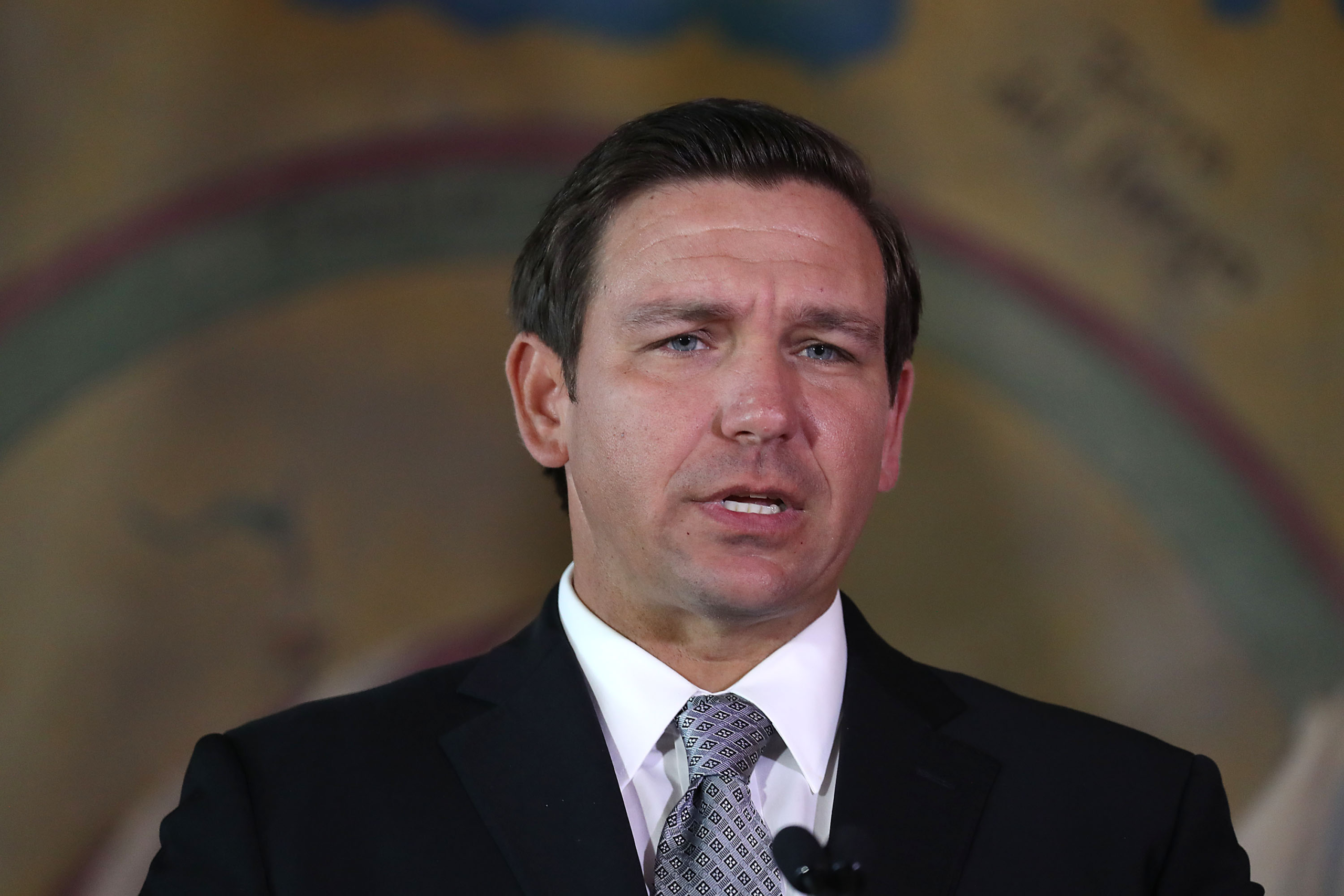
Ron DeSantis, 46th governor of the state of Florida. (Joe Raedle/Getty Images)
In 2018, then-U.S. Representative Ronald D. DeSantis was narrowly elected to Florida’s governorship over Democrat Andrew Gillum by 0.4 percentage points. Eight years later, he is preparing to exit office having earned a historic 19.4 point re-election victory in 2022 – the largest gubernatorial margin in Florida since Democratic Governor Bob Graham’s re-election in 1982.
Infrastructure, The Environment, and Debt Repayment
As governor, DeSantis has championed a “pay-as-you-go” philosophy by drawing on budget surpluses to fund investments in critical infrastructure improvements, environmental initiatives, and debt repayment without long-term borrowing.
The 2023 “Moving Florida Forward Infrastructure Initiative” leveraged $4 billion from revenue surplus to allocate a total $7 billion towards expediting the timeline of substantial roadway projects, such as the I-4 Ultimate Expansion, by up to two decades, bypassing projected inflationary increases in construction costs.
The DeSantis Administration has overseen advances in Everglades restoration and water quality projects, such as the establishment of the Resilient Florida Program. By the conclusion of DeSantis’s second term, Florida will have allocated nearly $9.5 billion towards these initiatives and surpassed all prior administrations.
When DeSantis exits office in January 2027, Florida will have retired more than half of its tax-supported debt in only seven years, including obligations that have accrued since Florida statehood in 1845. In doing so, the administration has maintained its AAA credit rating across all three major bureaus.
COVID-19 and Culture Wars
DeSantis rapidly ascended to the forefront of the national conservative movement with his decision to re-open Florida schools and businesses in late 2020, despite opposing guidance from the Centers for Disease Control and Prevention (CDC). These actions would eventually evolve into the state’s Medical Freedom Act. In 2022, DeSantis faced condemnation for rebuking a group of high school students wearing masks, telling them “We’ve gotta stop with this COVID theater.”
The 2022 Parental Rights in Education Act, commonly known as the “Don’t Say Gay” law, barred K-3rd grade classroom instruction on sexual orientation or gender identity and was heralded by DeSantis as prohibiting “indoctrination.” This legislation sparked fierce conflict with The Walt Disney Company regarding its Central Florida operations. Following a comprehensive settlement in March 2024, the governing relationship between the Central Florida Tourism Oversight District (formerly Reedy Creek Improvement District) and Disney appears to have largely returned to business as usual.
Simultaneously, DeSantis signed the Individual Freedoms Act – similarly known as the “Stop W.O.K.E. Act” – which aimed to eliminate alleged Diversity, Equity, and Inclusion (D.E.I.) initiatives within workplace and instructional environments across the state, as well as Critical Race Theory (CRT) based curricula. While the 11th U.S. Circuit Court of Appeals struck down the law’s restrictions on private employers in March 2024, parallel federal injunctions also prevented enforcement within public universities. Nonetheless, the state ultimately bypassed this through the passage of Senate Bill 266, which codified statutory frameworks for post-tenure review and explicit course standard requirements preventing the teaching of “identity politics” and the distortion of “significant historical events.”
By April 2026, the Republican Party of Florida surged to a voter registration advantage of nearly 1.5 million over the Florida Democratic Party, representing a massive net gain of approximately 826,000 since 2018.
The 2024 Presidential Election
Capitalizing on his decisive re-election victory, DeSantis was promoted by prominent voices within the Republican Party, including billionaire donor Ken Griffin, as a formidable alternative to then-former President Donald Trump.
In April 2023, the Republican-controlled Florida Legislature approved a specific exemption to the state’s “resign-or-run” elections provision, permitting incumbent governors to run for president without resigning. DeSantis formally launched his campaign only 26 days later during a first-of-its-kind Twitter Spaces virtual launch event marred by technical problems that critics used to frame the launch as a blunder.
Following DeSantis’ campaign launch, his once-ironclad political relationship with Trump began to rapidly deteriorate. DeSantis faced frequent attacks by the Trump campaign, including the use of monikers “Ron DeSanctimonious” and “Meatball Ron,” while enduring lasting reputational damage for running against Trump.
Following a bruising second-place finish in Iowa, DeSantis exited the presidential race in January 2024, endorsing Trump, who then announced at a New Hampshire rally that the “DeSanctimonious” nickname would be retired. DeSantis then returned to Tallahassee having rediscovered a legislature that remained largely in lockstep with his agenda.
What Does the Future Hold?
U.S. Representative Byron Donalds, who was endorsed by Trump 18 months before the Florida primary elections were held, won the Republican nomination for governor in mid-August. DeSantis initially declined to back any particular candidate, and in February 2025 stated that “[Donalds] just hasn’t been a part of any of the victories that we’ve had here over the left over these last years.” DeSantis eventually formally endorsed Donalds shortly after the candidate clinched the nomination.
Nonetheless, DeSantis will leave office in January 2027 in a state bearing little similarity to the one he inherited in 2019. Amidst reports of an offer being made on a Lake Wales residence, DeSantis has signaled that he anticipates a return to private life.
