
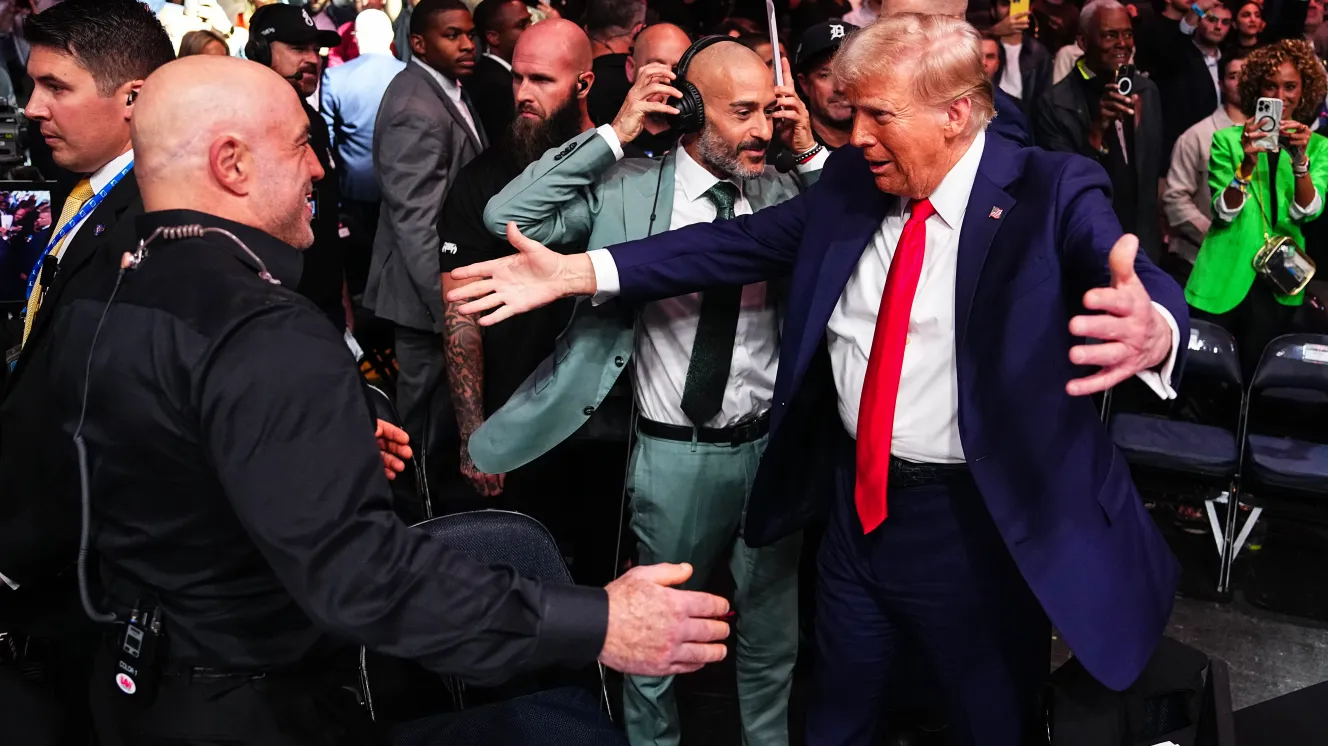
President Trump greets podcaster Joe Rogan at a UFC event at Madison Square Garden (Jeff Bottari/Zuffa)
While an Ipsos poll shows that President Donald Trump’s approval rating among Republican voters sits at 81%, prominent conservative commentators like podcaster Joe Rogan and commentator Tucker Carlson have recently broken with the president. According to Amie Parnes of The Hill, Republican strategists have grown “increasingly worried” ahead of a midterm season in which they feel particularly vulnerable, as Trump’s national approval rating averages at 38% according to the New York Times.
In 2024, Trump campaigned heavily on the state of the economy, promising to “Make America Affordable Again” by slashing energy prices and ending inflation. In October 2024, roughly a month before the election, a Gallup poll found that a majority of voters, 54%, believed Trump would be better able to handle the economy.
Also on the campaign trail, Trump repeated that his first presidency “had no wars” and promised that he was “not going to start wars” in his second term. The same 2024 Gallup poll found that 52% of voters trusted Trump more to handle foreign affairs.
Now over a year into Trump’s second term, the United States is at war with Iran. In response to American and Israeli strikes targeting Iranian military infrastructure, missiles, and leadership, Iran attacked commercial tankers in the Strait of Hormuz. With 20% of the world’s oil flowing through this waterway, the blockage in the strait has threatened the global oil supply. As a result, the national average gas price rose as high as $4.55 a gallon in May, 50% higher than when the war started. Also, President Trump’s IEEPA tariffs have led to a 7% retail price increase for imports. Although the tariffs were struck down by the Supreme Court, the Tax Foundation believes this would have grown had they remained in place. Amid these rising costs, a June poll by Marist University measured Trump’s approval rating on the economy at 33%, the lowest recorded by the pollster dating back to 2019.
Such actions have led prominent conservative influencers to criticize the president. In March 2026, Rogan stated that Trump supporters “feel betrayed” by America’s current military campaign in Iran, and podcaster Theo Von called the attacks “diabolical.” When discussing the Iran conflict, Carlson said he believes that Trump was “fully aware that it was a betrayal of his explicit promises for 10 years not to do this.” Carlson went so far as to say that he is tormented by his role in supporting Trump’s presidential campaign.
Influencers like these were widely seen as a major asset to Trump’s victory in 2024. Trump received Rogan’s endorsement after appearing on Rogan’s show just 11 days before election day. Within three days, the episode gained nearly 40 million views on YouTube. Theo Von also hosted Trump on his show in August 2024. By October, the episode had amassed about 14 million views on YouTube.
For over a decade, Carlson has been an influential voice at the forefront of conservative media. Carlson was one of the first pundits to take Trump’s election campaign seriously when it was announced in 2015. His support for Trump continued through the 2024 campaign, when Carlson spoke at the Republican National Convention.
The general audiences of Rogan’s and Von’s podcasts are predominantly young men. 51% of Rogan’s viewers are between the ages of 18 and 34, and 80% of that group are men. Similarly, 75% of Von’s audience is men under 40.
One of Trump’s strongest gains in 2024 was among men under 50. In 2020, President Joe Biden carried the group 53%-43%, but Trump won it 49%-48% in 2024.
Unlike mainstream news networks, such as CNN, or legacy newspapers, like The New York Times, podcast hosts may hold a large influence over younger voters who previously supported Trump in 2024. Polling from Voxtopica found that “54% of 18-to-34-year-olds who said that podcasts influenced their vote in 2024 swung for Trump last November, compared to 43% who voted for Harris.”
During the 2024 campaign, shows like the Joe Rogan Experience and Theo Von’s This Past Weekend gave Trump a platform to directly reach wide audiences that consumed political content online. According to the PEW Research Center, 76% of Americans aged 18-29 stated they received their news from “social media at least sometimes or often.”
With midterm elections often being decided by a party’s ability to encourage voter turnout among their base, the reality that key online personalities who championed Trump in 2024 have become more critical may add to the struggles Republicans are already facing with the broader electorate. Mitchell Brown, a Republican pollster for Cygnal, said that Republicans are far less excited to vote in this midterm election than Democrats and highlighted that men under 40 pose the largest risk among Republican voters.
