
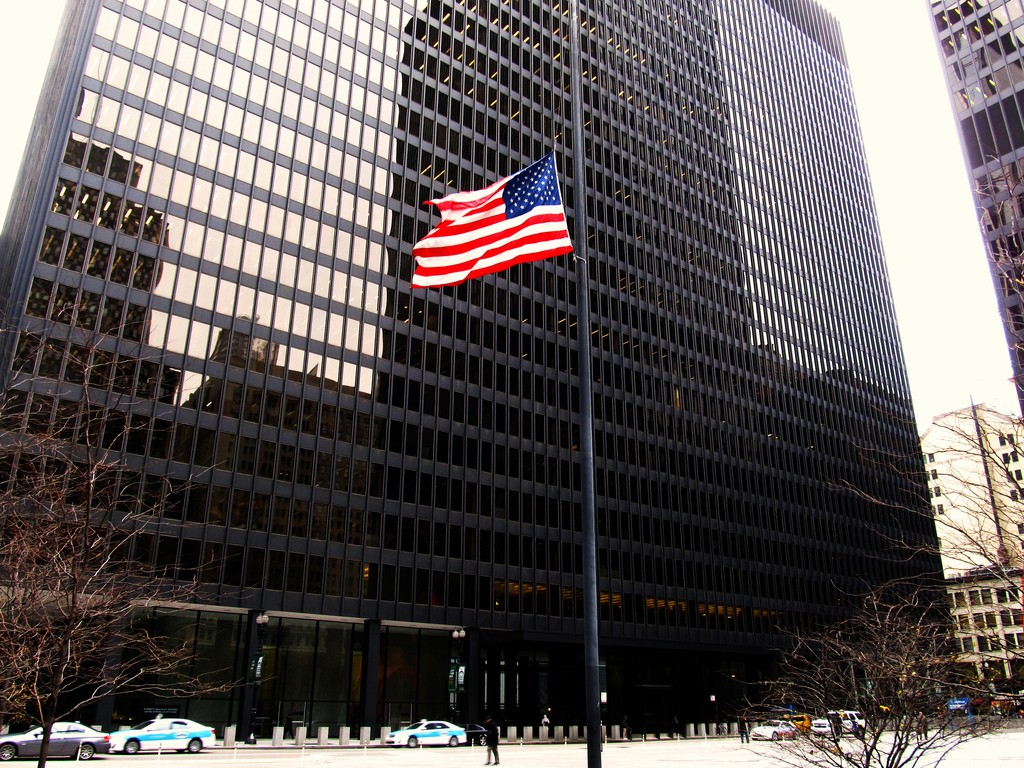
United States Court of Appeals for the Seventh Circuit is housed in the Everett McKinley Dirksen United States Courthouse in Chicago, Illinois (United States Court of Appeals for the Seventh Circuit LinkedIn)
On August 25th, 2026, the Seventh Circuit Court of Appeals, arguing it was bound by precedent in Stanley v. Georgia and Ashcroft v. Free Speech Coalition, ruled that virtual, computer-generated child sexual abuse material (CSAM) possessed in the privacy of the home, which does not depict real children, was protected speech under the First Amendment.
In 2024, Steven Anderegg was charged in Wisconsin with the production, distribution, and possession of CSAM, and with transferring the content to a minor under the age of 16. The images depicted hyper-realistic pre-pubescent children engaging in sexual acts. The images were produced by Stable Diffusion, a generative AI software, in combination with added software and curated sexually explicit prompts. The content was then sent to a 15-year-old boy over Instagram, along with a description of how the content was made. Anderegg filed a motion to dismiss the charges, which the trial court granted in part, dismissing the possession charge while denying the motion with respect to dismissal of the other charges. The prosecution appealed the dismissal, but ultimately lost their appeal to the Seventh Circuit Court.
The central question in US v. Anderegg is whether or not virtual, computer-generated CSAM is protected under the First Amendment. Historically, while obscene material falls outside of First Amendment protections, obscene material in private homes is considered to be protected.
Anderegg was prosecuted under the Child Pornography Prevention Act (CPPA) of 1996. The CPPA expanded a federal prohibition to criminalize the production, distribution, and possession of virtual CSAM, even when the content did not contain any real children. The constitutionality of the CPPA was questioned in Ashcroft v. Free Speech Coalition, which asked whether virtual CSAM was beyond protections under the First Amendment.
In Ashcroft, the Court set the precedent that when the CSAM does not depict an actual child, it is protected by the First Amendment. The Court found that the CPPA went beyond previous precedent, which distinguished CSAM from other forms of sexually explicit speech. With regard to the argument that virtual CSAM could be used to groom children, the Court stated that the government cannot ban speech fit for adults simply because it may fall into the hands of children. The Court also explained that the mere tendency of speech to encourage an unlawful act is not a sufficient reason to ban it. To the argument that virtual CSAM cannot be distinguished from real CSAM, the Court wrote that it may not suppress lawful speech because it resembled unprotected speech.
Following the ruling of Ashcroft v. Free Speech Coalition, the Prosecutorial Remedies and Other Tools to end the Exploitation of Children Today (PROTECT) Act of 2003 was passed. Along with establishing systems like AMBER Alerts, the act outlawed the possession of any virtual depiction of a minor engaging in sexually explicit content. A definition which worked around the problems the Court found with the CPPA in Ashcroft by not focusing tightly on a definition of child pornography but by tying it to legal standards like obscenity. It expressly stated that the minor depicted does not need to actually exist.
One of the main arguments in U.S. v. Anderegg relied on Stanley v. Georgia. Stanley, established an individual’s right to possess obscene materials in the privacy of their own home. Prosecutors argued that Stanley v. Georgia only applied to materials depicting adults; the Seventh Circuit found no basis for interpreting it in such a “limited fashion.” Instead, the court explained that the ruling was concerned with the location where the material was possessed rather than the content itself.
The main argument for the government was based on Osborne v. Ohio, which reaffirmed a previously upheld ruling giving the government authority to prohibit the possession of CSAM involving actual children, even when the material was kept in the privacy of one’s home. The government also argued that New York v. Ferber should govern in Anderegg. Ferber held that CSAM involving actual children could be prohibited without violating the First Amendment because the government has a compelling interest in protecting children from exploitation. Due to the ruling in Ashcroft and because the images presented in the case are not real children, the court found neither Osborne nor Ferber applied.
In accordance with Ashcroft v. Free Speech Coalition, the Seventh Circuit wrote that the increased chance of children being groomed at some future, indefinite time was not enough to justify banning virtual CSAM; rather, a stronger and more direct connection between the content and child exploitation would be needed to reach that point. Additionally, in response to concerns that virtual CSAM would make it more difficult to find real child victims of CSAM, the court said it is unlikely that prohibiting access to the virtual CSAM market would help the government reduce the availability of real CSAM. The court stated that it was “duty-bound” to follow the ruling in Ashcroft, lest “anarchy prevails in the federal judicial system,” despite the “misgivings” of its application to the present circumstances.
The Honorable Joshua Kolar and John Z. Lee wrote a concurring opinion for the case. In it, they explain that the court would benefit from added guidance from the United States Supreme Court on the relationship between the First Amendment and virtual CSAM, saying, “given the relentless advancement in artificial intelligence models, we have some concerns about the lines these cases draw, but we are not free to redraw them ourselves.” They quoted Associate Justice of the Supreme Court Clarence Thomas, who said in Ashcroft v. Free Speech Coalition, “if technological advances thwart prosecution of ‘unlawful speech,’ the Government may well have a compelling interest in barring or otherwise regulating some narrow category of ‘lawful speech’ to enforce effectively laws against pornography made through the abuse of real children.” In United States of America v. Steven Anderegg, the Seventh Circuit Court said the day Justice Thomas was referencing “may have arrived.”
The concurring opinion also addressed issues that were not governing in this case’s appeal. These included the concern about the datasets used for training generative AI that contained hundreds of real CSAM images to create the images at issue. They also addressed the concern that the market for AI-generated CSAM may impact the demand for real CSAM, if nothing else for the purpose of training the AI models.
This opinion was released at a time when the National Center for Missing and Exploited Children (NCMEC) has reported being overwhelmed with reports from tech companies of suspected AI-generated CSAM. Anderegg’s images were flagged when NCMEC received a tip from Meta, Instagram’s parent company. The nonprofit works with law enforcement to identify whether the children depicted in this content are real or virtual. NECMEC says that with the surge of reports, many reports leave out information needed for law enforcement to investigate further.
