
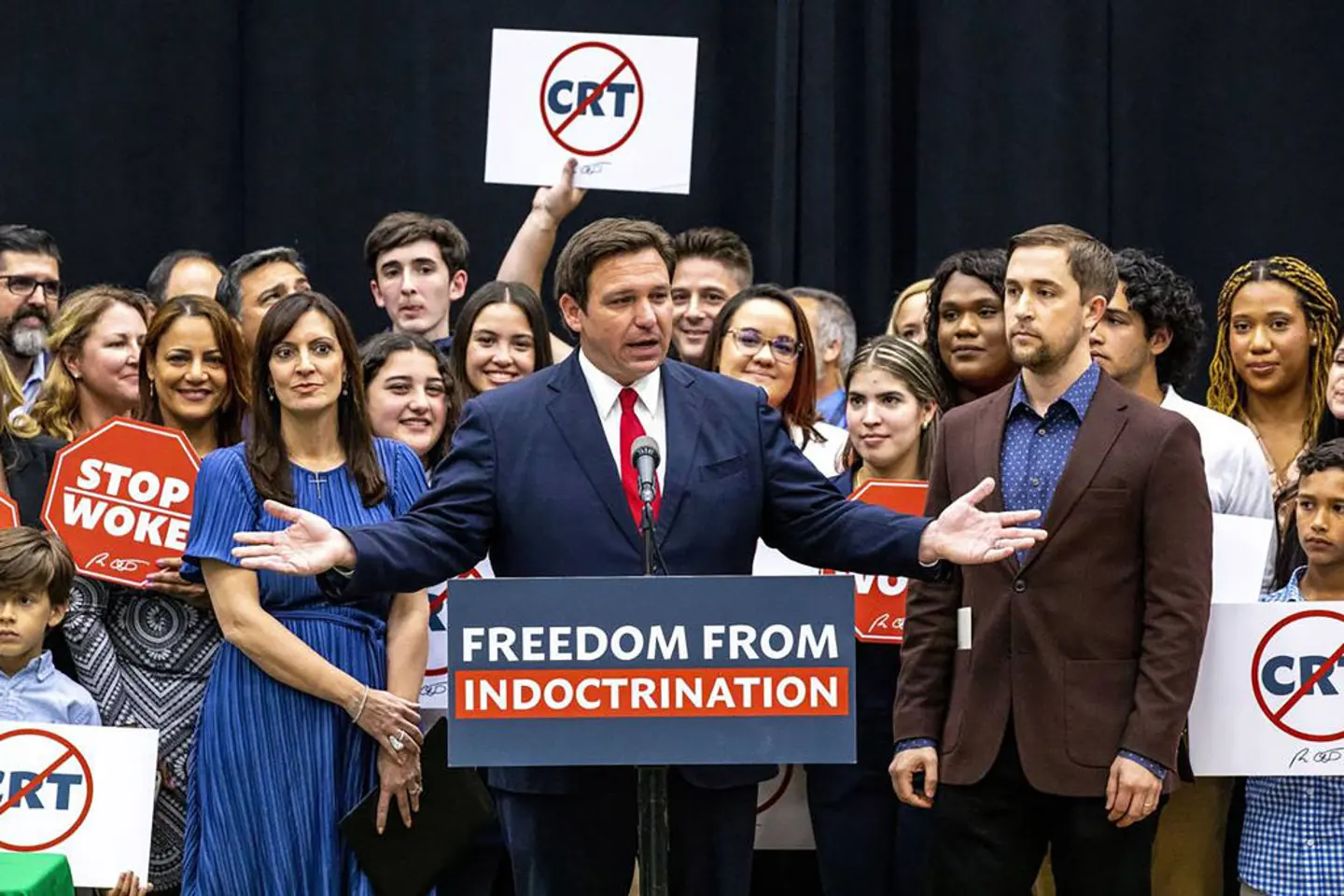
Ron DeSantis signs House Bill 7, known as the “Stop W.O.K.E Bill.” (Daniel A. Varela/Miami Herald/Tribune News Service)
In 2023, Florida Governor Ron DeSantis suggested that the state legislature would “reevaluate” its relationship with the educational organization College Board. This discussion with Paul Renner, the Speaker of the Florida House of Representatives at the time, came after the College Board introduced its Advanced Placement (AP) African American Studies course. The course features theories of intersectionality and queer theory, which DeSantis said “runs afoul of [Florida’s] standards,” as he accused the concepts of being “neo-Marxist.”
The College Board is an organization that administers the Standardized Aptitude Test (SAT) and AP courses, two factors for college admissions for students nationwide. The SAT is a test taken by juniors and seniors in high school that is used by college admissions and scholarship agencies to evaluate students’ abilities in math and reading. AP courses and exams are classes students can take during high school that can count as transfer credits when they attend college. The College Board currently offers 40 AP courses, including subjects such as Human Geography, Calculus, Biology, English Language, and U.S. History.
In alignment with DeSantis’ fight against “woke” ideology, the Florida Department of Education (FDOE) released on May 4 the framework for its own accelerated U.S. History course. This framework originated from House Bill 1537, enacted in 2023, which allows the creation of alternative accelerated credit paths for Florida students. Florida Advanced Courses and Tests (FACT) courses are the product of this initiative. These courses are accelerated and, upon passing an end-of-year exam, grant college credit for students to use at an in-state college or university. While FACT is similar to AP, International Baccalaureate, or Advanced International Certificate of Education courses, it is unclear whether colleges and state universities outside of the Florida College System will accept FACT credit. The first FACT course, College Algebra, was piloted in the 2025-2026 school year and has been planned to be implemented statewide for the 2026-2027 school year. The second course, FACT U.S. History, has seen much more news coverage.
According to the FDOE, the FACT U.S. History course is designed to teach U.S. History while “ensuring materials are free from ideological basis or indoctrination.” The FDOE also said that it “represents an important step toward restoring academic integrity…after years of…ideologically driven instruction.”
The main push and pull between the AP U.S. History and FACT U.S. History courses is the lens through which its subject matter is viewed. According to Frederick Hess of the center-right think tank American Enterprise Institute, the FACT course is a “very explicit attempt to frame” the United States as a “good, special” nation as opposed to the “fundamentally imperfect” image of the United States that he claims AP courses paint.
While the FACT framework does not shy away from the dark periods of American history, such as slavery and Japanese internment camps, it presents these events as “aberrations from an otherwise admirable story.” The single suggested textbook for FACT U.S. History is, Land of Hope by Wilfred McClay, which was written as a “formidable challenge” to A People’s History of the United States by Howard Zinn. Zinn’s book is known for critiquing American participation in human and civil rights abuses, while McClay’s book presents negative events in American history as deviations from a generally positive narrative. Of the 21 textbooks suggested by the College Board for AP U.S. History, Wilfred’s is not included. These textbooks are only suggested, however, as both AP and FACT courses give instructors autonomy to structure their classes, with only the final exam used to determine college credit being standardized.
Dana Goldstein, an education and families reporter for the New York Times, points out the major differences between the FACT and AP courses. Namely, the FACT course introduces ideas of the Protestant Reformation as giving rise to democratic ideals, emphasizing the religious and European heritage of early U.S. History. This includes the writings of Martin Luther and John Calvin and their influence on the United States’ earliest documents. This comes at the expense of limiting, but not fully removing, the discussion of indigenous cultures in America before and at the time of European settlement. In contrast, AP U.S. History goes deeper into the cultures of indigenous tribes. Additionally, the course addresses the contradictions between the “anti-slavery founders” and their status as slave owners. The FACT curriculum says that the Constitution is an anti-slavery document, diverting from a mainstream understanding that the Constitution is a compromise between the slaveholding and free states, as seen in Article 1, Section 9, Clause 1.
The American Historical Association (AHA) issued a statement in defense of the AP U.S. History course. In their release, they stated that FACT U.S. History offers a “partial, distorted, and educationally unsound account of our nation’s history” and “imposes an overt ideological agenda” on Florida students. Regarding the content of the course, the AHA has argued the FACT course “omits or downplays pivotal events commonly taught in college-level US history courses.” In one example, the AHA disputed the FACT course claim that the phrase “all men are created equal” reflects a broad agreement among the founding fathers that “no man had the right to enslave another against his consent.”
At the time of the announcement of this course, Florida has one of the highest rates of participation in AP exams across the nation and there has been no indication that AP U.S. History or other AP courses will be leaving the state of Florida. Additionally, as is the case for all AP exams, students will still be allowed to sit for an AP U.S. History exam at a school that offers it without being enrolled in the course. In the 2026-2027 school year, FACT U.S. History will pilot its curriculum in Florida public and charter schools. While it is unclear when the course will be widely available, based on the timeline of the release of FACT College Algebra the course could be fully implemented as soon as the 2027-2028 school year if the pilot is successful.
