
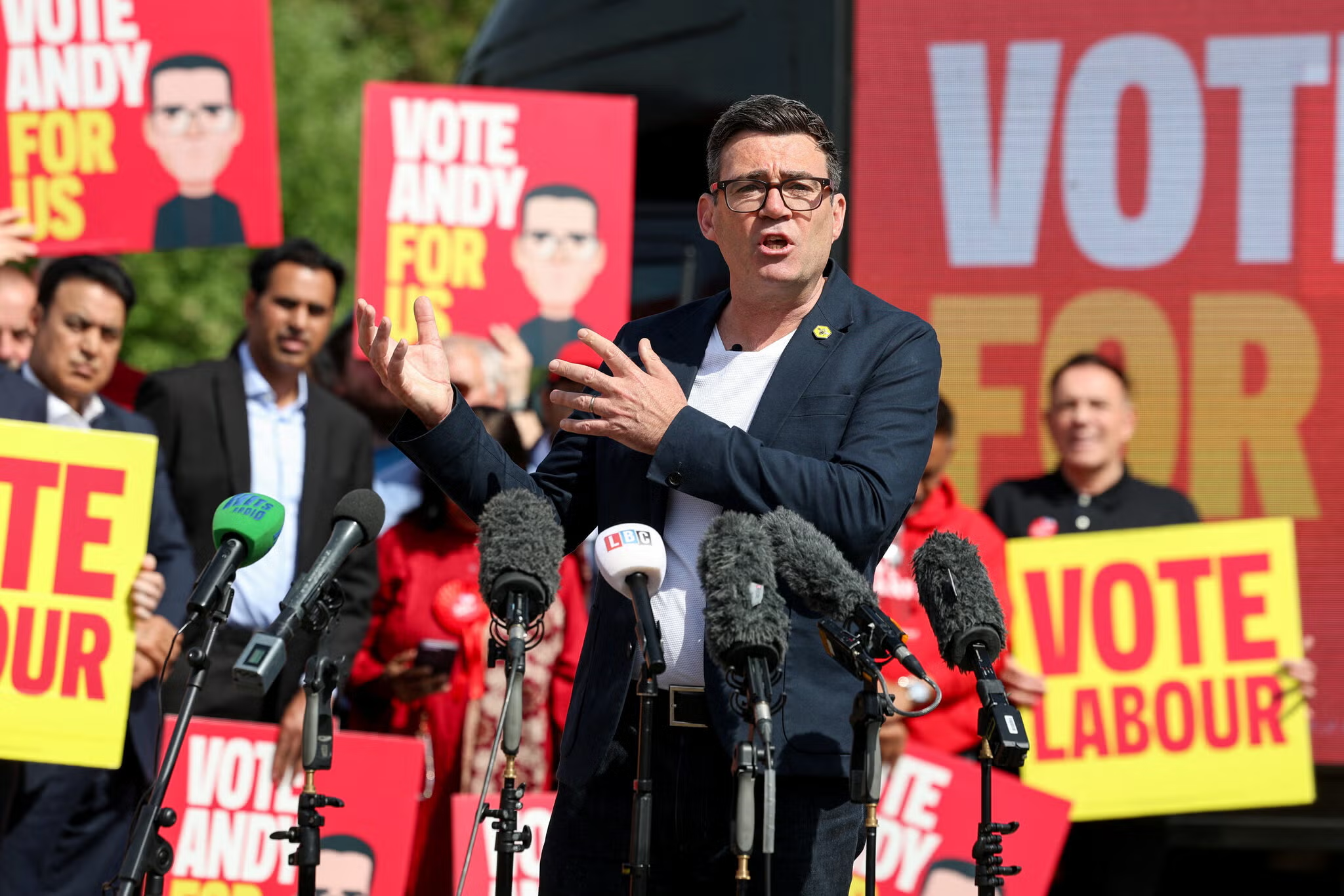
U.K. Prime Minister Andy Burnham at his campaign launch for Parliament. (Temilade Adelaja/Reuters)
On July 20, Andy Burnham became Prime Minister of the United Kingdom. He replaced the unpopular Keir Starmer to become the country’s seventh prime minister in the last decade. The last prime minister to serve a full five-year term was David Cameron, who departed from the position in 2016. In 2024, Starmer led the Labour Party to an electoral landslide, ending 14 years of Conservative government. Many citizens and Labour Party politicians believed Starmer failed to deliver during his time in office, and after calls from many politicians in his own party to step down as prime minister, he announced his resignation in June.
Prior to his current position as prime minister, Burnham was the Member of Parliament for Leigh for 16 years, from 2001 to 2017. However, he left this position in 2017 to become the Mayor of Greater Manchester. This past June, he won a by-election to re-enter the House of Commons as the Member of Parliament for Makerfield and promised to run for leader of the Labour Party (a position he unsuccessfully sought in 2010 and 2015). Leadership subsequently made him prime minister as Labour holds a majority in Parliament. October 27 marked 100 days in office for Burnham.
Devolution
One of Burnham’s main focuses has been devolution of power away from London. He has announced plans for the County of Devon and others to start directly electing their own mayors. To help carry out decentralization of power away from London, Burnham has also created a secondary administrative center, Number 10 North (a reference to the prime minister’s London residence of 10 Downing Street) in Manchester. The goal of the project is to symbolize and achieve greater connection between the government and people across the country.
Burnham’s push for devolution has not satisfied some political leaders, as the first ministers of Scotland, Wales, and Northern Ireland signed the Cardiff Agreement to chart their courses for independence from the British government. John Swinney (leader of the Scottish National Party), Rhun ap Iorwerth (leader of Plaid Cymru, the Party of Wales), Mary Lou McDonald (president of Sinn Féin), and Michelle O’Neill (Northern Ireland’s First Minister) came together to announce that “no Westminster government has the right to block democracy or undermine the principle that our people will decide their own future.”
Despite Separatist parties holding power in the governments of Scotland, Northern Ireland, and Wales for the first time, Burnham opposes the growing independence movements. He has stated that, for the time being, a Scottish independence referendum is “off-limits” and that a referendum on the reunification of Ireland is “off the table.” Burnham met with John Swinney and Rhun ap Iorwerth in Scotland, where the two first ministers told Burnham that further devolution within Scotland and Wales is not Burnham’s choice. Burnham’s office stated the talks were “constructive.”
Other Domestic Policies
Some of Burnham’s other announcements include capping bus fares at £2 and removing the 5% consumption tax on energy bills. Both policy proposals have been received well by the British public.
In late September, Burnham led his first Labour Party conference as prime minister in Liverpool, outlining his administration’s top priorities. He promised to create a national care service for the elderly, remove the ban on public control of water companies, and bring housing and energy companies under greater public control. Burnham claimed he will “break” with the “wrong path” Britain had been on for the past 40 years by shifting focus away from the past principles of “Deindustrialization. Deregulation. Privatization.”
Burnham’s statements have also accused every administration since Margaret Thatcher’s of failing public services, including fellow Labour Prime Ministers Tony Blair and Gordon Brown. Burnham’s focus on public ownership is evident in his support for moving the West Midlands bus network into public ownership, which he claims would help save over 4,500 jobs.
Burnham also cited Brexit as another example of Britain going down what he claims is the “wrong path” and announced that the U.K. will hold a summit with the European Union later this year. He hopes to make economic deals and advance U.K.-European relations, with the Labour Party stating that Burnham will come out with more announcements about “the right path ahead” in U.K.-European relations later this year.
On October 11, Burnham became the first prime minister to claim that Russia interfered in the 2016 Brexit referendum. Burnham did not say that the vote was illegitimate; however, Ken McCallum, a chief of Britain’s MI5 intelligence agency, confirmed Russian attempts to interfere, but also emphasized a difference in “what may have been attempted and what actually resulted.”
At the party conference, Burnham also outlined plans for electoral reform. Burnham announced the creation of a National Commission on Electoral Reform, which would attempt to make voting more inclusive and “give power to people in every postcode.”
Foreign Policy
During his time in office, Keir Starmer was widely criticized for the U.K. government’s response to the situation in Gaza. Large pro-Palestinian protests took place across the U.K., and Starmer faced significant backlash when he threatened to ban some of the pro-Palestine marches.
Burnham’s government has already taken a firm stance on the conflict. On September 22nd, Burnham delivered a speech at the United Nations General Assembly where he announced a “reset” on Middle East policy. He stated that Israel’s actions have harmed the prospect of a two-state solution, and said that Israel’s settlements in the West Bank have the potential to “put a viable Palestinian state beyond reach.”
Burnham then claimed his government had taken action by banning and sanctioning trade with actors involved with illegal Israeli settlements. Burnham also labeled Israel’s occupation of Palestinian lands as illegal. At the same September Labour Party conference where Burnham outlined his domestic policies, his Foreign Secretary Ed Miliband addressed pro-Palestinian protesters directly, acknowledging “you were right” about being angered by the treatment of Palestinians. Miliband also said that settler terrorists in the West Bank were committing an “ethnic cleansing” of the local Palestinians.
At the UN General Assembly in New York, Burnham also held a meeting with President Donald Trump for the first time. The American leader described Burnham as a “natural business person” and stated that they were “doing very well so far.” They discussed AI, as well as situations in British overseas territories including the Chagos Islands and the Falkland Islands.
In July, Ukrainian President Volodymyr Zelenskyy became the first foreign visitor to the U.K. under Burnham’s premiership. Burnham reaffirmed the U.K.’s “unwavering” support for Zelenskyy and Ukraine against Russia’s aggression as the conflict approaches its 5th year mark, characterized by constant drone warfare with no end in sight.
Approval Ratings
Burnham has soared in approval ratings, especially compared to his predecessor. In most polls, he ranks higher than the leaders of other major parties in the U.K., including Kemi Badenoch of the Conservatives, Zach Polanski of the Green Party, and Nigel Farage of the far-right Reform U.K. According to a poll by The Times, Burnham sits at around a +8% net approval rating, with the next closest party leader being Conservative Kemi Badenoch trailing at +2%.
A recent boost in the polls helped the Labour Party in its first electoral test under Burnham. When he resigned as prime minister, Starmer also resigned as the Member of Parliament for the London seat of Holborn and St. Pancras, setting off a by-election for his replacement. Labour candidate Sagal Abdi-Wali successfully beat Green Party leader Zach Polanski for the seat. During Starmer’s time as prime minister, the Greens had been rising in popularity, but their defeat at Holborn and St. Pancras could signify the potential for Labour to win voters back under Burnham’s leadership. This is a positive sign for the Labour Party in a future general election that is at most three years away.
