
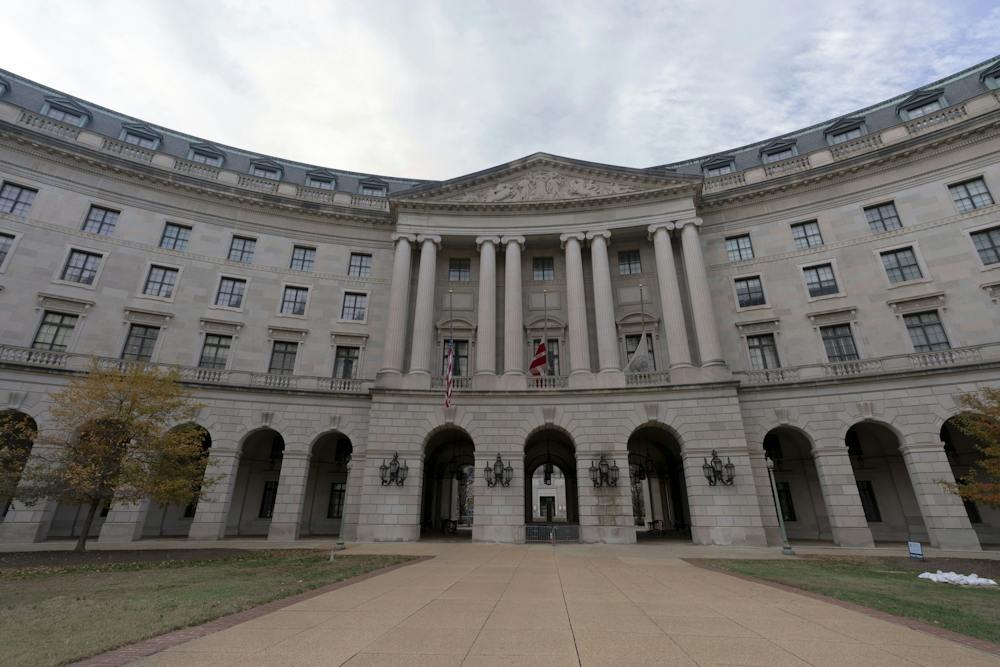
U.S. Environmental Protection Agency building in Washington, D.C. (Jose Luis Magana/AP Photo)
Led by New York, twenty-one states are suing the U.S. Environmental Protection Agency (EPA) after its decision to repeal the 2024 Carbon Pollution Standards. The lawsuit was filed on October 1 by the Democratic-led group seeking to overturn the appeal, arguing it would set back decades of climate and environmental work.
Under former President Joe Biden’s administration, the EPA announced a final carbon pollution standard in April 2024 after researchers discovered that 25% of overall domestic greenhouse gas emissions in 2022 came from the power sector. The pollution standards were known as the Clean Air Act (CAA) and were meant to target the power sector and create new guidelines for existing coal-fired power plants and for any new gas power plants. The CAA aimed to significantly reduce carbon pollution and strengthen the emission standards to protect human health and the environment from harmful impacts.
The EPA’s decision to repeal the 2024 Carbon Pollution Standards was made in September based on a reevaluation of the most effective emission reduction methods for the relevant subcategories. Their final ruling will be effective on November 16 and will remove the emissions guidelines that are currently in place for fossil fuel-fired power plants, along with standards based on carbon capture and storage. The EPA expects this final ruling to allow the United States to make greater use of its resources, including coal and natural gas.
In analyzing the 2024 CAA, the current EPA concludes that the technology used in the past to make the emissions guidelines was not available at the scale and pace required to produce the environmental benefits once claimed by the Biden administration’s EPA.
As claimed by the EPA in a recent analysis it conducted, the requirements of the past guidelines placed a heavy burden on power plants, as their required cost and timelines were unfair or unrealistic, possibly leading to a closure. The EPA also believes that the previous guidelines underestimated the time needed for the infrastructure changes to be put into effect, and the standards were found by the EPA to create an inefficient use of natural gas.
September 14th, EPA Administrator Lee Zeldin spoke to the American people, saying, “For over 15 years the Obama and Biden administrations implemented a war on coal to destroy reliable and affordable energy. The Trump Administration has come in to protect American energy and to make sure you can afford to keep the lights on.”
The EPA believes its decision will financially benefit Americans at the local level, along with saving three hundred billion dollars from the energy industry. Secretary of Energy Chris Wright also commented on the decision, saying, “Today’s announcement will help ensure reliable electricity generation regardless of whether the wind is blowing or the sun is shining by allowing coal and natural gas plants to keep generating power when Americans need it most.”
In addition, a separate rule proposed in September could prevent future administrations from implementing guidelines on power plants’ greenhouse gas emissions.
The Plaintiffs’ Argument
With the addition of Pennsylvania’s governor, the District of Columbia, New York City, Chicago, and the city of Denver, the twenty-one-state coalition argued that the EPA was “gutting one of the country’s most significant climate protections.”
New York’s Attorney General Letitia James also commented directly on the repeal, saying that “dismantling these protections is a betrayal of American families, and the stakes are too high to allow this administration to once again put profits over people.” She added that this decision was based on “callous disregard” and was leaving future generations of Americans to pay the price in their health and the environment.
The twenty-one states involved in the lawsuit have shown great concern for how the EPA’s decisions will impact the environment once factories are free from the current guidelines. Jeffery Robbins, the executive director of CleanAIRE North Carolina, stated, “Joining this lawsuit sends a clear message: North Carolina will not stand by while federal rollbacks force our families to pay higher costs at the pump for dirtier air.”
Despite reassurance directly from the EPA, many are not convinced that the repeal will have positive effects on the American people. Many environmental groups across the country, including the Natural Resources Defense Council and Environmental Defense Fund, have stated that they believe the repeal only allows power plants to increase their emissions, which will intensify the effects of global warming.
Despite what was stated by the EPA on the day of the decision, many Americans have found that the proposed benefits will not outweigh the potential environmental cost. Recent surveys have found that 62% of Americans are concerned about climate change, with 74% supporting stricter environmental protection laws. With these concerns in mind, Michael Gerrard, a law professor at Columbia University, explains that “2026 is shaping up to be the warmest year in recorded history.”
Gerrard is not the only one to report similar findings on today’s temperatures. Concerns about what America’s climate could look like in the next ten years have been a driving force in the argument against the repeal.
The states challenging the decision have petitioned the U.S. Court of Appeals for the District of Columbia to strike down the repeal. Their main argument is based on their belief that the EPA has unlawfully abandoned pollution limitations and did not properly consider any alternatives.
In addition, the coalition informed the EPA that they have every intention to sue over the agency’s failure to regulate pollution for many power plants. The EPA has yet to comment on the pending lawsuit.
This lawsuit comes during a time of large environmental law debate as the Supreme Court recently heard Suncor Energy (U.S.A.) Inc. v. County Commissioners of Boulder County. The city of Boulder is suing oil and gas companies seeking compensation for damage caused by disasters linked to climate change. The U.S. Supreme Court heard oral arguments in this case on October 5th, just a few days after the twenty-one-state joint lawsuit against the EPA over its repeal of the 2024 Carbon Pollution Standard.
With neither the state coalition nor the EPA backing down on their decisions, it is unclear what exactly the future could look like for environmental policy in America.
