
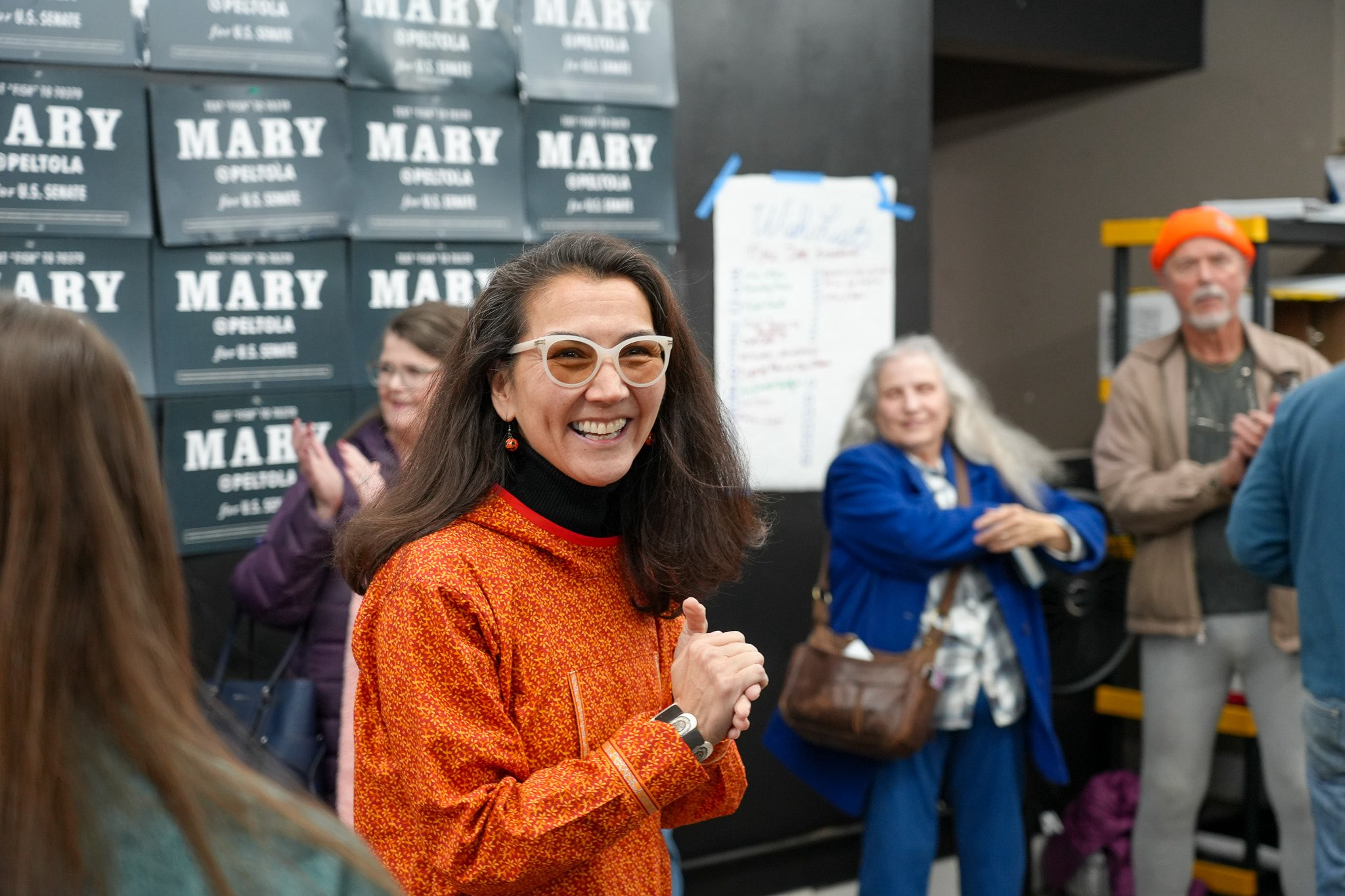
Democrat Mary Peltola, a candidate for Alaska’s U.S. Senate seat, campaigns in Palmer, Alaska. (@MaryPeltola on X)
As the midterm elections approach, a state that has long been viewed as a GOP stronghold is at the center of an unusually competitive Senate race. In Alaska, a state that President Donald Trump won by 13 points in 2024, the Silver Bulletin polling average places former Democratic Representative Mary Peltola at 47.8% and Republican Senator Dan S. Sullivan at 45.1% as of Monday, November 2. The race could be critical to the Democratic Party’s efforts to net a gain of four Senate seats to flip control of the chamber. If elected, Peltola would be the first Democrat elected to the Senate from Alaska since Mark Begich in 2008.
Trump visited Wasilla, Alaska on October 13 to campaign for Sullivan, demonstrating the senator’s willingness to tie himself to the current administration and national party leaders. Peltola, by contrast, has sought to actively distance herself from the national Democratic Party. After former Vice President Kamala Harris’ political organization sent an unsolicited fundraising appeal on Peltola’s behalf in August, the Peltola campaign stated she is not seeking the endorsement of politicians from the Lower 48 states. This followed attacks from Republicans like National Republican Senatorial Committee (NRSC) spokesman Nick Puglia claiming the fundraising appeal from the former vice president is evidence that Peltola will work “hand in hand with Kamala Harris to put Alaska last.”
Despite his closer proximity to national politics, Sullivan has still opted to break from Trump on certain issues, including the president’s deal to import diesel from Russia and a Pentagon proposal to livestream an execution by firing squad to the public. After Trump canceled the livestream of the execution, Sullivan said he personally lobbied the White House and Trump to do so. Asked by POLITICO whether the Trump administration is being too friendly with Russia in light of Trump’s diesel deal, Sullivan responded that he sometimes disagrees “with [Trump’s] rhetoric” regarding Russia but maintains he is still “very hawkish” on Moscow.
Economic concerns and the rising cost of living have been the most prominent issues in the race, especially as Alaska’s geographic isolation drives high transportation costs for everyday necessities, particularly in the state’s rural areas. According to Nathan Frandino of Reuters, high fuel and energy prices are a central concern among Alaska voters, especially in rural communities that are dependent on heating oil and imported fuel. These economic concerns have become deeply intertwined with the ongoing war in Iran, which has caused disruptions to global energy markets and has been a major contributing factor in rising fuel prices.
During their October 15 debate, Peltola took a strong stance against the war in Iran, claiming the war is “driving up our energy bills and hurting Alaskans with no end in sight.” She was also critical of Sullivan’s voting record on the matter, as the incumbent senator has voted fourteen times against war powers resolutions, which allow Congress to exert its constitutional right to declare war and seek the withdrawal of U.S. forces from unauthorized conflicts. While Sullivan also acknowledged the war’s impact on rising prices and signaled a desire for the conflict to end, he remained firm that a deal to end the conflict must prevent Iran from obtaining a nuclear weapon and end their control over the Strait of Hormuz. Peltola, on the other hand, said U.S. troops should be “removed and protected” before a formal deal is reached, remarking that an agreement is “so far out of sight” and “Iran can weather hardships. They are waiting us out.”
In addition to rising fuel costs, Sullivan’s support for the One Big Beautiful Bill Act passed on July 4, 2025 has also become an economic point of contention, particularly over its implications for healthcare access in rural Alaska. Peltola has denounced the bill, arguing it eliminated Medicaid coverage for thousands of Alaskans who depend on the program. In many remote areas of the state, Medicaid pays for transport services from rural villages to specialists in major population centers, making the issue especially salient for much of Alaska’s rural populace. Sullivan has denied the bill would cut Medicaid coverage for Alaskans, and argued that the Rural Transformation Program included in the bill, which seeks to modernize and expand healthcare access across rural communities in all 50 states, will aid Alaska’s healthcare system. Both candidates support extending Affordable Care Act (ACA) tax subsidies, which were introduced in 2021 to help eligible Americans afford health insurance by reducing their monthly premiums. Sullivan broke ranks with his party alongside fellow Republican Senator Lisa Murkowski to vote for an extension of ACA tax subsidies in December 2025, largely motivated by Alaska’s high cost of health insurance.
The candidates have also traded blows over their approach to protecting Alaska’s fishing industry, which is deeply intertwined with the state’s economy and cultural identity. Both candidates have voiced concerns about trawl bycatch, the unintended catching of marine species by commercial fishing vessels, which can pose a threat to vulnerable marine life populations. Sullivan has touted his Bycatch Reduction Act, which advanced from the Senate Commerce Committee last month, as an effort to reduce excess fish captured by large commercial trawlers. Sullivan has contrasted his bill with Peltola’s record in the House, as she did not introduce legislation to address the issue during her single House term. In response, Peltola characterized Sullivan’s bill as inadequate, referring to it as a “half-hearted and half-baked solution.” In addition, she criticized his campaign for receiving over $300,000 in contributions from trawlers supporting Sullivan.
Alaska’s distinctive electoral system has introduced an unusual complication to the Senate race. Under the state’s ranked-choice voting system, adopted in 2020, the top four candidates in a non-partisan primary advance to the general election, where voters then rank the candidates in order of preference. If no candidate receives an outright majority of first-choice votes, the candidate with the fewest votes is eliminated, and their ballots are transferred to the next eligible preference. The process then continues until a candidate secures a majority of the remaining votes. In the primary, a man named Daniel J. Sullivan Jr. placed among the top four primary candidates and advanced to the general election alongside Senator Sullivan, despite a failed Republican lawsuit to prevent him from running. The incumbent senator alleges that Daniel J. Sullivan Jr. is running in coordination with the Peltola campaign and the Democratic Party with the intention of misleading voters. Sullivan Jr. and Peltola deny these allegations, with Sullivan Jr. maintaining that he is running as a moderate Republican in opposition to President Trump and what he calls the “MAGA party.”
Another lawsuit was filed by the Department of Justice (DOJ) on October 22, seeking to prevent Alaska from certifying the election results if Peltola defeats Senator Sullivan by a margin less than the number of votes cast for Sullivan Jr. The lawsuit argues that voters could mistakenly cast votes for Sullivan Jr. that were intended for the current Republican senator, potentially altering the outcome of the election. The Alaska Supreme Court previously ruled in June that Sullivan Jr. could appear on the ballot, and Peltola has denounced the DOJ’s lawsuit as corrupt overreach in Alaska’s election process. Many election law experts believe the lawsuit has little merit, with University of Notre Dame law professor Derek Muller writing in a blog post that the legal argument “is one of the worst ones I’ve ever seen.” The lawsuit has also drawn disapproval from Murkowski, who said on X that “Alaska has already handled this” and that the DOJ “should never have filed this lawsuit.”
