
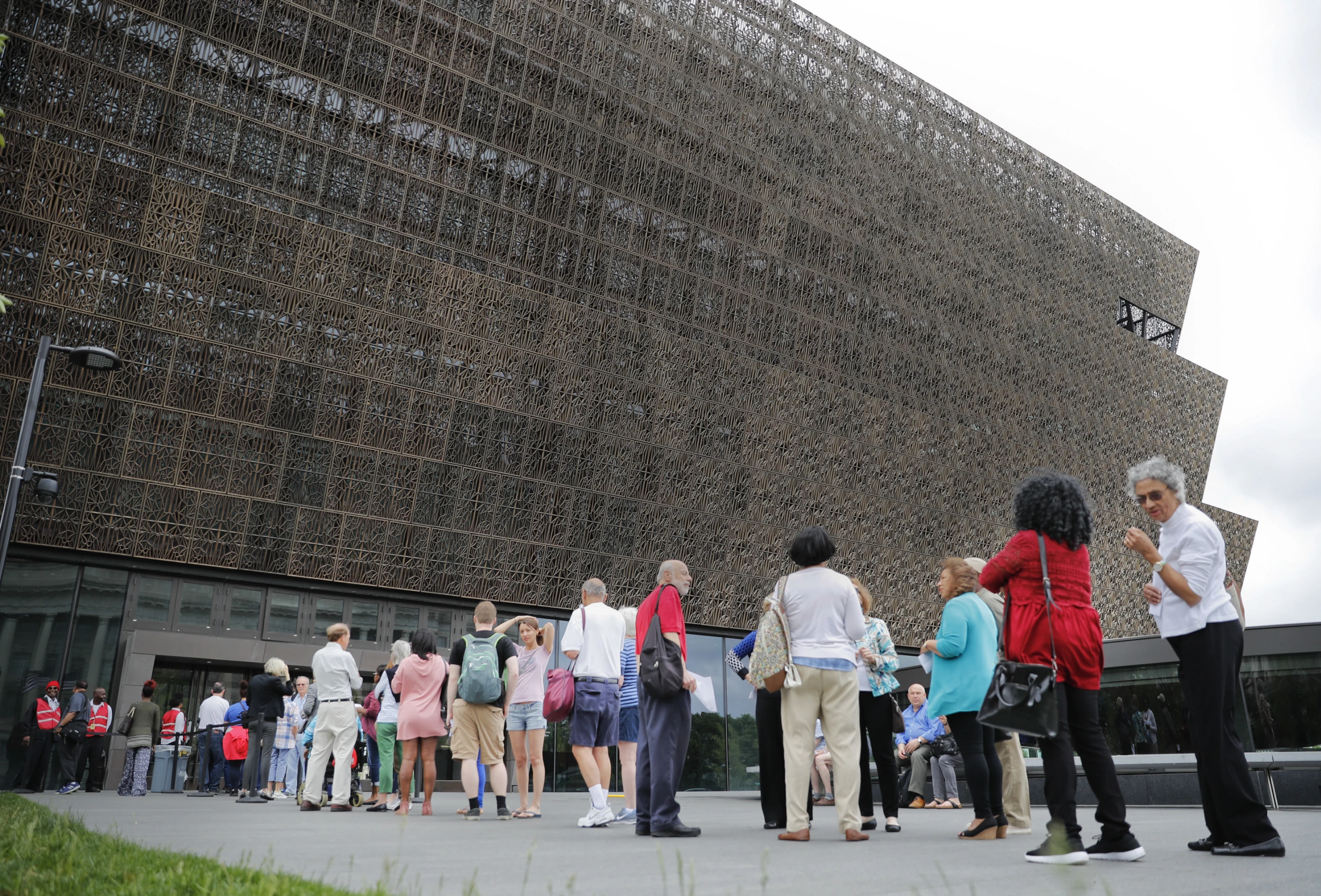
The Smithsonian National Museum of African American History and Culture in Washington. (Pablo Martinez Monsivais/AP Photo)
The Trump administration is planning a full year of celebrations to commemorate 250 years of United States independence. In accordance with this agenda, the White House issued Executive Order 14253 in March 2025 to enforce the Trump Administration’s intentions to remind “Americans of our extraordinary heritage, consistent progress toward becoming a more perfect Union, and unmatched record of advancing liberty, prosperity, and human flourishing.”
Section 2 of the executive order prohibits the Smithsonian Institution from investing in exhibitions or programs that fail to represent and uphold federal policy ideologies and values. Such exhibitions and programs include those deemed by the White House to encourage racial division among Americans or undermine American principles. The White House has placed the Smithsonian Institute at an impasse: comply with the federal government or continue its tradition of independent operation and risk loss of funding.
The Documentation Struggle
In an August 12 letter addressed to Smithsonian Secretary Lonnie G. Bunch III, the White House ordered the submission of ten categories of documents from eight Smithsonian museums to be presented for review within 30 to 75 days of receiving the letter. Any corrections to the content presented by the Smithsonian were further ordered to be implemented within 120 days of the letter’s issue.
After the government shutdown and staff changes warranted an initial extension of the documentation deadline, authors of the August 12 Letter, Vince Haley and Russel Vought, issued a second letter on December 18, 2025 requesting the remainder of documentation not provided at the extended deadline. The same letter warned that the budget to the institution would only be dispensed upon the Smithsonian’s compliance with Executive Order 14253 and the August 12 letter.
The missing documentation was outlined as “Exhibit A” in the December 18 letter. Notable categories the administration requested from the Smithsonian include current and future exhibitions through 2029, America 250 Programming, internal administration, and points of contact. These categories were provided to Haley and Vought by the Office of Management and Budget (OMB) three days prior to the letter they issued to the Smithsonian. While Exhibit A suggested a documentation deadline of December 30, 2025, Haley and Vought requested all remaining documentation be provided by January 13, 2026.
In an email sent on the January 13 deadline, Bunch submitted several remaining requested documents, including photographs of text displays and labels. Bunch stated that the remaining documentation would be provided “on a rolling basis.” The White House and Trump Administration have not stated if the provided documentation was satisfactory to their requests.
Smithsonian Staff and Board Changes
Major staff changes for the Smithsonian Institute began in November of 2024 with the removal of Stephanie Stebich as Director of the Smithsonian American Art Museum following staff complaints. She was reassigned to an advisor position under Kevin Gover, the undersecretary for museums and culture.
On January 20, 2025, the White House issued Executive Order 14151 to end “radical and wasteful” government programs. In E.O. 14151, the White House issued a “hiring freeze” on federal employees working for or under the executive branch. Although arguably excluded from the order by its independence from the branches of government, the Smithsonian Institution also announced a “hiring freeze” on federal employees alongside the White House.
The Trump administration’s influence on Smithsonian employees continued to develop through Spring of 2025, as President Trump announced via social media the removal of Kim Sajet as Director of the Smithsonian National Portrait Gallery. In response, the Smithsonian Institution released a statement on June 9, 2025 claiming that “all personnel decisions are made by and subject to the direction of the Secretary, with oversight by the Board [of Regents].” Despite further confirmation of the Board’s support of Bunch, Sajet resigned in June 2025 and now serves as director of the Milwaukee Art Museum.
Several administrative changes for the Smithsonian are scheduled for 2026, as six seats may be vacated on the Board of Regents. The board consists of the Chief Justice of the United States, the Vice President, three Senate members, three House members, and nine citizens. Of the eight federal officials, four must represent the Democratic Party, and four must represent the Republican Party. The board is tasked with overseeing the administration of the Smithsonian Museum. Appointments must be nominated by the Board and approved by Congress and the President.
According to the minutes from the Smithsonian’s June 9, 2025 meeting, four citizen regents are leaving the Board at the end of their terms in 2026. The Board voted in October 2025 to renominate two citizen members, Denise O’ Leary from Colorado and Franklin D. Raines of D.C., for secondary six-year terms. Appointments were directed to be made under legislation introduced and supported by Congressional members of the Board.
The potential of six open seats amidst the pressure of the Trump Administration creates an apparent shift from historical appointments. E.O. 14253 instructs Vice President JD Vance to work with selected Presidential staff members, the Senate Majority Leader, and the Speaker of the House to appoint citizen members aligned with the policies set forth in the order. The order implies appointments will be made through alignment with the Trump administration’s agenda rather than the agenda of the Smithsonian Institute.
The Portrait Controversy
In January 2026, the Smithsonian National Portrait Gallery removed the placard noting President Trump’s two impeachments and his supporters’ January 6th riot on the Capitol. The switch was made during the installment of Trump’s newly commissioned photograph. Smithsonian spokeswoman Concetta Duncan claimed the label change was aligned with the National Portrait Gallery’s exploration of “less descriptive ‘tombstone labels.’” However, the change appears to have been made as part of the president’s assertive influence on the Smithsonian.
Despite the president’s unveiled official portrait from his first term, the White House has since pressured the Smithsonian to install a new portrait alongside a display of “beautiful artwork from patriotic Americans” sent to the president, despite exhibitional protocol prohibiting such displays. The idea was first introduced by the State Department’s acting chief of protocol, Abby Jones, and official White House photographer, Daniel Torok. To the public, the proposed exhibition is intended to promote Trump “fan art,” and stirs controversy among the public considering the unveiled portrait from the end of his first term.
The proposition comes after President Trump’s voiced disapproval over his portrait in the Colorado Capitol led to the installment of a new portrait, and the installment of an autopen photograph of former U.S. President Joe Biden between President Trump’s two photographs in the White House’s Presidential Walk of Fame.
The Opposition: Citizen Historians
Citizens and historians individually have both expressed great concern for the Trump administration’s involvement in the Smithsonian Institute. A poll conducted by Quinnipiac University revealed 60% of the 1,220 self-identified registered voter participants stated opposition to the Trump administration’s Smithsonian involvement, with the majority of Republican, Democrat, and Independent voters in agreed opposition.
For some, the opposition has become a call to action. Georgetown University professor and China historian, Jim Milward, and his fellow historian colleague, Chandra Manning, enlisted volunteers titled “citizen historians” tasked with systematically photographing and recording the current exhibitions among the Smithsonian’s twenty-one museums and millions of artifacts and artwork. Each volunteer is required only to be in possession of a smartphone and is accordingly assigned a gallery to photograph on their phones to share on a temporary storage site, currently holding 25,000 photos and media.
Milward, Chandra, and fellow colleague, Jessica Dickinson Goodman, described the project’s goal as a “shared effort to stand up for the independence and professionalism of the Smithsonian Institution,” which appears to be a target of “censorship” under the White House Review.
The Support: Taxpayer and Official Disapproval
The White House, however, continues to receive support from officials and the public, who also believe some current Smithsonian exhibitions represent too much of the nation’s faulty past and not enough of the success.
The conservative research and educational institution, the Heritage Foundation, designed its 1776 project in 2020 as a blueprint of celebration for the United States’ 250th birthday in 2026. In the foundation’s 2020 President’s Essay detailing this plan, former U.S. House Speaker Newt Gingrich criticized the Smithsonian’s intentions to “dilute the significance of the events” from the American revolution “by including everybody, no matter how irrelevant.” Noting the Smithsonian’s planned exhibition, “Many Americas, Many 1776’s,” Gingrich called on President Trump’s 1776 commission to “rewrite” such “sophistry and silliness” ahead of the 2026 festivities.
More recently, Mike Gonzalez, a senior fellow of the Heritage foundation, praised the White House’s ordered correction of the Smithsonian Institution’s “woke” exhibitions, claiming they portrayed America “in a poor light.”
Other supporters in the public agreed that their taxpayer funds should be used to highlight America’s progress, not its past. In a Truth Social post from August 2025, the president called the Smithsonian “out of control” with their exhibitions discussing America’s past in slavery and other faults rather than the great successes. Said post received over 40,000 likes and 10,000 reposts from the public in support.

Great article! Very informative.