
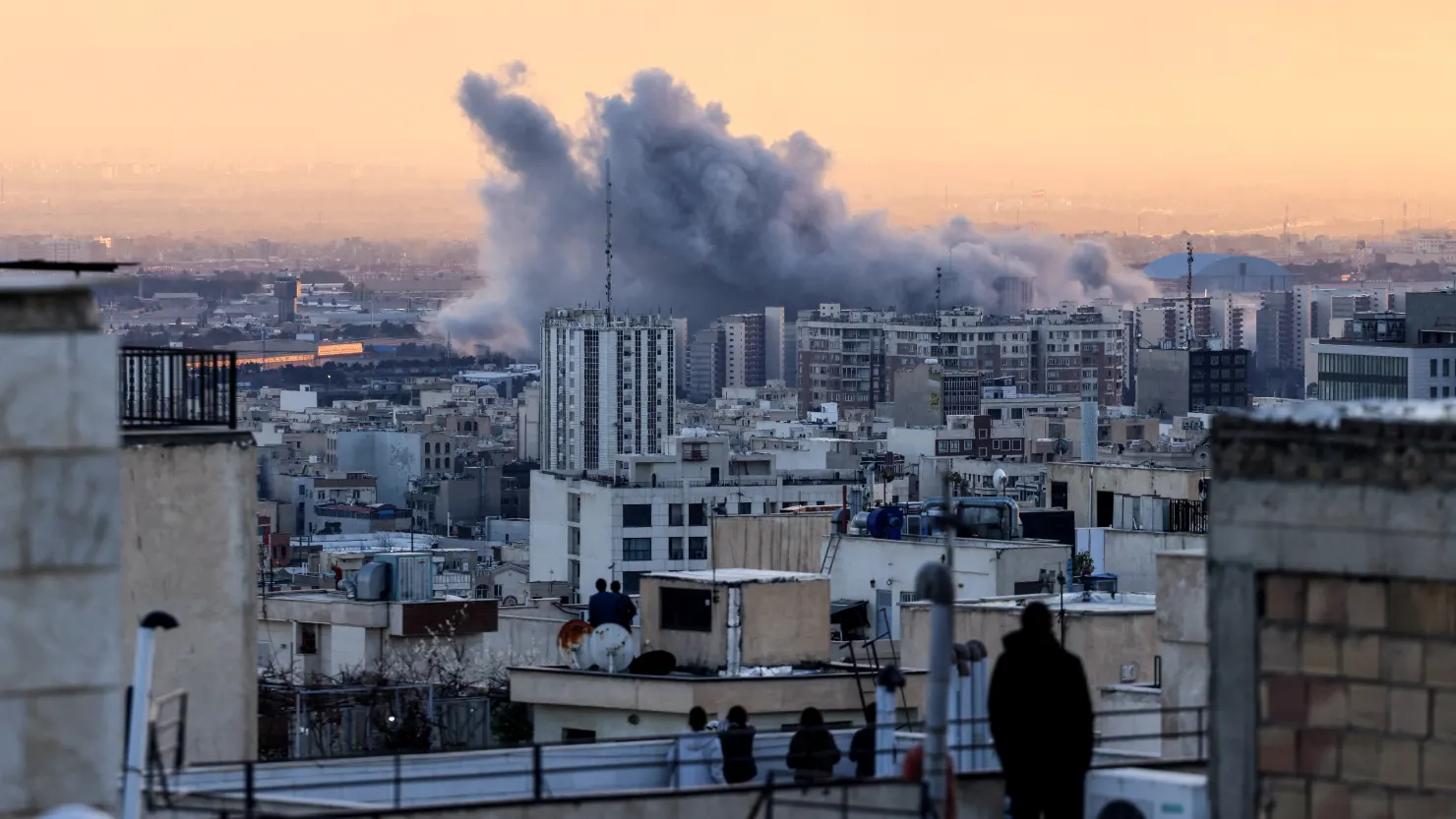
Smoke rising from military strikes in Tehran, the capital city of Iran. (Atta Kenare/Getty Images)
On December 28, 2025, protests developed across Iran, mobilizing primarily in the major cities and turning into the largest protests that have hit the nation since 2022. The current protests were initially caused by economic instability. According to the Statistical Center of Iran, the inflation rate rose to 42.2% in December 2025 compared to December of the previous year, with reports that the rial, Iran’s national currency, had depreciated to 1.38 million to the U.S. dollar. Various vendors and commercial traders closed their businesses in response to the economic turmoil and mismanagement from the Iranian government. However, in a short period of time, many protestors shifted their message to one considerably more anti-regime.
In the Isfahan province in the central region of Iran, many were seen on December 30 chanting for the demise of Supreme Leader Ayatollah Ali Khamenei. Starting at this point, there was an increase in reports of protester deaths. On December 31, a man named Amirhesam Khodayarifard was killed by a gunshot wound to the head by security force members of Iran. The government then promptly claimed that Khodayarifard was a member of a militia force, even employing the Islamic Revolutionary Guard Corps to visit his family to pressure them into affirming the regime’s claim.
As the new year began, the number of deaths rose to unprecedented levels. On January 2, U.S. President Donald Trump publicly warned the Iranian regime not to kill protestors, threatening to intervene if the regime chose that course of action. In order for the Iranian government to avoid international scrutiny, authorities began to cut telephone lines and internet connections within the country. This blackout affected not just mobile phones but also credit card purchases and ATMs, leading the economy into stagnation. With the online disruption in place, human rights organizations like Amnesty International warned that forces of the Iranian regime would have fewer constraints in how they respond to the protests.
In just 48 hours, from January 8 to 10, Iran International, based in the United Kingdom, reported that at least 2,000 demonstrators were killed. Considering that the internet shutdown made it hard to spread videos and pictures of the dead, this estimate is considered conservative, with the potential casualties being much higher. As of February 2026, the death toll is estimated at 7,000, but other estimates posit that the death toll could be as many as 30,000. Additionally, the Iranian regime has allegedly been torturing protestors. In one case, hundreds of photos were leaked of deceased citizens in a Tehran mortuary, who had their faces swollen and disfigured in such a way that many of them could not be identified.
A major opposition leader and international advocate, Reza Pahlavi, the son of the former Shah of Iran, spoke publicly and urged Trump to intervene in Iran. Pahlavi explained that there are signs that a collapse of the Iranian government is imminent and that a military strike or operation could be instrumental in weakening the regime. On February 13, Trump told reporters that regime change in Iran “would be the best thing that could happen.” The president then moved the USS Abraham Lincoln and three guided-missile destroyers to the Middle East in order to assist with any potential future operations. Additionally, since the withdrawal of the Joint Comprehensive Plan of Action (JCPOA) by the U.S. in 2018, Trump has been pushing for Iran to accept a better deal, and amid the escalating situation, he stated that if Iran did not accept a nuclear deal soon he would be willing to strike their facilities more severely than he did in 2025. Subsequently, Trump ordered the USS Gerald R. Ford to proceed to the Middle East to provide support as well.
Start of the Conflict and Key Moments
These escalating tensions ultimately developed into a full-scale war. On February 28, the U.S. and Israel initiated operations named Epic Fury and Roaring Lion, respectively. They launched strikes that began to hit various locations in Iran. With one of the most important strikes happening right as the operations commenced, with the killing of Supreme Leader Ayatollah Ali Khamenei and many top Iranian officials. Within hours, Iran responded with strikes against cities such as Tel Aviv and Haifa in Israel, several U.S. military bases located in Qatar, Kuwait, the UAE, and Bahrain, and also attempted to strike various civilian zones in the Persian Gulf regions, such as in Riyadh and towards the Kuwait International Airport.
On March 1, during attacks from Iran targeting a tactical operations center at Port Shuaiba, six United States Army Reserve soldiers were killed, and 30 soldiers were injured. Shortly after, in a news release, Lt. Gen. Robert Harter, chief of the U.S. Army Reserve, paid respects to the fallen soldiers. On March 7, when the fallen soldiers were being transferred, the Secretary of Defense, Pete Hegseth, Donald Trump, and others were present for their solemn transfer. A week later, six members of the U.S. Air Force personnel were killed in an aerial refueling accident during operations against Iran.
In other developments, on March 8, Mojtaba Khamenei, son of Ayatollah Ali Khamenei, was appointed as the new Supreme Leader of Iran by a clerical council. However, he has yet to make a public appearance, and the Russian ambassador to Iran has claimed that he is currently hiding for safety concerns. President Trump commented that he was not happy with their decision and insinuated that Mojtaba could also be killed like his father. On March 28, the Houthis, an Iran-backed militia group situated in Yemen, launched strikes against Israel for the first time in the war. This action could risk inserting Yemen into the wider conflict. The government of Yemen has placed the blame on Iran for these actions and condemned Iran’s “frequent attempts to drag” Yemen into the war.
Since the start of the war, Iran has closed the Strait of Hormuz. The Strait is a passage routinely used by countries such as Saudi Arabia, Kuwait, Iraq, Qatar, and the UAE for exporting their oil to other countries. Due to how close Iran is situated to the Strait, it can effectively stop transportation from taking place. Iran has used methods such as placing mines, firing anti-ship missiles, flying drones, and using submarines to halt movement in the Strait of Hormuz. The closure of the Strait has caused oil prices to increase substantially. The price of Brent crude oil, which is used as the international indicator of oil prices, has risen 51% since the start of March. This is more than the increase which occurred when Saddam Hussein invaded Kuwait back in 1990. Trump had been seeking help from other countries, especially those in NATO, to assist in reopening the Strait. However, no country offered to help. With countries like Spain explicitly denying Trump’s request.
On April 2, Trump gave a speech from the White House, explaining recent developments of the conflict. He articulated that the conflict would be over within three weeks and mentioned the duration of previous U.S. conflicts to suggest that the current war would be relatively quick in comparison. Furthermore, on April 7, Trump posted that Iran’s civilization, “will die tonight, never to be brought back again” if it didn’t reopen the Strait of Hormuz. By the evening of that day, Iran agreed to a two-week ceasefire, with mediation from Pakistan.
However, after 20 hours of negotiations, no deal was accepted that would put an end to the conflict. Ultimately, on April 13, the U.S. began a blockade of the Strait of Hormuz with the plan of intercepting any ship that paid a toll to Iran to enter the channel, and destroying any mines that Iran placed along the Strait.
Opinions and Future Predictions
The Pew Research Center polled Americans and found that around six in ten Americans disapprove of Trump’s handling of the conflict. There exists a significant partisan gap in views on the war. The majority of those who lean or identify as Republican support Trump’s handling, while the majority of those who lean or identify as Democrats disapprove of Trump’s action. The majority of Americans are also concerned about higher gas and fuel prices due to military action in Iran.
Jonathan Panikoff, the director of the Scowcroft Middle East Security Initiative, stated that the end of the Iranian regime is more likely to consist of the Iranian Revolutionary Guard Corps (IRGC) having partial control of the country rather than a full-fledged democracy. Borzou Daragahi, senior nonresident fellow at the Atlantic Council, posits something similar and adds that the IRGC would bypass the powerful clerical authorities and get rid of unpopular religious ideas that are pushed by the current religious authorities, such as the mandatory hijab statutes.
China has been relatively quiet throughout the entire conflict. China has enough oil reserves to withstand many months without receiving oil exports from Iran, and so, experts like Henry Tugendhat predict that China will continue to avoid helping Iran more than is necessary. Additionally, Russia has been just as idle. Anna Borshchevskaya, Harold Grinspoon Senior Fellow, describes how Vladimir Putin has been giving verbal condemnations of the actions being done by Israel and the United States, but as of yet, no military assistance has been provided to Iran. She explains how Russia has been trying to position itself as a mediator in the conflict by keeping in touch with many leaders and delegates involved in the negotiations between Iran and the U.S, and has overall been playing the long game.
Europe, on the other hand, has been divided on how to act. Some countries are in favor of the U.S-Israeli military campaign, believing that it would make Europe safer from the threat of the Iranian regime. Others are cautious in condoning the actions of the Trump administration due to their views on Trump’s regard for international law and threats of military action in places like Greenland. Nonetheless, the U.K. has given the U.S. military permission to conduct defensive action on British military bases. France has also dispatched their sole aircraft carrier to provide support to European allies.
Ultimately, the Iran war is an ever-changing situation with varying opinions and predictions by experts and citizens. The future of the conflict is still uncertain. It may end within weeks as Trump stated before, or last longer if military objectives are delayed. Either way, the wide-reaching effects of this conflict have and will continue to have impacts on economic, political, and social systems even after the conflict ends.
