
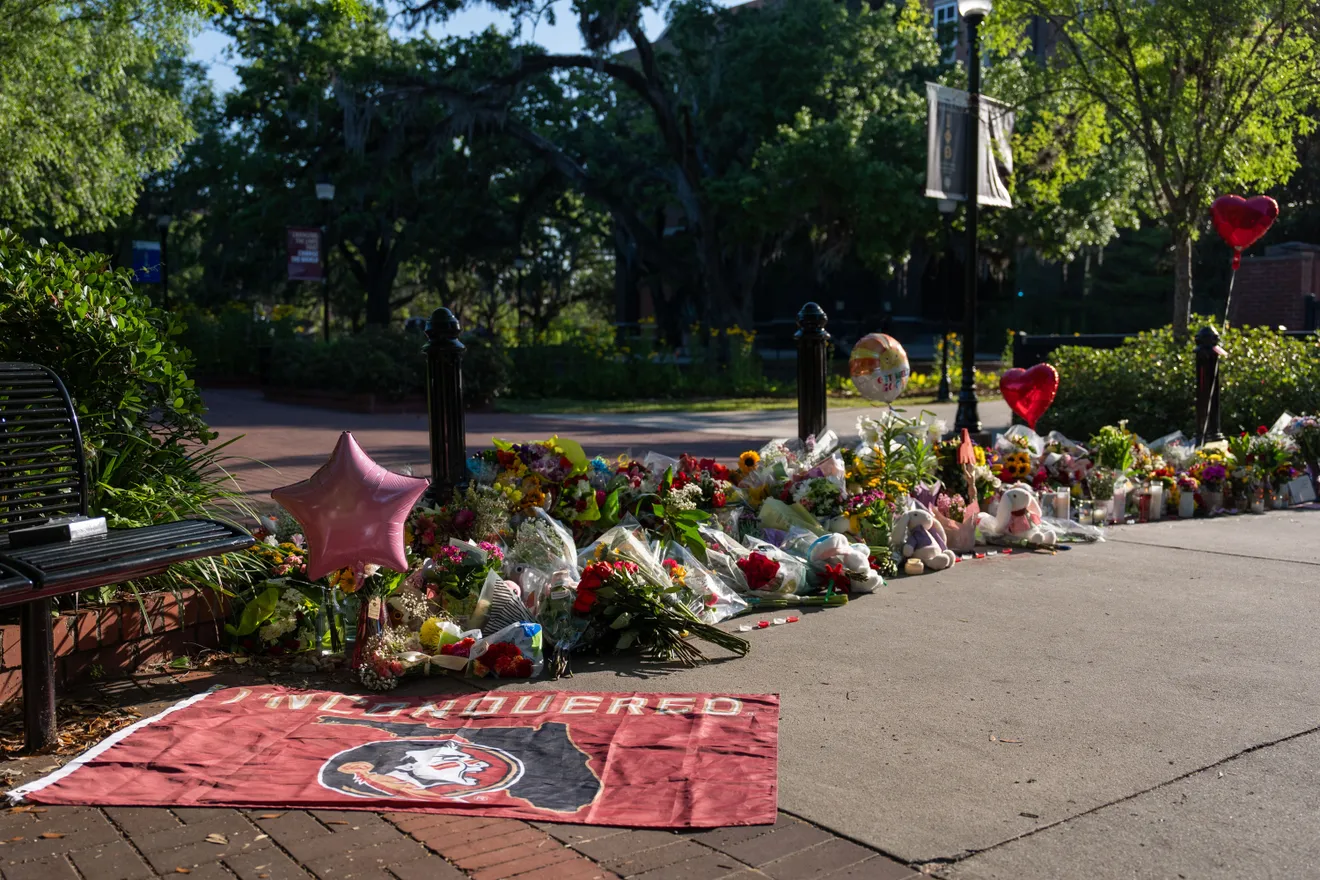
On April 18, 2025, several memorials were set up near the Florida State University’s Student Union building the day after a shooter killed two and injured six. (Alicia Devine/Tallahassee Democrat)
After the shooting at Florida State in April 2025, state lawmakers sought to address questions about state legislation to decrease gun violence. In February 2026, the “School Safety” bill (HB 757) passed the Florida House 83-25 and was received by the Senate Rules Committee on February 26. After leaving committee an amended version of HB 757 passed the Senate. HB 757 then passed the House as amended and will go before Governor Ron DeSantis for his signature. A key and controversial provision of the bill is one which expands the Guardian Program. The Guardian Program was implemented after the 2018 Parkland shooting via the 2018 bipartisan Marjory Stoneman Douglas Act in an attempt to provide quicker responses to threats when police have not yet arrived. The Program is currently only in K-12 schools. HB 757 seeks to extend the Guardian Program to public postsecondary educational institutions, including FSU. The program would allow university faculty and staff to carry concealed firearms on campus just as K-12 teachers can, provided they go through the same 144 hours of training, psychological evaluations, and drug testing.
In Debate
Representative Michelle Salzman, who filed the bill in the House, made clear during a Budget Committee meeting that postsecondary institutions first have to opt in to the program. However, Senator Tina Scott Polsky noted in late February that in the current implementation of the Guardian Program in K-12 schools, individual school districts decide if the Guardian Program is right for their community. Florida’s state universities instead have governor-appointed boards of trustees who would decide if the school should opt in, so students and staff don’t have a say. Polsky’s concern is that because the current administration is in support of expanding the Guardian Program, universities who don’t opt in might not receive the funding they need.
Critics are concerned that introducing more firearms distracts professors from their jobs and creates a culture of fear that stifles academic freedom and learning. During a Senate Committee hearing for HB 757’s companion bill (SB 896), FSU professor Charles McMartin testified in opposition. He spoke to his experiences of surviving three separate shootings, including at FSU, and stated that “introducing more guns into these environments increases the risk of accidental shootings, misidentification, and escalation, not safety.”
In the face of opposition, the philosophy of those who advance the bill remains the same. In the same hearing, Senator Jason Brodeur said in support that “we are reminded constantly in this world, unfortunately, that the only thing that stops a bad guy with a gun is a good guy with a gun.”
Restrictions
During a House Committee meeting, Salzman spoke of her bipartisan collaboration with Representative Christine Hunschofsky when drafting HB 757. They ensure student-staff, like resident assistants and student workers, cannot carry on campus. Their reasoning is that, unlike K-12 districts, college campuses face a higher prevalence of mental illness and drug and alcohol abuse among students. Hunschofsky is from and represents most of Broward County, including Parkland.
HB 757 also takes provisions of the Marjory Stoneman Douglas Act and applies them to higher education. They require universities to have a rapid alert system for the entire campus, active assailant response plans, better locks on doors, and a threat assessment team that identifies individuals who may pose harm to themselves or others have all been incorporated. For example, if a student is dual-enrolled and is reprimanded at their high school, this must be communicated to the university they’re enrolled in. Additionally, the bill creates a 1,000-foot buffer zone around the borders of a campus where expelling a firearm becomes a felony, with exceptions for private property.
Parkland Perspective
The Guardian Program is named after Chris Hixon, Aeron Feis, and Scott Beigiel, who were the school employees killed trying to save lives during the Parkland Shooting. Hixon’s son Tom, who “wholeheartedly disagree[s] with this bill and how it’s written,” said he wants it to include safe storage, limits on the types of weapons being carried, and communication between Guardians and law enforcement. It’s not yet clear how outside law enforcement would be able to distinguish between the shooter and a Guardian.
Ryan Petty, whose daughter Alaina was killed in the Parkland shooting, is advocating for change by supporting the bill. He notes that “the shooter at Marjorie Stoneman Douglas killed 17 people in approximately six minutes. By the time law enforcement rallied, the math had already done its terrible work.” There were armed School Resource Officers (SROs) present during the Marjorie Stoneman Douglas shooting who remained outside the building while the shooter was active instead of entering to confront him.
HB 757 would take effect immediately if signed by Governor DeSantis.
