

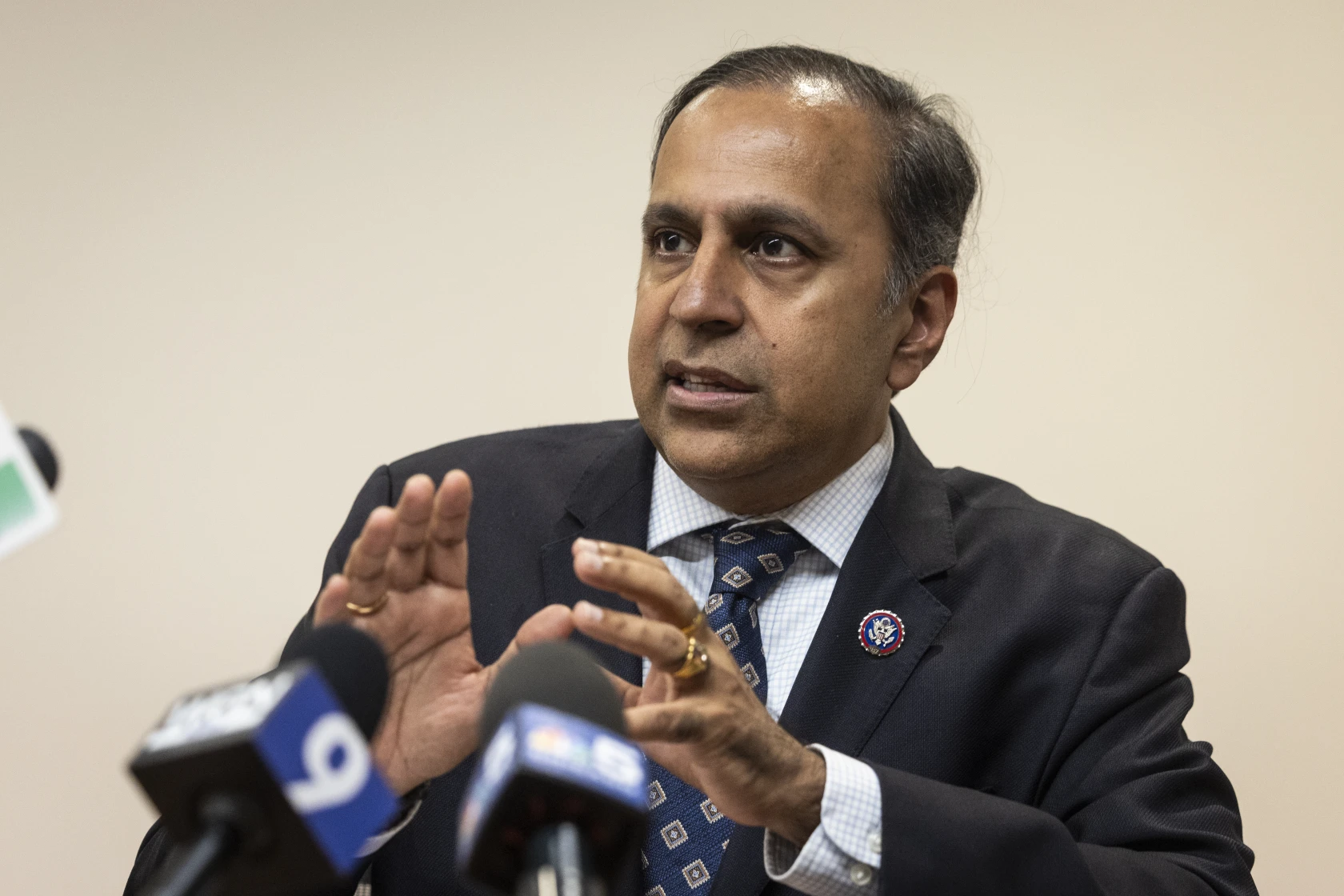
Democratic Representative Raja Krishnamoorthi, a candidate to replace retiring Democratic Senator Dick Durbin in Illinois. (Ashlee Rezin/Sun-Times)
The 2026 midterms will continue on March 10 and 17 with primaries in Mississippi and Illinois. Between the two states, every congressional election is rated as “solid” by the Cook Political Report in favor of either a Republican candidate or a Democratic candidate in the general election. However, many House incumbents in each state are facing primary challengers in 2026, and retirements in Illinois have opened competitive primaries between ambitious Democrats. Additionally, some Democrat-held House districts in Illinois were decided by less than ten percentage points in the 2024 presidential election, and some Republican challengers see a chance to be competitive despite the doubts of forecasters. On March 10, candidates in Mississippi will need 50% of the vote to win their primaries outright and avoid an April 7 runoff. On March 17, the Illinois primaries will be the first in the nation this year to be held without a runoff requirement.
Mississippi

In Mississippi, where President Donald Trump won by 22.9 percentage points in 2024, Republicans are defending a Senate seat this election cycle. Republican Senator Cindy Hyde-Smith, who was initially appointed to the seat in 2018 and won her first full term by 10 points in 2020, is running for reelection. None of the bills Hyde-Smith has sponsored during her Senate tenure has become law, and she does face a Republican primary opponent this year in physician Sarah Adlakha. However, Hyde-Smith is running with endorsements from Trump and Mississippi’s entire Republican delegation in Congress, as well as a nearly $4 million advantage in campaign financing at the end of 2025. Adlakha has raised questions about Hyde-Smith’s campaign funding, criticizing donations the senator has received from lobbyists.
There are three Democrats running to challenge Hyde-Smith this election cycle, although Mississippi voters have not elected a Democrat to the Senate since 1982. The three candidates are district attorney Scott Colom, Marine Corps veteran Albert Litell, and teacher Priscilla Williams-Till. Colom has raised the most money on the Democratic side thus far, approximately $1.2 million, and is backed by Representative Bennie Thompson (MS-2). His main goals are “lowering costs for families,” saving hospitals, bringing home jobs, and working across party lines to “get things done.” Williams-Till is a distant cousin of Emmett Till, who was a 1955 lynching victim at the age of 14. There is also an independent in the race, Ty Pinkins, who was the Democratic nominee for Mississippi’s other U.S. Senate seat in 2024. Pinkins stated his decision to run as an independent rather than a Democrat in 2026 was rooted in his concerns over “party insiders who prioritized fundraising over values and vision.”
Each of Mississippi’s four U.S. House seats were decided by more than 20 percentage points in 2024, and all four are considered “solid” by the Cook Political Report in favor of the incumbent party in 2026. Only two incumbents in Mississippi’s House delegation face primary challengers this year. In Mississippi’s majority-black 2nd district, Thompson is facing attorney Evan Turnage and logistics professional Pertis Williams III in the Democratic primary. However, Thompson has fared well in his most recent primaries, receiving 96.3% of the vote in 2022 and winning his 2024 nomination without a challenger. In Mississippi’s 4th on the Gulf Coast, Republican Representative Mike Ezell is facing a primary challenger who is connected to former Representative Steven Palazzo, whom he ousted in the district’s 2022 primary. That challenger is Sawyer Walters, a former Palazzo staffer. Walters did not report any fundraising by the end of 2025, and Ezell received Trump’s endorsement in October.
Illinois

Joe Biden won Illinois by 16.9 points in the 2020 presidential election, but Kamala Harris won the state by just 10.9 points in 2024. Still, Democrats expect to easily win Illinois’ statewide races in 2026, as forecasters predict comfortable victories for the party in the Senate and gubernatorial elections.
Democratic Senator Dick Durbin, the second-highest-ranking Democrat in the Senate, is retiring after five terms, leaving Illinoisans with their first open Senate election since 2010. Ten Democrats are running in the primary to replace Durbin, but Representative Raja Krishnamoorthi (IL-8), Representative Robin Kelly (IL-2), and Lieutenant Governor Juliana Stratton have emerged as polling frontrunners. Despite hailing from an uncompetitive suburban Chicago district, the Indian-born Krishnamoorthi entered the Senate race with $19 million in his House campaign account, and he has raised an additional $9 million since launching his Senate campaign. Stratton’s campaign fundraising has lagged well behind Krishnamoorthi’s, but she has received the endorsement of Governor JB Pritzker, who has donated millions to outside groups backing her. Kelly has attracted endorsements from former Chicago Mayor Lori Lightfoot and the Congressional Black Caucus PAC, but she has not yet polled above 20% support in any poll this year.
In a February debate, the three Democrats discussed Immigration and Customs Enforcement (ICE) and its effects on Chicago under the Trump administration. Reid Epstein of The New York Times noted a subtle difference in Stratton’s calls to “abolish ICE” and Krishnamoorthi’s calls to “abolish Trump’s ICE,” claiming that the stances display how the candidates “aren’t split by major ideological or policy differences” but enforce almost unnoticeable differences in their messaging efforts. Most recent polls in the Democratic primary have been sponsored by either Krishnamoorthi or Stratton, but a February poll by Tulchin Research found Krishnamoorthi at 39% support, Stratton at 23%, and Kelly at 8%.
Meanwhile, Republican voters in Illinois have a wide field of little-known candidates hoping for the Senate nomination. A poll by Emerson College in January found no Republican Senate candidate above 10% support in the primary, with 84% of voters undecided on the race. However, former Illinois Republican Party chair Don Tracy has received endorsements from former Senator Mark Kirk, as well as all three of Illinois’ Republican members of Congress. Additionally, Tracy ended 2025 with over $2 million to spend on his campaign, with attorney Jeannie Evans as his closest fundraising competitor.
Only Republican voters have a choice in Illinois’ 2026 gubernatorial primaries, as Pritzker is unopposed in his Democratic reelection primary. January polling by Emerson College in the Republican gubernatorial primary suggests that former state Senator Darren Bailey is headed for a rematch with Pritzker in 2026, as the only candidate with double-digit support. Bailey ran for Illinois’ governorship in 2022, winning the Republican nomination after Pritzker and the Democratic Governors Association spent over $34 million to boost his campaign. According to Shia Kapos of POLITICO, Pritzker viewed Bailey as “a candidate he could easily beat,” so he spent the money on ads that emphasized Bailey’s conservative record to Republican primary voters. In the general election, Pritzker defeated Bailey by a 54.9%-42.4% margin. After his 2022 defeat, Bailey ran for Congress in 2024, challenging Republican Representative Mike Bost in the primary for Illinois’ rural southern 12th district. Bost won by just 2,735 votes. As Bailey seeks another chance to face Pritzker this year, he will have to defeat wealthy real estate developer Rick Heidner, DuPage County Sheriff James Mendrick, and conservative policy research website president Tad Dabrowski in the Republican primary. Trump endorsed Bailey in the 2022 gubernatorial campaign and Bost in the 2024 House campaign, but he has not weighed in on Bailey’s 2026 race.
Illinois’s plurality-Black 2nd district, which includes some southeast Chicago suburbs and several rural counties along the Indiana border, is open in 2026 due to Kelly’s run for Senate. Kelly won reelection to the seat in 2024 by 35.1 points, and Kamala Harris won the district’s 2024 presidential vote by 33.1 points. Eleven Democratic candidates are running in the primary to replace Kelly, including former Representative Jesse Jackson Jr., Cook County Commissioner Donna Miller, State Senator Robert Peters, and State Senator Willie Preston. Both Miller’s and Jackson’s campaigns sponsored polls on the race last year. Conducted in July 2025 by Lester & Associates, the poll sponsored by Jackson’s exploratory team showed Jackson leading with 21% support. Miller’s poll, conducted in December 2025 by Global Strategy Group, also showed Jackson leading the race with 24% support; however, when voters were introduced to all candidates in the race, Miller led with 32% support.
Illinois’ 7th district, another plurality-Black district covering the West Side and downtown Chicago, is the most Democratic district in the state, having voted for Harris by 65.5 points in 2024. Thirteen candidates are vying for retiring Democratic Representative Danny Davis’ seat in 2026. The 84-year-old Davis has represented the 7th district since 1997, surviving close primary challenges late into his tenure. Frontrunners in the 2026 race include former Cook County Commissioner Richard Boykin, political organizer Kina Collins, Chicago City Treasurer Melissa Conyears-Irvin, emergency physician Thomas Fisher, state representative La Shawn Ford, and real estate developer Jason Friedman. Both Conyears-Irvin and Collins ran for the seat in 2024, receiving 21.6% of the vote and 18.0% of the vote, respectively. Collins also challenged Davis in the 2022 primary for the seat, losing by just 4,579 votes. Davis has endorsed Ford for the seat.
Krishnamoorthi’s Senate run leaves Illinois’ 8th district in the outer Chicago suburbs open in 2026, and the state’s top Democrats are split on the wide field of Democratic primary candidates hoping to take his place. Former Representative Melissa Bean, who served the 8th district in Congress from 2005 to 2011, is running with the backing of Senator Tammy Duckworth, Representative Bill Foster (IL-11), and Representative Brad Schneider (IL-10). Progressives like Representatives Chuy García (IL-4) and Delia Ramirez (IL-3) have rallied behind tech consultant Junaid Ahmed, Durbin has endorsed Hanover Park Trustee Yasmeen Bankole, Davis has endorsed business owner Neil Khot, and Representatives Mike Quigley (IL-5), Jan Schakowsky (IL-9), and Eric Sorensen (IL-17) have endorsed Cook County Commissioner Kevin Morrison. Polling is scarce for the primary, but the division among Illinois’ Democratic leadership on the race is similar to the division found in a September 2025 poll by Normington Petts for Bean’s campaign. The poll found Bean leading the field with 10% support, followed by Ahmed at 8%, Morrison at 5%, Bankole at 3%, and Khot at 1%. In terms of fundraising, Khot, Bean, and Ahmed were the only candidates to have raised over $1 million by the end of February.
81-year-old Democratic Representative Jan Schakowsky is retiring after representing the northern Chicago area in Congress for fourteen terms. At the time of her retirement decision, Schakowsky was already facing a primary challenge in Illinois’ 9th district from 26-year-old progressive social media influencer Kat Abughazaleh, a critic of Democratic leadership in Congress. After Schakowsky’s decision to retire, State Senator Laura Fine and Evanston Mayor Daniel Biss entered the race, building rosters of endorsements and fundraising hauls totaling over $2.5 million. Schakowsky endorsed Biss for the seat, but Abughazaeleh has maintained a lead in fundraising with over $3.3 million raised. Aside from the top three, Skokie School District 73.5 board member Bushra Amiwala, State Representative Hoan Huynh, State Senator Mike Simmons, and former FBI agent Phil Andrew are among the Democrats running for the 9th district nomination. The most recent poll in the primary was conducted by Public Policy Polling for Evanston RoundTable in February, finding Biss leading at 24% support, Abughazaleh at 17%, Fine at 16%, and all other candidates below 10%, with 22% of voters undecided.
As Julie Bosman and Jennifer Medina of the New York Times note, Illinois’ four open House primaries have attracted millions in outside spending from pro-Israel groups with ties to the American Israel Public Affairs Committee (AIPAC). Elect Chicago Women, a group with connections to AIPAC, has supported Bean in the 8th district and Fine in the 9th district, while another group called Affordable Chicago Now has supported Miller in the 2nd district. Meanwhile, the United Democracy Project, which is officially aligned with AIPAC, has supported Conyears-Ervin in the 7th district. The four women who have benefitted from this funding have faced criticism from some of their rivals, who align with Pritzker’s criticism that AIPAC is “significantly MAGA-influenced.”
In Illinois’ suburban 6th district, which Harris won by only 5.5 points in 2024, Democratic Representative Sean Casten is facing engineer Joey Ruzevich in his 2026 reelection primary. Ruzevich is endorsed by former Representative Marie Newman, whom Casten ousted from Congress in a 2022 primary when their districts were merged during redistricting. Ruzevich has differentiated himself in the race by criticizing Casten’s support of Israel, but the congressman ended 2025 with a $1.3 million fundraising advantage. The 6th district is almost evenly divided between Chicago suburbs in Cook County and DuPage County. In his 2022 primary against Newman, Casten received 84.7% of the vote in DuPage County and 53.5% of the vote in Cook County.
Although forecasters are skeptical of Republican candidates’ odds in Illinois’ Democrat-held House seats, Republicans will still have contested primaries in a handful of districts won by Harris by fewer than ten points in 2024. For Casten’s 6th district seat, 2024 nominee and energy consultant Niki Conforti is facing activist Skylar Duensing in the Republican primary. While Harris won the 6th district by 5.5 points in 2024, Casten won his reelection by 8.4 points. In the race for Krishnamoorthi’s open seat in Illinois’ 8th district, which Harris carried by 7 points, 2024 nominee Mark Rice, accountant Kevin Ake, software company co-owner Jennifer Davis, and retired police officer Herbert Hebein are all seeking the Republican nomination. In Illinois’ exurban 14th, which Harris won by 5.2 points, Oswego Public Library Board member James Marter and former Naperville township supervisor Gary Vician are hoping to challenge Democratic Representative Lauren Underwood. Underwood outperformed Harris in 2024, winning reelection by 10.2 points. In Illinois’ long 17th district, which stretches through northern Illinois reaching Rockford, Peoria, and Bloomington, Carroll County Board chair Julie Bickelhaupt is facing coffee shop owner Dillan Vancil for the nomination to take on Democratic Representative Eric Sorensen. In 2024, Sorensen won reelection by 8.9 points, even as Harris only carried the 17th district by 4.8 points.
Of Illinois’ three Republican members of Congress, Representative Mary Miller is the only one facing a primary challenge in 2026. Miller, in Illinois’ central 15th district, is facing challengers Judy Bowlby and Ryan Tebrugge in her reelection primary. Bowlby, a health policy lobbyist, has promised to “negotiate across the aisle” with Democrats if elected and has broken with her party to criticize Trump’s tariff policies. At the end of 2025, however, Bowlby and Tebrugge combined for less than $24,000 raised against the three-term congresswoman. Trump won Illinois’ 15th by 39.9 points in 2024, and Miller has long been an ally of the president since she won his backing for the 15th district seat in a two-incumbent primary caused by redistricting in 2022.

