
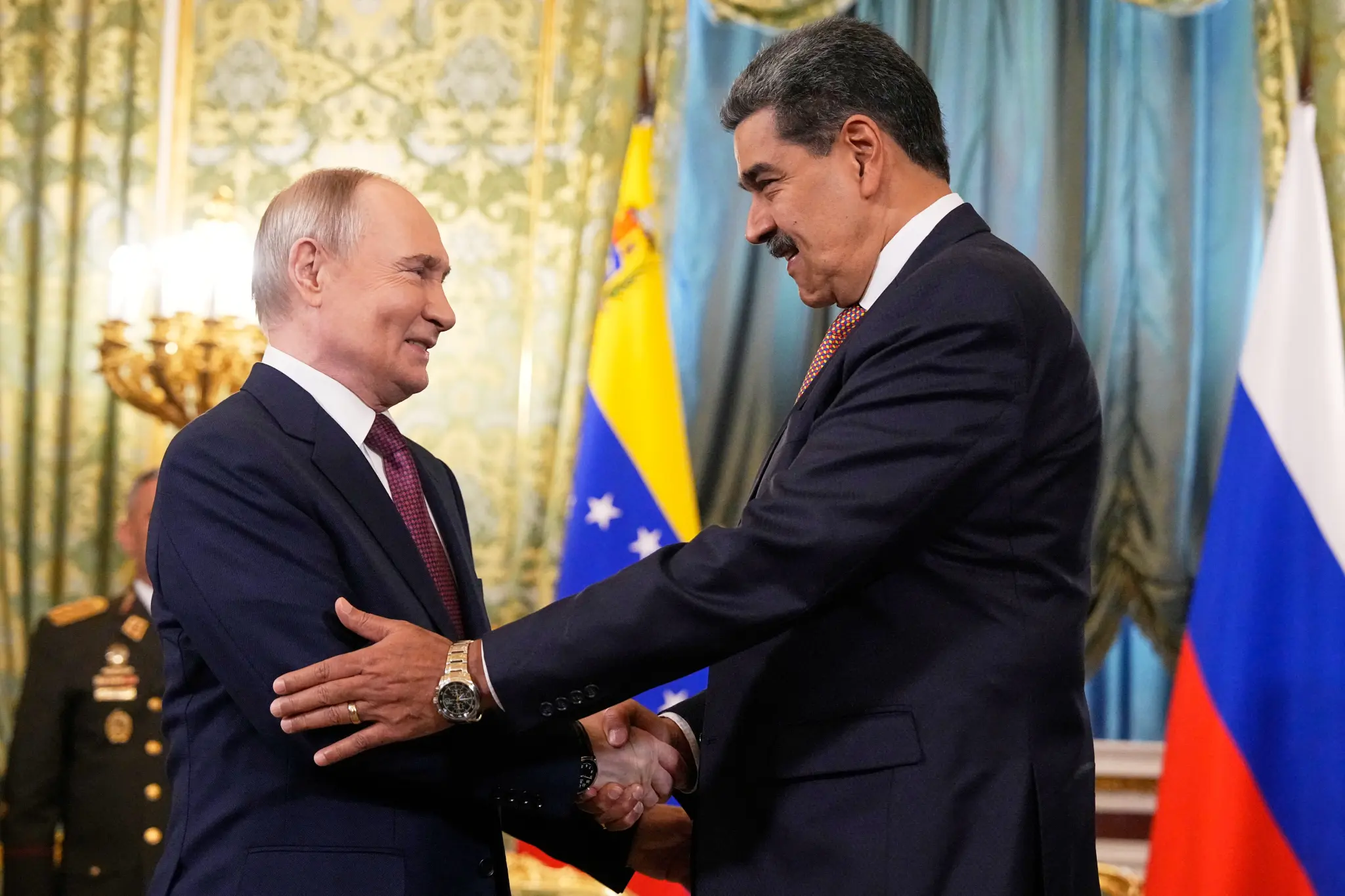
Russian President Vladimir Putin and then-Venezuelan President Nicolas Maduro meet at the Kremlin in May 2025. (Photo by Alexander Zemlianichenko / POOL / AFP)
Following the seizure of Venezuelan President Nicolas Maduro, many are left wondering what the future holds not only for Venezuela, but also for its closest allies. Among those most affected is Russia, one of Venezuela’s most significant partners. The two nations have been political allies since 1945. Russian President Vladimir Putin has been involved with Venezuelan policy since the early years of the Chavez presidency, when Russia sought to counter U.S. interests in the country and re-establish Russia as a major power. Because of the recent U.S. military intervention in Venezuela, the partnership has become the basis for speculation on what the future could hold for Russia.
Oil diplomacy has served as the central pillar of Russia-Venezuela relations. In the words of British educationalist James John Guy, “Venezuela literally floats on oil, a fact which not only makes this country unique in Latin America but from which it has gained international stature at the global level.” This status is reinforced by the fact that Venezuela possesses the largest amount of oil reserves in the world, accounting for approximately 17% of global reserves. To leverage this, Russia has repeatedly provided loans, debt restructuring, and prepayment-for-oil deals in exchange for access to Venezuelan crude oil and energy resources. Conversely, Venezuela has tied itself to Russia by receiving loans from Rosneft, Russia’s largest oil company, to keep its oil industry alive and provide the government with funds during its economic crisis. This partnership, though established beforehand, was strengthened after 2004, when Chavez realized the unprecedented “oil bonanza” could be used to Venezuela’s benefit. He began to trade with multiple Russian oil companies. This dynamic not only deepened Venezuela’s dependence on Russia but also gave Russia a foothold in the Western Hemisphere.
The United States and its Western allies have broad sanctions on Russian oil, making it difficult and less profitable for Russia to legally move its oil and crude. To circumvent this, Russia has been taking advantage of the sanctions on Venezuelan oil, helping sell it and, in turn, receiving payments in crude and oil shipments. By doing this, Russia has been able to begin to close revenue gaps which were being caused by the sanctions on its own oil. However, now that Maduro has been captured and the U.S. has been redirecting oil revenues away from Russian channels, Moscow isn’t able to benefit directly from Venezuelan oil shipments like it used to. As a result, Russia’s strategies for closing revenue gaps and compensating for losses caused by sanctions may have to change.
Other than Venezuela aiding Russia in bypassing sanctions, the capture of Maduro also disrupted the system the two nations had in place, where Moscow used Venezuelan oil to recover loans and maintain steady revenue. Under the oil-for-debt agreement that Russia and Venezuela had in place, Venezuelan crude shipments and oil revenues were used to help repay Russian loans and support Russian energy firms operating within the country. As a result of the overnight shift in political control and financial oversight, Russia lost a dependable source of income, further affecting its ability to combat the economic effects of sanctions and foreshadowing a potential for further Russian losses as the U.S. moves to control Venezuelan financial channels.
After the intervention in January, Washington began physically blocking Venezuelan tankers filled with oil, affecting Russian oil sales and shipments. Additionally, the United States now controls the Venezuelan currency, which prevents it from being used to repay Russian loans or benefit any Russian companies. Now that Maduro is captured, President Donald Trump has stated that the U.S. will be “selectively rolling back sanctions to enable transport and sale of Venezuelan oil products to global markets”, compounding the negative effects on Russia’s economy and exacerbating its newfound inability to offset its own oil sanctions.
Because of the decline in Russian oil revenue, Moscow’s ability to support its partners, especially ones so far away like Venezuela, has been similarly affected. Akin to the U.S. attack on Iran back in June of 2025, the U.S.’s rapid intervention in Venezuela revealed the limits of Russia’s ability to protect its allies, harming Russia’s reputation as a reliable security partner. Russia is currently in a power competition with the United States, and because of this new development, it’s becoming clear to other nations that Russia isn’t holding its weight in terms of alliances with foreign nations.
Conversely, Russia is also seeking to capitalize on the capture of President Maduro, as it violates international law. Legal scholars emphasize that the use of force without a United Nations Security Council mandate in the absence of a legitimate claim of self-defense is a clear violation. Russia will likely use this as a way to advance its narrative on Western neo-colonialism, allowing Moscow to point fingers at the United States as violators of international law while projecting itself as defenders of sovereignty. Though President Trump used the Monroe Doctrine to justify the invasion, Russia is using these recent events as a way to push its anti-Western propaganda.
Russia’s war in Ukraine remains the dominant factor shaping its global strategy. Resources that were previously used for sustaining influence in Latin America are now yielding diminishing returns, while also offering little ability to retaliate directly. Some believe that because of this ongoing war, Russia has little to no incentive to attempt to remain a factor in Venezuela. Henry Ziemer, an associate fellow with the American Program at the Center for Strategic and International Studies (CSIS), stated that “it seems more likely that Russia will focus its efforts instead on trying to dissuade further U.S. seizures of sanctioned oil tankers… given the importance of the global ghost fleet to its economy and war machine”.
Not only is Russia discouraged from acting due to financial restraints, but Moscow is also forced to stay quiet because of current negotiations with President Trump to try to end the war in Ukraine. Analysts at the Institute for the Study of War consider Russia’s reaction to this ordeal as a “balancing act”, given they signaled displeasure with the events while also staying unconfrontational and avoiding any action that could jeopardize their diplomatic relations with the U.S. Their response also highlights how Russia’s actions are strategic in nature, with them choosing to not escalate conflicts with Washington while already being involved in a high-stakes conflict in Europe.
While it’s still unclear how Russia will proceed in the near future based on the information experts have, many analysts believe Russia will seek accommodation rather than confrontation, while also leveraging the situation to argue for competing spheres of influence.
