
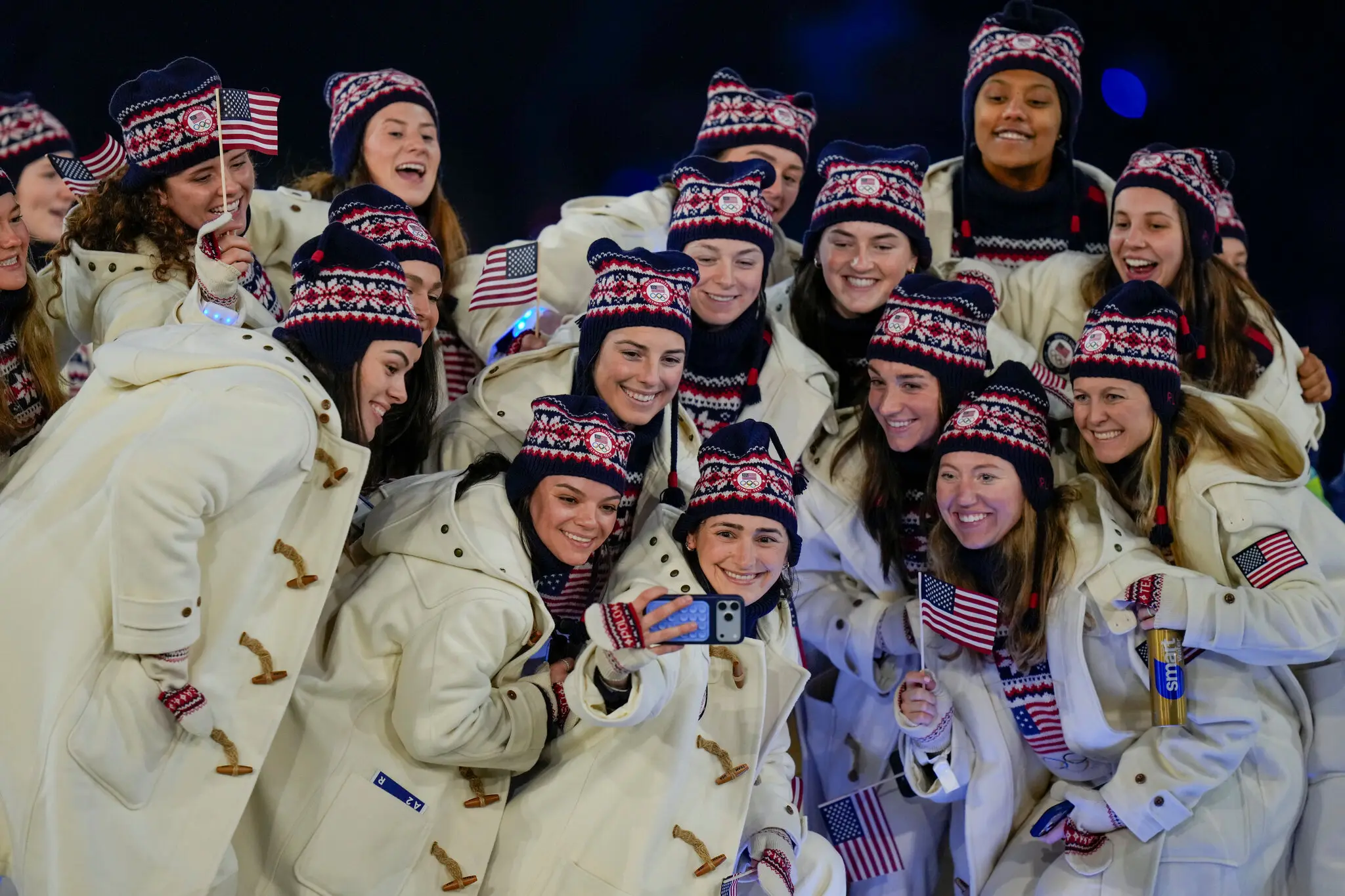
Team USA athletes pose for a selfie during the Opening Ceremony of the 2026 Winter Olympics. (Vincent Alban/The New York Times)
At the Opening Ceremony of the 2026 Winter Olympics, Kirsty Coverty, the International Olympic Committee president, proclaimed that the Games are a place for athletes to compete “without being held back by the politics or division of their governments.” As the United States faces domestic political tension stemming from nationwide protests over President Donald Trump’s increased crackdown on immigration, as well as international tension over Trump’s aggressive foreign trade policies and talks of acquiring Greenland, Team USA athletes have treaded carefully when responding to questions about politics. Some athletes’ responses have highlighted a sense of discomfort with current events, but they have also expressed hope for a successful Games and pride in representing their nation.
In interviews, many athletes have expressed their desire to see more compassion from American citizens and politicians. Chris Lillis, a Team USA freestyle skier and 2026 gold medalist, commented that he feels “heartbroken about what’s happened in the United States,” referring to increased immigration enforcement and protests, and thinks that “as a country we need to focus on respecting everybody’s rights and making sure that we are treating our citizens, as well as anybody, with love and respect.”
Chloe Kim, a 2026 silver medalist snowboarder and daughter of immigrants from South Korea, shared a similar sentiment to Lillis, saying that, “I think in moments like these, it is really important for us to unite, and kind of stand up for one another for all that’s going on.” Like many of her teammates, she stated she is “really proud to represent the United States,” referencing the opportunities it has given her and her family and encouraging people to lead “with love and compassion.”
Athletes like Team USA ski racer Lindsey Vonn have used their platforms to offer words of hope. When asked about representing her country, and specifically, her home state of Minnesota,
the center of unrest over Immigration and Customs Enforcement (ICE) presence after the shooting of Renee Good and Alex Pretti, she responded, “it’s where I grew up, and my heart is incredibly heavy for everyone at home.” However, she made clear that in representing the United States, athletes are representing “more than what’s happening right now.”
When asked about how he felt representing the U.S. right now, Hunter Hess, Lillis’ freestyle skiing teammate, responded, “it brings up mixed emotions to represent the U.S. right now…It’s a little hard.” He noted that wearing the American flag on his uniform, “doesn’t mean I represent everything that’s going on in the U.S.” Rather, he emphasized that he is competing to represent his own morals, his friends, his community, and the people who support him.
President Donald Trump took to Truth Social to respond to Hess’s comment, calling Hess “a real Loser” and stating that “He shouldn’t have tried out for the Team, and it’s too bad he’s on it.” The president also expressed that he found it “very hard to root for someone like this.”
Trump was not the only public figure to criticize Hess and his teammates for their comments. Former Green Bay Packers quarterback Brett Favre, Special Presidential Envoy for Special Missions of the United States Richard Grenell, and Republican congressman and Florida gubernatorial candidate Byron Donalds all took to social media to respond. On the social media platform X, Donalds wrote, “YOU chose to wear our flag…to represent our country…If that’s too hard for you, then GO HOME.” Grennel, who, in addition to his current role, was the US ambassador to Germany during President Trump’s first term, also responded on X, calling Hess a “privileged Gen Z from Oregon [who] hasn’t traveled much,” and told him to “move to Canada if you aren’t proud to wear USA.”
Statements regarding U.S. domestic politics from Italians in the Olympic host city of Milan have not been limited to just Team USA athletes, however. After the U.S. Department of Homeland Security announced that investigative agents from ICE would be part of American security teams in Milan, several hundred Italians protested on the streets of Milan, blowing whistles and carrying signs with messages such as “Milan despises you,” “No ICE in Milano,” and “Milano with Minneapolis.” Despite explanations from U.S. officials that ICE agents would be “directed and managed exclusively by Italian authorities,” protesters continued.
Barbara Barile, an Italian spectator of the Opening Ceremony, told the New York Times, “We must distinguish between those who govern and those who are governed.” While the American athletes were welcomed during the opening ceremony with cheers, the American political figures shown were not met with such enthusiasm. As cameras cut to Vice President JD Vance and his wife, Usha Vance, the stadium was reported to have erupted with booing as the athletes continued to make their way into the stadium.
Phillip GiGueliemo, a grandson of Italian immigrants and coach for Alysa Liu, a Team USA figure skater and 2026 gold medalist, thought the crowd was booing the athletes. He was disappointed because “It was supposed to be the pinnacle of my life to see my athlete walk into the stadium, but it turned into a really sad moment for me.” He believes “the athletes don’t deserve this,” a statement aligning with Braile’s comment that the U.S. government’s policies should be separated from the athletes there to compete.
Some athletes have remained apolitical and focused on their events in the midst of political discourse seeping into the games. Summer Bricher, a luger, stated that she focuses on the fact that “there are a lot of really good people at home” who she is “proud to represent.” Similarly, men’s hockey player Zach Werenski stated he just tries to “block it all out” when it comes to politics. He also discussed meeting Vance, saying that “he wants all the athletes here to show well for our country, and that’s our goal.”
American spectators like Helen Wehner and her brother Andrew decided to hide their national identity while watching the games. They did not bring any American clothing or signage to the events, but had a change of mind after arriving. Helen Wehner described her experience, stating, “once you’re here, you see it’s really about the athletes…I want the athletes to see they have some support.”
While spectators have shown support for the athletes, some negative public responses have taken a toll on Team USA athletes’ mental health. Amber Glenn, a Team USA 2026 gold medalist figure skater and LGBTQ+ advocate, announced her choice to take a step back from social media, citing that she was facing “a scary amount of hate/threats” after voicing her opinions on the Trump administration’s treatment of the LGBTQ+ community during an interview at the Games. While she noted that people tell her she should “stick to her job, shut up about politics,” Glenn insisted that “politics affects us all.”
Although the games have concluded, political discourse surrounding the Olympics has continued. When the Team USA men’s hockey team won its first gold medal since 1980, a controversial video of the team celebrating in the locker room began to circulate online. The team accepted a call from Trump, who invited them to visit the White House and attend his State of the Union address. The president then told the men, “we’re gonna have to bring the women’s team, you do know that.” He also joked that if he did not invite the women’s team, he would probably be impeached, to which the team responded with laughter. The captain of the women’s hockey team, Hilary Knight, said to reporters that she thought the joke was “distasteful and unfortunate,” but stressed that “whatever is going on should never outshine or minimize their work,” referring to the gold medal the women’s team had won in overtime against Canada. The men’s team attended Trump’s State of the Union speech on February 24, but players like Vincent Trocheck criticized the politicization of his team’s victory, saying “all we really wanted to do was represent everybody in here and everybody in our country as well as we could.”
