

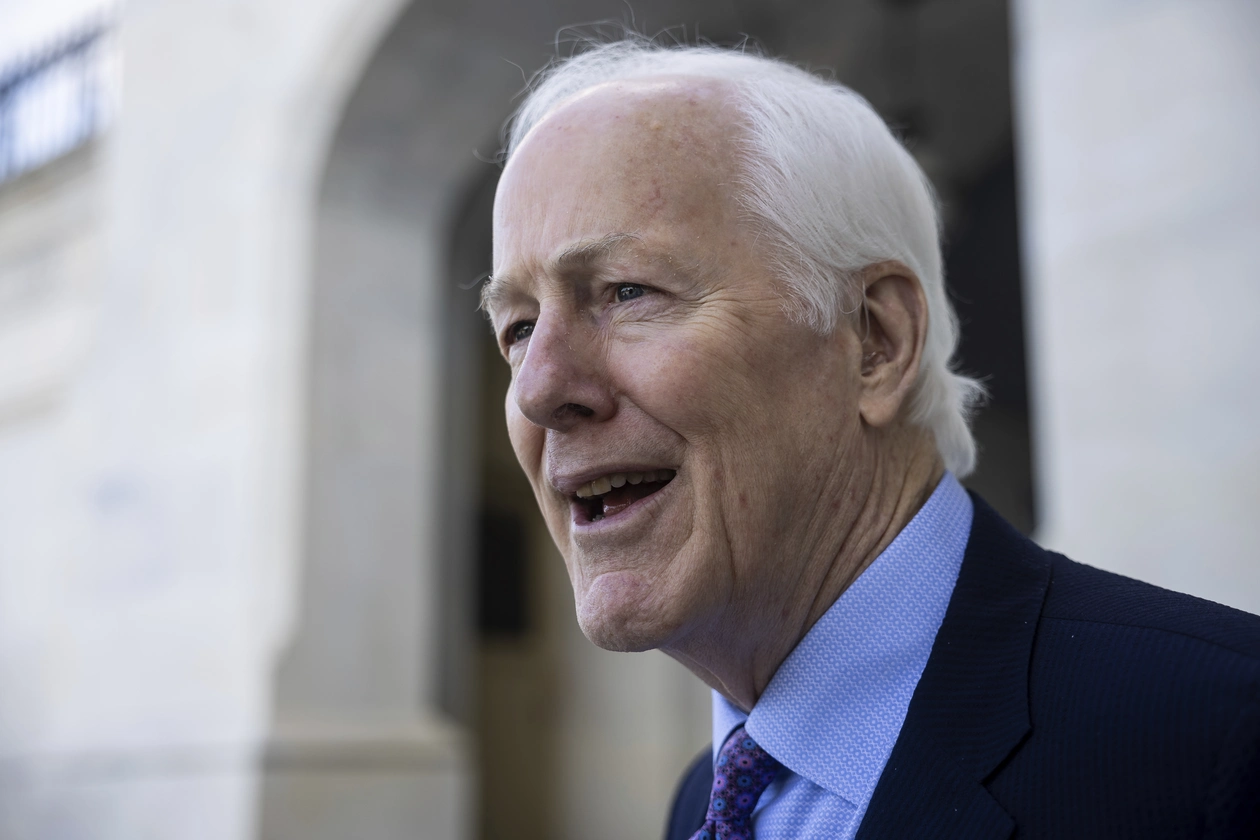
Republican Senator John Cornyn of Texas, who is running for reelection in 2026. (Francis Chung/POLITICO)
A separate article about the March 3 Democratic primaries has been posted here.
The 2026 midterm elections begin on Tuesday, March 3, with primaries in Texas, North Carolina, and Arkansas. Nominees will be chosen for competitive statewide races, as well as dozens of U.S. House seats. In those House primaries, redistricting led by Republicans in Texas and North Carolina has changed the partisan makeup and geographic area of both states’ congressional districts, creating new pickup opportunities for Republicans. Additionally, a handful of Republican House members are retiring in safely Republican districts, prompting competitive primaries to replace them. All three states require a threshold of votes to win the primary outright; otherwise, a runoff election between the top two candidates will be scheduled. Candidates need 50% of the vote to win a primary without a runoff in Texas and Arkansas, and 30% of the vote in North Carolina.

Texas
Republican Senator John Cornyn, who has represented Texas in the Senate since 2002 and rose to serve six years as the chamber’s second-highest-ranking Republican, has a competitive reelection primary in 2026. Cornyn’s top two challengers are Attorney General Ken Paxton and Representative Wesley Hunt.
Cornyn, who voted with President Donald Trump’s position in 100% of his Senate votes in 2025 according to calculations by the Center for American Progress Action Fund, has been criticized by his challengers over a handful of his past votes. The incumbent Senator supported a bipartisan deal on gun restrictions in 2022, which included background checks for the gun purchases of those under 21 years old and rules that would allow guns to be temporarily confiscated from people deemed potentially dangerous. Both Paxton and Hunt have ripped Cornyn’s support of the bill, arguing that the deal amounts to unconstitutional gun control. Additionally, Cornyn and Paxton have traded blows over aid to Ukraine amid its war with Russia, after Cornyn supported a $95 million Ukraine aid package in 2024. Paxton described Cornyn’s support of Ukraine aid as “America Last,” while Cornyn labeled Paxton’s criticisms as “Russian propaganda.”
Paxton, meanwhile, has a history of ethics controversies that have plagued him over his time as Texas’ top legal officer. In 2023, Paxton was impeached by the Republican-controlled Texas House over allegations that he offered inappropriate favors to donors and retaliated against whistleblowers. Paxton was acquitted by the Texas Senate, shortly after Trump lauded him as one of the “TOUGHEST & BEST Attorney Generals in the Country” in a Truth Social post. Then, in 2025, Paxton again occupied a negative spotlight when his then-wife cited “biblical grounds” as the reason for their divorce.
Hunt, who is serving his second term representing the Houston area in the U.S. House, has polled behind Cornyn and Paxton throughout the campaign. However, some Republican strategists consider his conservative bona fides to be an advantage against Cornyn in a primary election, while his lack of a major scandal could make him a more capable general election candidate than Paxton. Trump won Texas by 13.7 points in the 2024 election, but Paxton’s last statewide victory in 2022 was a 9.7 point margin in his Attorney General reelection. According to general election polling averages by RealClearPolitics, Hunt is indeed the strongest performing general election contender of the top three Republican primary candidates at this point.
The RealClearPolitics polling average for the GOP primary shows Paxton leading with 29.8% support, followed by Cornyn at 27.8% and Hunt at 19.5%. None of these numbers is close to the 50% support needed to win the primary without a runoff, so the top two finishers in March could advance to a second round of voting on May 26. Trump has not endorsed a candidate in the race, but Paxton has picked up the backing of the conservative activism group Turning Point Action, and Cornyn earned the support of the U.S. Chamber of Commerce in early February. By the end of January, Cornyn and his allies had spent over $50 million on advertisements in this race, easily dwarfing the spending of Paxton and Hunt.
Republican Governor Greg Abbott has ten challengers in his reelection primary as he seeks a fourth term but he also has President Donald Trump’s endorsement and $90 million to spend on his campaign. The governor’s challengers include U.S. Army veteran Pete Chambers, State Board of Education member Evelyn Brooks, and former Navy SEAL Charles Crouch. Abbott, who has served as Texas’ governor since 2015, would become the state’s longest-serving governor in history if he wins and completes a fourth term, which would be scheduled to end in January 2031. Currently, the longest serving governor in Texas history is Rick Perry, Abbott’s predecessor, who took over the job in 2000 when then-Governor George W. Bush resigned to become president. Perry went on to serve three full terms as governor before leaving office in 2015.
Six Republican-held U.S. House seats in Texas are open in 2026, with incumbents opting to retire or run for another office. All six districts voted for Donald Trump in the 2024 presidential election by at least 20 points.
Texas’ 8th, which includes some Houston suburbs and exurbs as well as some rural areas northwest of the city, is being vacated by Republican Representative Morgan Luttrell. The 50-year-old congressman is leaving office after serving two terms, and has endorsed attorney Jessica Steinmann to take his place. Steinmann served in the U.S. Department of Justice from 2020 to 2021 during the first Trump presidency, and has previously worked in the office of Republican Senator Ted Cruz. Steinmann picked up Trump’s backing in February. Steinmann’s rivals include Army veteran Nick Tran and businessman Brett Jensen. Jensen has loaned his own campaign $1.5 million, which makes up the vast majority of his fundraising. Under the new Texas congressional map, the 8th district voted for Trump by 27.7 points in the 2024 presidential election.
Republican Representative Michael McCaul is retiring in Texas’ 10th, which includes downtown Austin, the university town of College Station, and a swath of rural counties extending as far east as Polk County, which is northeast of Houston. Trump won the 10th by 22.6 points in 2024. McCaul has not endorsed a successor, but both Trump and Abbott have backed attorney Chris Gober for the seat. Gober has represented billionaire Elon Musk in recent years, helping the former White House advisor with creating a super PAC that dedicated over $250 million to support Trump’s 2024 presidential campaign. Gober faces nine opponents in the primary, including Army veterans Rob Altman and Scott MacLeod, Bee Cave Mayor Kara King, businessman Ben Bius, and lobbyist Jessica Karlsruher. Gober’s campaign ended 2025 with nearly $1 million on hand, easily outpacing the rest of the field.
Texas’ rural western 19th district, which voted for Trump by 51.6 points in 2024, is open in 2026 with the retirement of Republican Representative Jodey Arrington. The district includes the cities of Lubbock and Abilene, as well as rural farming and ranching communities across its thirty-three counties. The Republican primary to replace Arrington includes seven candidates, including businessmen Tom Sell and Matt Smith, conservative policy advocate Abraham Enriquez, former Lubbock County Commissioner Jason Corley, and pardoned January 6 convict Ryan Zink. Abbott has endorsed Enriquez, the founder of the Hispanic-focused conservative advocacy organization Bienvenido US. Sell, who helped develop the 2002 farm bill as the deputy chief of staff for the U.S. House Agriculture Committee, has endorsements from Representatives Pete Sessions (TX-19) and Jake Ellzey (TX-6), as well as a half-million-dollar fundraising advantage over Enriquez to start the year. Corley, who launched his campaign in December 2025, was expelled from his commissioner post by a Lubbock County judge shortly after announcing his congressional run, due to a rule in the Texas Constitution mandating a specific timeframe for current officeholders to run for another office. Corley filed a lawsuit challenging the decision.
Under its old lines, Texas’ 35th district connected parts of San Antonio and Austin to create a district that voted for Harris by 33.6 points in 2024, but the redrawn lines combine southern San Antonio and rural counties east of the city for a district that voted for Trump by 10.4 points. The new district is 60% Hispanic, a demographic that powered Republican gains in 2024. Democratic Representative Greg Casar opted to leave the 35th district for the Austin-based 37th district in 2026, but the Democratic Congressional Campaign Committee (DCCC) still labels the 35th as one of its “Districts in Play” in 2026. State Representative John Lujan, who flipped a Bexar County State House seat in 2021, is running in the 35th district Republican primary with Abbot’s endorsement. Carlos De La Cruz, the brother of Representative Monica De La Cruz (TX-15) and the owner of a kickboxing gym, is also running for the seat and picked up Trump’s endorsement in February.
Republican Representative Chip Roy, a House Freedom Caucus member who has clashed with GOP leadership over spending bills, is leaving Texas’ 21st district to run for the state’s open Attorney General post. The 21st district voted for Trump by 21.7 points in 2024, and it includes parts of northern San Antonio, southern Austin, and rural Hill Country counties. Out of the twelve candidates in the Republican field vying to replace Roy, former Major League Baseball player Mark Teixeira has the advantages of a Trump endorsement and a capacity for self-funding. Teixeira has loaned $2.5 million to his campaign, while his best-funded opponents began 2026 with less than $200,000 on hand. Teixeira’s opponents include former Kendall County Republican Party chair Michael Wheeler, businessman Jason Cahill, and former Federal Election Commission member Trey Trainor.
Texas’ Houston-area 22nd district, where Trump won by 22.1 points in 2024, is open due to the retirement of Republican Representative Troy Nehls. The congressman’s identical twin brother, former Fort Bend County Constable Trever Nehls, is running for the seat in 2026 and has Trump’s endorsement. If Trever Nehls wins the 22nd district seat, it will be the first time a member of Congress has been replaced by their identical twin in United States history. The only other Republican candidate for the seat is geophysicist Rebecca Clark, after state Representative Jacey Jetton dropped out of the race in response to Trump’s backing of Nehls.
In the northern Houston suburbs, Texas’ 38th is open due to Hunt’s U.S. Senate bid. The district chose Trump by 20.9 points in 2024, making it the closest of Texas’ six open Republican seats. Mortgage broker Jon Bonck, West Houston Airport president Shelly deZevallos, Tomball Independent School District board member Michael Pratt, Army veteran Barrett McNabb, and businessman Larry Rubin led in fundraising for the seat to begin in 2026. Bonck has been endorsed by Trump and Senator Ted Cruz, as well as six U.S. House members from Texas and the conservative Club for Growth PAC. DeZevallos has been endorsed by three members of the Texas U.S. House delegation. A poll by the University of Houston found Bonck at 22% support and deZevallos at 10%, with 50% undecided in the race.
Under a new congressional map pushed by Texas Republicans ahead of the 2026 elections, three congressional districts that supported Kamala Harris by double-digit margins in 2024 under the old map now would have supported Trump by double-digit margins. With all three districts’ incumbents running in new districts in 2026, the GOP expects to pick up the three open seats.
Texas’ 9th district has been represented by Democratic Representative Al Green since 2005, and under the old congressional map, it supported Kamala Harris by 44.1 points in 2024. Under the new Texas congressional map, many of Green’s constituents are in the heavily Democratic 18th district, and the 9th district has been moved to red-trending eastern Houston area cities like Pasadena and Baytown, as well as neighboring Liberty County. In 2026, Green is running against fellow Democratic Representative Christian Menefee in the 18th district primary, as the new 9th district would have backed Trump by 19.9 points in 2024. The new 9th district has nine Republican primary candidates in 2026, including state Representative Briscoe Cain, Army veteran Alex Mealer, former Representative Steve Stockman, and San Jacinto College Trustee Dan Mims. Cain, who attracted social media attention in 2019 when he was temporarily suspended from Twitter for telling then-presidential candidate Beto O’Rourke “my AR is ready for you,” has endorsements from Abbott and four U.S. House members from Texas. Mealer, who currently serves on the Metropolitan Transit Authority of Harris County and received Trump’s endorsement in February, outpaced Cain in fundraising, ending 2025 with just over $600,000 on hand. Stockman is seeking a return to Congress six years after being released from prison, where he served part of a ten-year sentence from convictions related to fraud and corruption before the sentence was commuted in 2020 by Trump. A recent University of Houston poll found Mealer leading with 34% support, followed by Cain at 26%.
Texas’ 32nd district in Dallas supported Harris by 23.6 points in the 2024 presidential election under the old district boundaries, but the redrawn district extends east into heavily Republican rural counties and would have supported Trump by 17.7 points in 2024. Two Democratic members of Congress from Dallas, Jasmine Crockett and Marc Veasey, declined to run for reelection in 2026, and Democratic Representative Julie Johnson decided to leave the 32nd district to run for Veasey’s 33rd district seat. With no incumbent Democrat running for the 32nd district in 2026, nine Republicans are running to flip the seat. Attorney Jace Yarbrough is running for the GOP nomination with Trump’s endorsement, but he finished 2025 behind two other candidates in fundraising. Those candidates are businessman Paul Bondar, who unsuccessfully ran for Congress in Oklahoma in 2024, and pastor Ryan Binkley, who ran a long-shot presidential campaign in 2024.
Two Republican House incumbents who have prominently broken with their party in the past face primary challengers from the right in 2026. Republicans in Texas’ 2nd, in the northern Houston area, will choose whether to nominate Representative Dan Crenshaw for a fifth term. Crenshaw, who has referred to allegations of voter fraud in the 2020 presidential election as “mass manipulation,” criticized “performance artists” in conservative politics, and promoted aid to Ukraine amid its war with Russia, faces state Representative Steve Toth and two others for the 2nd district nomination. Toth, regarded as one of the most conservative members of the Texas House, emphasizes his “unwavering” conservatism in contrast to Crenshaw. In Texas’ vast 23rd district, which stretches across the state’s western border with Mexico and reaches the El Paso and San Antonio areas, the Republican primary is a rematch of one of the nation’s closest 2024 primaries. Representative Tony Gonzales, who was censured by the Texas Republican Party in 2023 over his votes in favor of bipartisan gun laws and same-sex marriage protections, is facing 30-year-old YouTube gun rights advocate Brandon Herrera, whom he defeated in a 2024 primary runoff by just 354 votes. Herrera, nicknamed “The AK Guy” on his YouTube channel, ran a fierce campaign to the right of Gonzales in 2024 but ultimately lost while facing criticism for controversial jokes he made about sensitive topics like veteran suicide. Gonzales has the advantage of a Trump endorsement in 2026, a luxury he did not have in 2024. In addition to Gonzales and Herrera, former Representative Quico Canseco is running in the primary, making this his third bid to return to Congress since being ousted from the 23rd district seat in 2012.
South Texas has experienced some of the strongest rightward shifts in the nation since the 2016 presidential election. For example, in 2024, Donald Trump won Webb County, which is 95% Hispanic and sits on Texas’ border with Mexico, by 2 percentage points. In 2016, however, Webb County supported Hillary Clinton by 51.5 points. Similar trends have occurred across South Texas, and through redistricting, Texas Republicans increased the region’s influence in its three congressional districts. Two of those districts, Texas’ 28th and 34th, are still held by moderate Democratic Representatives Henry Cuellar (TX-28) and Vicente Gonzalez (TX-34). However, both of the redrawn districts voted for Donald Trump by over 10 percentage points in 2024, and the GOP hopes to flip them in 2026. Trump has endorsed candidates in both districts’ primaries this year. Trump has backed Webb County Judge Tano Tijerina in the 28th and former federal prosecutor Eric Flores in the 34th. Tijerina, who became a Republican in December 2024 and was recruited for this race by national Republicans, faces animal rescue advocate Eileen Day in the 28th district primary. Eric Flores faces a more prominent primary rival for the 34th district nomination in former Representative Mayra Flores, who has no relation. Mayra Flores was elected to Congress from the 34th district in a 2022 special election, but she lost the seat to Gonzalez by 8.5 points in the regular 2022 election. She faced Gonzalez again in 2024, but lost by 2.6 points. In addition to Eric Flores and Mayra Flores, three lesser-known candidates are seeking the nomination.

North Carolina
In North Carolina, Republican Senator Thom Tillis’ decision not to seek reelection has opened the doors for a highly competitive Senate race. Republicans have consistently held the state’s two Senate seats since 2014, but in the 2026 general election, the Republican nominee will likely face former Governor Roy Cooper, who has a statewide winning streak of his own. While numerous candidates are seeking the Republican nomination for Tillis’ seat, former Republican National Committee (RNC) chairman Michael Whatley appears to be the frontrunner in the race. In a poll conducted by Change Research in early January, Whatley held the lead in every demographic category measured, although the majority of voters polled were “unsure” about their preference or not planning to vote. Whatley’s competitors include IT professional Richard Dansie, attorney Don Brown, teacher Elizabeth Temple, CEO Thomas Johnson, and educator Michele Morrow. Beyond polls, Whatley also leads in the money race; he raised $5.2 million in 2025, while his next closest competitors, Brown and Morrow, only raised $146,000 and $3,728, respectively. Whatley also received an early nomination from President Trump, who personally encouraged him to run.
Raised in Blowing Rock, Whatley is a North Carolina native. He graduated from UNC-Charlotte with a history degree before pursuing a master’s in religion from Wake Forest, and a master’s in theology and juris doctor from Notre Dame. He has extensive political experience, which includes serving as a senior official at the Department of Energy under the George W. Bush administration, serving as Chief of Staff for former Senator Elizabeth Dole, and as lead of Trump’s Presidential Transition Energy, Environment, and Agriculture teams.
In December, Whatley told the media that he is “the only candidate that’s in a position to be able to beat Roy Cooper next fall because we are focusing very hard on the issues that matter to North Carolina.” His campaign is largely focused on economic issues, and he believes “we need to get more jobs, we need higher wages, and we need those lower prices.” Beyond the economy, Whatley is focused on government efficiency, lower crime rates, and the redevelopment of Western North Carolina post-Hurricane Helene. While both the primary and general election are expected to be highly competitive, Whatley is “excited because North Carolina is worth fighting for.”
Moving beyond the Senate, Republicans have an opportunity to pick up a House seat in North Carolina’s eastern 1st district, which has been represented by Black Democrats in Congress for over three decades. The Republican-controlled North Carolina legislature approved a new congressional map in October 2025, which reduced the 1st district’s share of Black voters from 40.7% to 32.1%. Republicans already control 10 of North Carolina’s 14 congressional seats, and with the new map, they have the potential to increase that number to 11. Under the old lines, Trump carried the 1st district by 3.1 points in the 2024 presidential election, but under the new lines, he would have won it by 11.6 points. Currently, the district’s seat is held by Democratic Representative Don Davis, who won his second term in 2024 by 1.7 points over Republican Laurie Buckhout. Buckhout, who briefly worked in Trump’s Department of War after her 2024 loss to Davis, is running for the 1st district again, facing Carteret County Sheriff Asa Buck, state Senator Bobby Hanig, and Lenoir County Commissioner Eric Rouse in the Republican primary. A February poll by Emerson College found Buckhout leading the primary with 26% support, followed by Buck at 22%, Hanig at 11%, and Rouse at 5%, with 36% undecided.

Arkansas
In Arkansas, where Trump won by 30.6 points in 2024, most Republican officeholders are unopposed in this year’s primaries. The state’s two members of Congress who do have 2026 primary opponents, Senator Tom Cotton and Representative French Hill (AR-2), each have Trump’s endorsement and millions of dollars to spend on their reelection efforts. Hill won his Little Rock area district by 17.8 points in 2024, which was the closest House race in Arkansas during that cycle. Cotton is challenged in his primary by pastor Micah Ashby and state trooper Jeb Little, while Hill is challenged by consultant and 2020 State House candidate Chase McDowell.

