
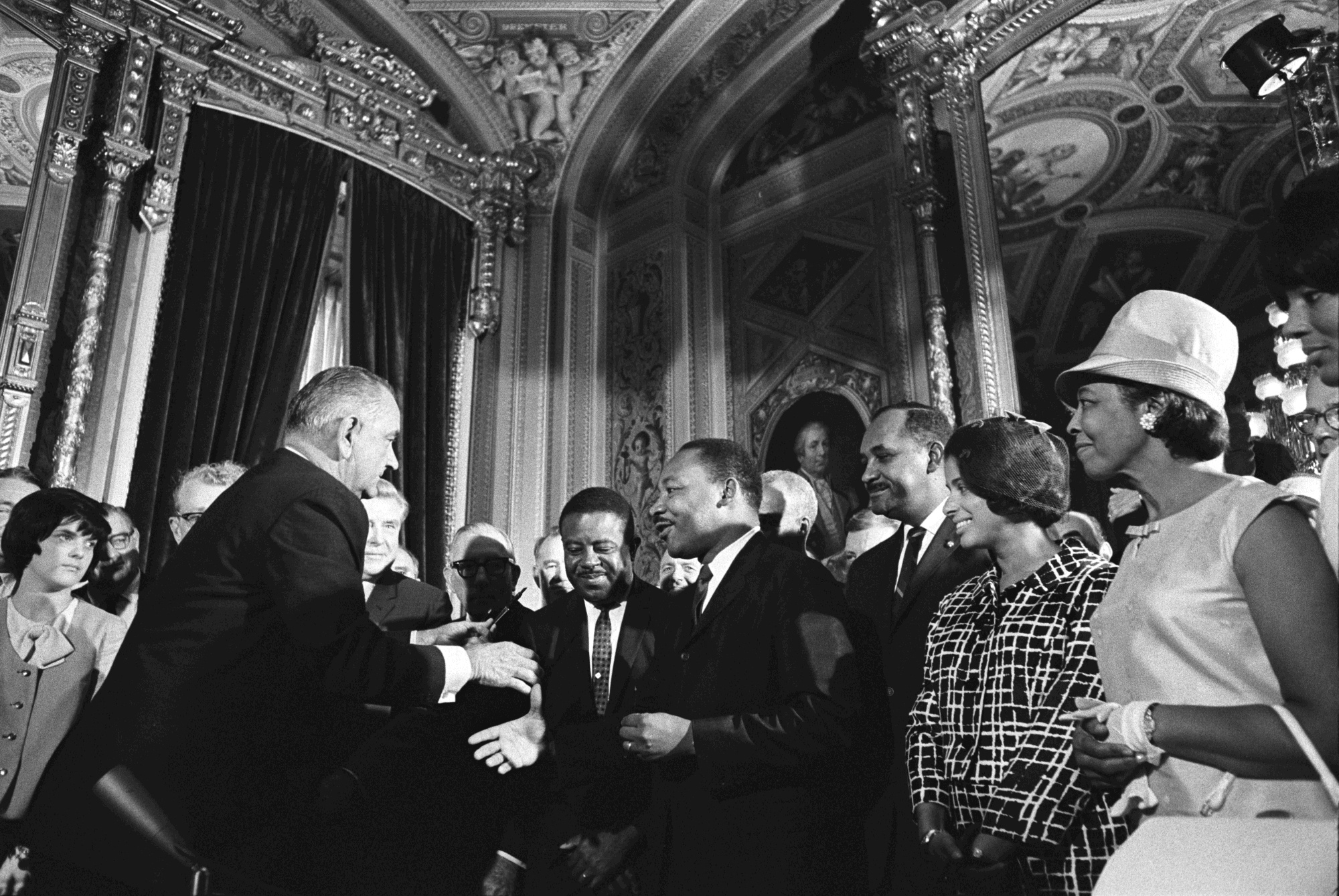
President Lyndon B. Johnson and Martin Luther King, Jr., during the signing of the Voting Rights Act on August 6, 1965. (LBJ Library photo by Yoichi Okamoto)
A Very Brief Voting Rights Act History
The history leading up to the passage of the Voting Rights Act (VRA) and the subsequent life of the VRA have been shaped by a long history of Supreme Court jurisprudence. In 1870, the Fifteenth Amendment was ratified, prohibiting the denial of the right to vote based on race. Despite this constitutional addition, Jim Crow Laws and other oppressive acts followed, leading to decades of civil rights demonstrations. One of the first cases regarding racial discrimination, Plessy v. Ferguson, limited federal authority regarding racial desegregation, claiming state segregation laws did not violate the Equal Protection Clause in the Fourteenth Amendment. Later, Smith v. Allwright invalidated the white primary in Texas and was a landmark decision in moving towards voting equality. However, there was still widespread segregation and oppression. The Bloody Sunday attack by state troopers against demonstrators in Selma, Alabama, in March 1965 was a major factor spurring Congress to pass and President Lyndon B. Johnson to sign the VRA.
Since its inception, numerous cases have upheld, amended, and interpreted particular provisions in the VRA. For instance, South Carolina v. Katzenbach held that the Fifteenth Amendment is a legitimate rationale for upholding the VRA. In 1980, the Supreme Court case City of Mobile v. Bolden determined that the Fifteenth Amendment protects only against intentional denials to vote based on race and thus a violation would necessitate constitutional remedies. In turn, with Thornburg v. Gingles, the Court formulated judicial review standards for the VRA and “vote-dilution” claims in redistricting maps after determining a district in North Carolina was not permissible under the VRA. In Bush v. Vera, another significant case regarding redistricting, the court held that districts based on race were not permitted and were evidence of gerrymandering.
In addition to a plethora of Supreme Court cases, the VRA was amended in 1970, 1975, 1982, 1992, and 2006. A key amendment to the Voting Rights Act was Section 5, which required states to receive preclearance from either the Attorney General or the District Court for the District of Columbia before altering their voting rules or changing their maps when they had a prior history of racial voter discrimination. Later, the coverage formula used to determine which jurisdictions were subject to Section 5’s preclearance requirement was invalidated in Shelby County v. Holder. Shelby County scrapped Section 5’s coverage formula of the VRA, in effect ending the preclearance requirement for jurisdictions with previous instances of discrimination. In 2016, Rucho v. Common Cause held that partisan gerrymandering claims are nonjusticiable. Rucho has allowed for both parties to have more control over drawing district lines.
Louisiana v. Callais
In 2022, Robinson v. Landry, formerly Robinson v. Ardoin, resulted in a federal court requiring Louisiana to draw a second majority-black district because of the court’s order claiming that the state likely violated Section 2 of the VRA. The map was created, which instituted two majority-black districts. The new map was then challenged by white Louisiana residents claiming it violated the Fourteenth Amendment’s Equal Protection Clause. This led to the current case, Louisiana v. Callais. A three-judge district court first ruled in Callais that the new map created as a result of the ruling in Robinson v. Landry did violate the Fourteenth Amendment’s Equal Protection Clause because “race predominated”. The District Court’s ruling was directly appealed to the Supreme Court, where the Court is now considering whether Louisiana’s creation of a second majority-Black congressional district constitutes an unconstitutional racial gerrymandering, even when drawn in response to a federal court finding that the state’s prior single majority-Black district likely violated Section 2 of the Voting Rights Act.
Louisiana v. Callais held oral arguments in front of the Supreme Court in March 2025, but it is in the process of rehearing due to a modification in the legal question presented. At the initial oral arguments, Louisiana defended the map with two majority-minority districts while Callais argued the map constituted a racial gerrymander. However, in oral arguments at the rehearing, Louisiana is no longer defending the map under the premise that compliance with Section 2 could actually be a constitutional violation. Callais, alongside Louisiana, argued the map is unconstitutional, basing their arguments on some precedents such as Miller v. Johnson. They say that race can be used in some instances, but the remedial map is unconstitutional because the court did not place specific durational limits on how long and to what extent race could be used when districting. Therefore, they argue that race may have been used beyond what Equal Protection calls for.
The Robinson plaintiffs are the individuals who challenged the original map and are arguing that the new map is constitutional. They have stated this claim since the beginning, prevailing in the initial case (Robinson v. Landry), forcing the state of Louisiana to create the map with a second majority-minority district in question presently. Robinson argues that the remedial map better represents black voters, is necessary given the previous court order to draw the map, and, because of the court order, does not infringe on Equal Protection guarantees. Robinson claims gerrymandering is a key issue here, as unequal representation would confine black voters into uneven districts and deprive them of representation, thus failing to abide by the VRA. According to them, these consequences would diminish racial minorities’ voting rights.
In the rehearing of oral arguments, Janai Nelson, arguing for Robinson, pointed to racially polarized voting creating a barrier to electing black candidates in LA elections. Nelson declared that the VRA is the only remaining tool to erase this barrier, as the court has previously ruled political gerrymandering is constitutional. While Ms. Nelson discussed the difference between partisan and racial voting, she articulated her position that the above premise holds regardless of which type of voting occurs. The idea of motivational versus general awareness of race was distinguished, with the state claiming that the general awareness of race falls under compelling interest. Nelson stated that, dating back to Shaw v. Reno, “there’s always an awareness of race” in redistricting.
What’s at Stake
The court’s decision in this case will determine if court-ordered redistricting to comply with Section 2 of the VRA is classified as a compelling interest under the Equal Protection Clause or whether this compliance actually violates the Fourteenth Amendment.
If the Supreme Court holds that the redrawing of district lines to comply with the court order does not violate the VRA, it would reaffirm that under the Fourteenth Amendment’s Equal Protection Clause, court-ordered redistricting to comply with the VRA satisfies strict scrutiny as a compelling interest. This would be consistent with the precedent set in recent cases, such as Allen v. Milligan in June 2023, where the Court held that VRA-compliant redistricting satisfies the compelling interest test.
If the Supreme Court holds that it is not a compelling interest, many scholars argue it would put the Voting Rights Act, particularly Section 2, in jeopardy. They note minority districts would be especially disrupted, and district lines would likely continue to be redrawn in a gerrymandered fashion, further diminishing political representation for various communities.
Given comments made during the October 15 rehearing of oral arguments, some reporters have suggested certain Justices would be inclined to disregard how much Section 2 of the VRA applies in this context, when it comes to ruling on Callais. Thus, allowing for the redistricting to ensue without being forced to agree on discarding the VRA entirely. Alternatively, it could ignore race in voting districts altogether by holding Section 2 to be unconstitutional because of its race considerations. By scrapping Section 2, the premise on which racial gerrymandering is prevented would be at risk. This would leave reliance on state provisions to enact any laws to promote racial equality in voting systems. In this scenario, states would have nothing binding them to fair districting politically or racially.
The Court’s Decision
A decision in Louisiana v. Callais is expected in June or July of 2026. Louisiana’s Secretary of State, Nancy Landry, has urged the courts to issue a ruling quickly, as Louisiana has an upcoming primary election in April.
