
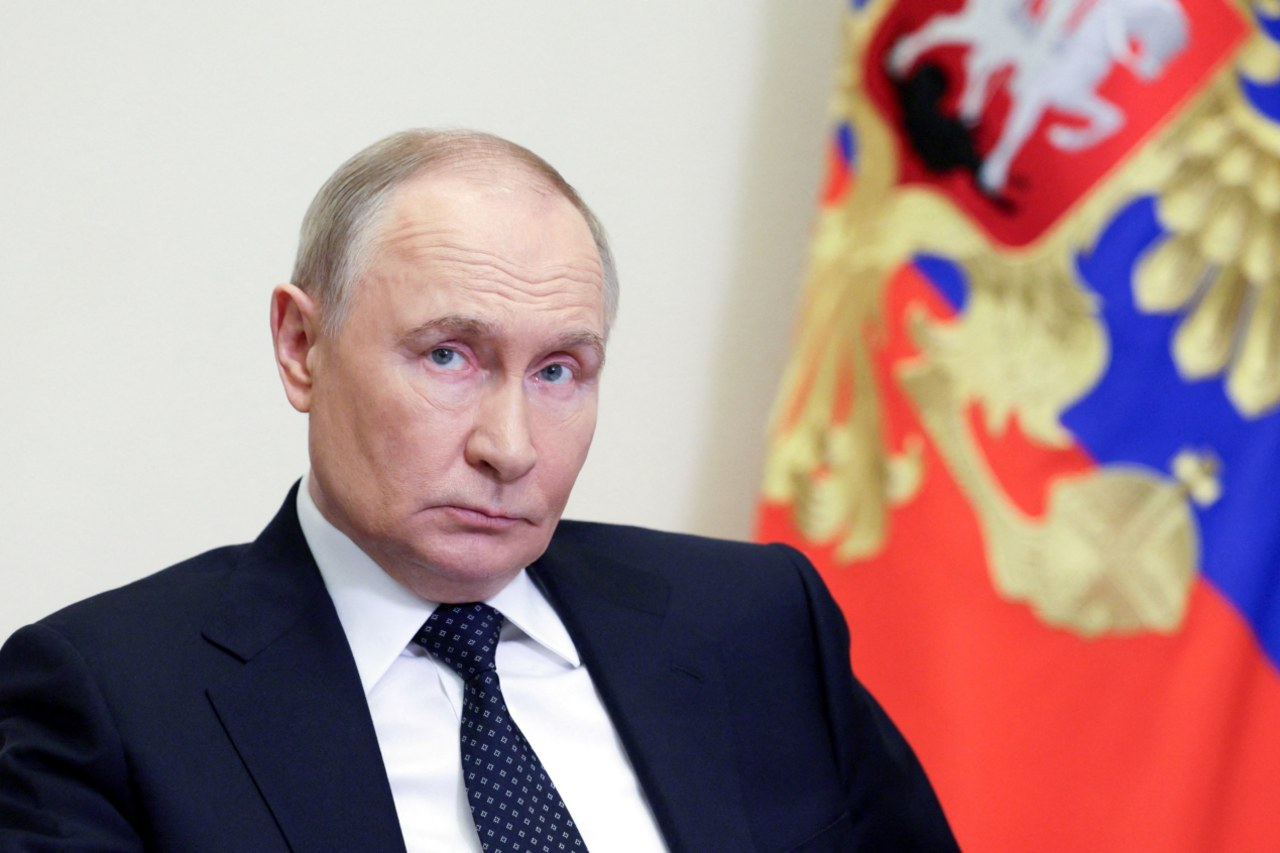
Russian President Vladimir Putin attends a government meeting in Moscow, Russia. (Gavriil Grigorov/Sputnik/Reuters)
As the Russo-Ukrainian War concludes its fourth year, the Armed Forces of the Russian Federation have surpassed the grim milestone of 1.2 million casualties, of which an estimated 300,000 are fatalities, according to Western intelligence reports. Russian advancement in key areas has slowed to an average of 15 to 70 meters per day, marking a shift from the invasion’s opening blitzkrieg to a war of attrition. However, despite mounting human, financial, and political costs, Moscow remains committed to its war effort.
The Launch of the “Special Military Operation”
Early in the morning of February 24, 2022, President Vladimir Putin addressed his country and the world in a televised speech. He declared that Russia was launching what he called a “special military operation,” claiming Russian forces were there to “liberate” a part of Eastern Ukraine called the Donbas region. This region has a significant Russian-speaking population who, according to Putin, were being oppressed by the Ukrainian government. Moscow has used this narrative to justify its longtime support for separatist movements in the region. In Putin’s own words: “The purpose of this operation is to protect people who, for eight years now, have been facing humiliation and genocide perpetrated by the Kyiv regime. To this end, we will seek to demilitarise and denazify Ukraine.” In the same speech, he also blamed the expansion of the North Atlantic Treaty Organization (NATO), a defensive Western military alliance, arguing its influence in Ukraine posed an existential threat to Russia. He asserted that Ukraine was run by “far-right nationalists” and “neo-Nazis” supported by NATO, and that the “showdown between Russia and these forces cannot be avoided,” framing military action in Ukraine as an act of “self-defense.” Moments after the speech concluded, air raid sirens sounded across the Ukrainian capital, Kyiv. Russian missiles began to strike shortly after, marking the beginning of the full-scale invasion.
Russian “Reunification”
In July 2021, seven months before he would order troops into Ukraine, Putin authored an essay titled “On the Historical Unity of Russians and Ukrainians” in which he argues that Russians and Ukrainians are “one people.” In support of this claim, he cites “spiritual, human, and civilizational ties formed for centuries.” He lists examples dating as far back as the ninth century, when the ancestors of modern Russians, Ukrainians, and Belarusians together formed the state of Ancient Kievan Rus.
More recently, these groups were united under the Union of Soviet Socialist Republics (USSR). In 1991, the USSR collapsed, leaving in its place several smaller states, including Russia and Ukraine. Putin has repeatedly lamented the fall of the Soviet Union and the resulting decline in Russian power. He says the breakup of the USSR was the “disintegration of historical Russia,” cutting millions of Russians off from each other. He goes on to write that the modern political entity of Ukraine is an “artificial” creation of past Soviet administrators, never meant to be an independent state, and that the people divided by this artificial “wall” should be reunified. Ukraine, according to Putin, has no national or cultural identity apart from Russia.
Putin is not alone in his view of the conflict. Although hard data is difficult to verify given media crackdowns in Russia, polls indicate roughly 70% Russian approval for the “special military operation.” One of these supporters, Yevgenia Gribova, works as a civilian volunteer at a military support center in the Russian city of Belgorod, close to the border with Ukraine. In an interview, she framed the conflict similarly to the President: “For us, this is a civil war between Russians and Russians who have forgotten a bit that they are Russians, that’s all.” This perspective is further reinforced by the influential Russian Orthodox Church. Patriarch Kirill, head of the Church, declared the conflict a “fratricidal” war, and publicly prayed that Ukraine be “liberated” from its leadership quickly, “so that as few brothers as possible kill each other.” The construct that Ukraine is a part of Russia is a core ideological tenet of Russia’s continued invasion, having been repeatedly stated by the President, echoed by state-run media, and reflected in statements by private citizens and the Church.
The Ukrainian Perspective
The reality of Ukrainian identity may paint a different picture than Putin would claim. In remarks for Ukraine’s Day of Statehood in 2022, Ukrainian President Volodymyr Zelenskyy directly addressed Moscow’s assertions: “Every day we fight so that everyone on the planet finally understands: we are not a colony, not an enclave, not a protectorate… not a province, but a free… sovereign, indivisible and independent state.”
The Kyiv International Institute of Sociology, in a 2025 poll, found that around 62% of Ukrainians remain steadfast in the war against Russia, labelling themselves “ready to endure as long as necessary.” Many young men who volunteered to fight even see it as a patriotic duty. In a Reuters interview, Pavlo Broshkov, a young Ukrainian soldier, described enlisting as doing “what every responsible Ukrainian citizen should do.” This sense of patriotism has only increased since the outbreak of the war, creating “a vibrant sense of Ukrainian nationalism,” says Dr. Eliot Cohen of Johns Hopkins School of Advanced International Studies. While exacerbated by the conflict, this trend had taken root long before any military confrontation.
In 2014, in what is now known in Ukraine as the “Revolution of Dignity,” large-scale nationwide protests led to the removal of then-Ukrainian President Viktor Yanukovych after he refused to sign a document that would have strengthened ties between Ukraine and the European Union (EU). In the following election, pro-Western candidates won the Presidency as well as a plurality in Parliament, an electoral outcome the new President, Petro Poroshenko, called a “course toward Europe.” The 2014 “Revolution” is the event that Putin claims started the conflict, characterizing it as a Western-backed coup. This geopolitical pivot toward the West marked the beginning of large-scale Russian interference in the country. Later that year, Russia annexed Ukraine’s Crimean Peninsula in violation of international law and began funding insurgencies in the Donbas region, setting the stage for the full 2022 invasion.
Today, when polled, Ukrainians “overwhelmingly” support closer ties with Europe, including joining the EU and NATO at 75% and 70% popular support, respectively. Regardless of any cultural ties to Russia, the Ukrainian people and their leadership have indicated strong support for a future separate from Moscow.
Spheres of Influence
Putin further argues that, because Russians and Ukrainians are “one people,” Ukraine should fall within Russia’s sphere of influence rather than the West’s, toward which Ukraine has been moving since at least 2014. Speaking at an event in St. Petersburg in 2025, Putin explicitly claimed, “I have said many times that I consider the Russian and Ukrainian people to be one nation. In this sense, all of Ukraine is ours.” One of Putin’s main objectives in Ukraine is to assert Russian influence where he believes it historically belongs, even comparing himself to the expansionist Tsar Peter the Great in this endeavor. In doing so, he would be righting what he has previously called the “greatest geopolitical tragedy” of the twentieth century: the collapse of the Soviet Union and subsequent loss of Russian hegemony.
There is also the Russian security perspective. According to Dr. Robert Berls Jr., a scholar of Russian area studies, “In Moscow’s view, security can be ensured only if Russia maintains a reliable sphere of influence over bordering countries” like Ukraine and Georgia. Influence over nearby states works to create a geopolitical buffer zone between Russia and the NATO forces that Putin decried in his 2022 speech. Berls goes on to say that Russia, both historically and under Putin, views itself as being “surrounded by enemies,” necessitating such a buffer zone. Consistent with the “self-defense” claim in Putin’s speech, Berls explains that “any effort by states within what Russia considers its sphere of influence to strengthen their ties with the West is viewed as a hostile act that requires appropriate countermeasures.”
A glance at modern Russian history shows behavior consistent with this logic. In 2008, Russia invaded Georgia when the former Soviet Republic began pursuing NATO membership and closer ties with Europe, a conflict that bears striking ideological similarities to the current war in Ukraine. In another stark parallel to the Ukraine conflict, Russia justified its incursion into Georgia as a mission to stop the state’s “genocide” and “aggression” against minorities in South Ossetia, mirroring Moscow’s current accusations of Ukrainian genocide in the Donbas region.
As of January 2026, Russian forces reportedly control approximately 90% of the Donbas region and 19% of total Ukrainian territory. Despite these territorial losses, the Ukrainian government in Kyiv remains independent and functional, supported by ongoing military and economic support from NATO and other Western allies. In an assessment, the Center for Strategic and International Studies found that current Russian battlefield progress falls “decisively short” of Moscow’s stated war aims.
Economic Strain
Moscow’s military commitment to “reunification” has reshaped not just regional geopolitics, but the entire Russian economy as the war in Ukraine burns through equipment and capital. Over the last four years, Russia has moved into a “war economy” from which a painless reverse appears increasingly unlikely.
Currently, the largest remaining stimulus to Russian economic activity is military expenditure. Officially reported defense spending accounts for over 40% of the state’s budget (compared to around 24% pre-war), amounting to roughly 8% of Russia’s GDP. However, experts agree there is likely an undisclosed “shadow budget” that brings the total significantly higher. Alexandra Prokopenko, a fellow at the Carnegie Russia Eurasia Center, describes the current Russian economy as “two-speed,” with war-related industry booming while civilian sectors struggle with labor shortages, high inflation, and high borrowing costs. She then warns that any shift away from high military spending will likely trigger a GDP collapse, since the “entire structure of the economy revolves around military orders.” Analyst Ruslan Pukhov agrees, arguing that the nation’s economic growth is now inextricably tied to “an existential crisis like the war in Ukraine.” Without the economic driver of conflict, experts forecast a grim transition for the Russian economy.
Besides fueling the war industry, a large part of the Russian military budget also goes to recruitment and troop salaries. According to reporting in the Wall Street Journal, in an effort to have young men sign up voluntarily for the “special military operation,” Russia has begun offering signing bonuses of up to $20,000. This money, significantly more than the average annual income in some regions, has become critical to many families hurt by recent economic conditions. Researcher Volodymyr Ishchenko assesses that returning soldiers, now accustomed to higher pay and potentially unable to find jobs in the post-war economy, could create a politically dangerous situation for the Russian President. In Ishchenko’s words, “It’s not a good idea for the state to disappoint armed men.”
No Man Rules Alone
Beyond keeping military output high, Russia’s new “two-speed” economy exacerbates existing structural constraints within the Kremlin’s system of governance. The war economy serves to consolidate more power in the group of ultranationalist siloviki (literally “strongmen”) that oversee Russia’s security and defense apparatus, including military procurement. Research by the Washington Institute indicates there is immense pressure on Putin to sustain the war from siloviki hardliners, who often personally gain from the increased military spending. The Kremlin grants these officials, like silovik Denis Manturov, great leeway in approving defense contracts, with little oversight. Manturov currently serves as both an executive at defense conglomerate Rostec, whose revenue hit record highs amid increased military contracts, and as First Deputy Prime Minister in charge of the military industry. Manturov and other top Kremlin officials maintain personal interest in continued military spending. “For [the security services], an end to the war would mean a loss of income, [and] a reduction in political influence,” concludes the New Eurasian Strategies Centre.
Apart from potential financial interests, this group of security elites also tends to harbor strong anti-Western worldviews. Putin’s closest inner circle consists mostly of these siloviki, who have Putin’s ear more than most other officials in the Kremlin. They often push the President to more hawkish positions in his foreign policy, according to Russia expert Mark Galeotti. Close Putin adviser Dimitri Medvedev, for example, characterized Ukraine as a “cancerous growth,” and called for the complete elimination of Ukrainian statehood. In the opening years of the war, another hardline influence was former Security Council Secretary Nikolai Patrushev. Ben Noble, associate professor of Russian politics, explains that “Patrushev is the most hawkish hawk, thinking the West has been out to get Russia for years.” Driven by such a worldview, Patrushev was also likely responsible for encouraging Russia’s invasion of Ukraine in the first place, according to reporting by the Washington Post. While Patrushev has since been moved from the Security Council to an advisory role, anti-Western sentiment and hawkish advice remain a dominant theme of Putin’s powerful inner circle.
While experts consider him a dictator, Putin still needs support from key figures in his government, including the siloviki. Losing support could indicate trouble for the stability of Putin’s rule, as it did in the failed June 2023 mutiny by paramilitary force leader and (former) Putin ally, Yevgeny Prigozhin. Russian domestic policy expert and Stanford Professor Kathryn Stoner notes that Putin relies on “individual loyalties rather than institutionalized, transparent chains of command,” putting regime stability “at the mercy of shifting loyalties” and making it “inherently fragile.” Recognizing the systemic fragility of his position, Putin has repeatedly purged potential challengers, instead surrounding himself only with those who have proven to be fiercely loyal to him. Still, this manner of consolidating power has its limitations. Alina Polyakova, President of the Center for European Policy Analysis, suggests that “Putin is not interested in peace [in Ukraine] because if he settles for something that he can’t sell as a win at home, that will make him look weak… And as soon as he shows weakness, that’s it for him and his rule.”
No End in Sight
The lack of progress in peace talks may be further evidence of the pressure facing Putin. Negotiations continue to refine a peace deal proposed by the U.S., though they have faced repeated disruptions. Talks were thrown into question by a Russian allegation of an assassination attempt on Putin in December, a claim the Central Intelligence Agency later found to be false. In a separate incident, Russia’s unusual use of its nuclear-capable Oreshnik missile near the Polish border led to unease in Europe’s top leadership during negotiations. Western officials have attributed these actions to Moscow stalling meaningful peace talks. In the words of the U.K. Prime Minister Keir Starmer, “Russia pretends to be serious about peace, but their actions never live up to their words.” Similarly, U.S. Vice President JD Vance asserted, “I’m not sure that Vladimir Putin himself has a strategy for how to unwind the war.” Moscow, however, has a different perspective. In a recent meeting, Putin proclaimed that his war aims will be met “unconditionally,” blaming diplomatic issues on the “current political elites” in Europe.
As to the content of the proposed deal, Putin categorically refused core provisions that would have established a demilitarized zone and frozen the frontlines at their current positions. This would have effectively left about a quarter of the contested Donetsk oblast (part of the Donbas region) under Ukrainian control, something Putin made clear was unacceptable. On the Ukrainian side, President Zelenskyy expressed willingness to accept some Russian demands, such as dropping NATO ambitions (contingent on Western security guarantees), but firmly rejected any Ukrainian cession of the Donbas region.
The unmet ideological and strategic need to reassert Russian influence over historically “Russian” areas, an economy dependent on the war effort, and pressure from a hawkish inner circle appear to have combined to create an unfavorable climate for de-escalation in Moscow. They leave Putin a strong basis, as articulated by himself and relevant experts, to prolong the conflict, even in the absence of battlefield success.

Such a great read. Pleasantly surprised with how well this article read— looking forward to reading more from this writer.