
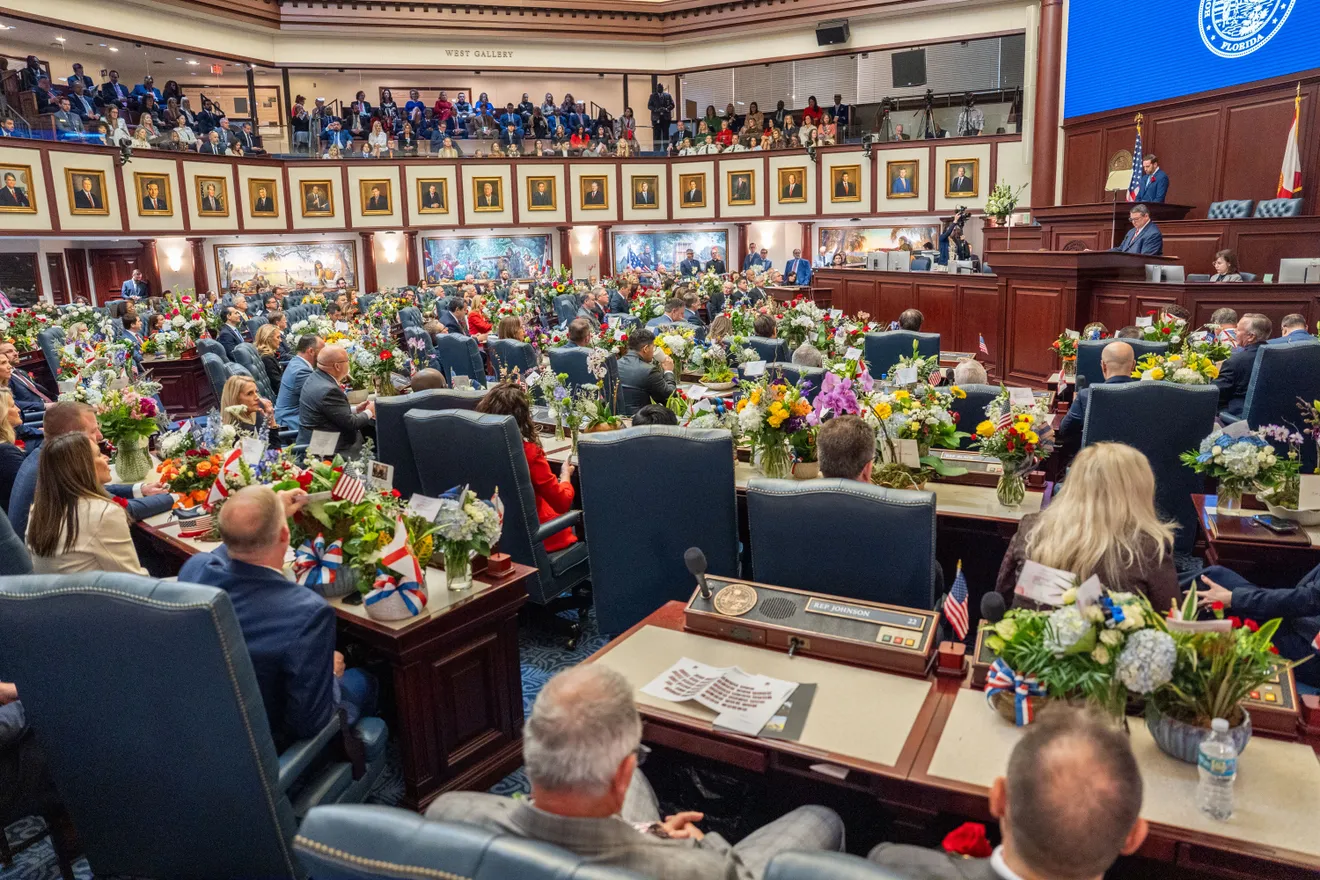
The Florida House of Representatives begins its 2026 session. (Alicia Devine/Tallahassee Democrat)
The 2026 Florida Legislative Session began last Tuesday, January 13th, with a ceremonial joint session of the House and Senate. The session began with the national anthem, played by Florida A&M University’s Marching 100. Following the anthem and an address by Senate President Ben Albitron, Governor Ron DeSantis delivered his final State of the State address to the legislators, where he touted the successes of the Florida GOP’s agenda over the last seven years in the policy issues of the economy, school choice, tax relief, immigration enforcement, elimination of Diversity, Equity, and Inclusion programs in higher education, and Everglades restoration. The Governor encouraged lawmakers this session to focus on the future of Artificial Intelligence, continue the expansion of the Second Amendment, put a measure against property taxes on the ballot, and further eliminate diversity, equity, and inclusion programs in government. The joint session dissolved following the Governor’s address.
Even before the new session began, it was extended. In January, Governor DeSantis issued a proclamation for a special session from April 20 to April 24, solely focused on congressional redistricting. Florida is the latest to join the congressional redistricting battle, joining states like California and North Carolina in the GOP and Democrats’ fight for the U.S. House Majority in the upcoming midterm elections.
Florida’s legislature has a GOP supermajority. Republicans control the state House, Senate, and Governor’s office. Republicans hold 27 seats in the Senate, while the Democrats have 11 seats. 1 seat is held by an independent who recently switched his party affiliation from Democrat to no affiliation. The Senate President and majority leader is Republican Jim Boyd of District 20, which encompasses parts of Hillsborough County and Manatee County. The Senate Minority leader is Democrat Lori Berman of District 26, which encompasses the lower half of Palm Beach County.
In the House, Republicans occupy 84 seats, while Democrats have 33, and there are 3 vacancies. The Speaker of the House and majority leader is Republican Daniel Perez of House District 116, which encompasses part of Miami-Dade County. The House minority leader is Democrat Fentrice Driskell of House District 67, which encompasses part of Hillsborough County.
Other items on Governor DeSantis and the Florida Republican Party’s agenda for this session include DeSantis’s proposed $117.36 Billion “Floridians’ First Budget.” The budget includes a 5% pay increase for law enforcement, $1.71 billion for early childhood education, $1.9 billion for the Florida College System, and $4.9 billion for highway construction. The proposal also recommended a Second Amendment Sales Tax Holiday, which would be an expansion of the tax holiday introduced in 2025.
While the session is young, multiple bills have been filed relating to topics such as immigration, school choice, and the Second Amendment. HB 197, which passed the House on the 15th, would require all private employers to use the state’s E-Verify system to confirm their employees are citizens or have legal authorization to work in the United States. HB 1307 and SB 1380 would prevent undocumented immigrants from obtaining a commercial driver’s license, receiving workman’s compensation, and require commercial driver’s tests to be administered in English only. SB 318, which passed unanimously, would overhaul the school voucher program. The bill has now been sent to the House for a vote.
In this past week of the legislative session, the House passed major gun legislation in the form of HB 133, which would lower the minimum age to purchase a long gun from 21 to 18. The current age restriction of 21 was passed after the 2018 mass shooting at Marjory Stoneman Douglas High School in Parkland, Florida.
