
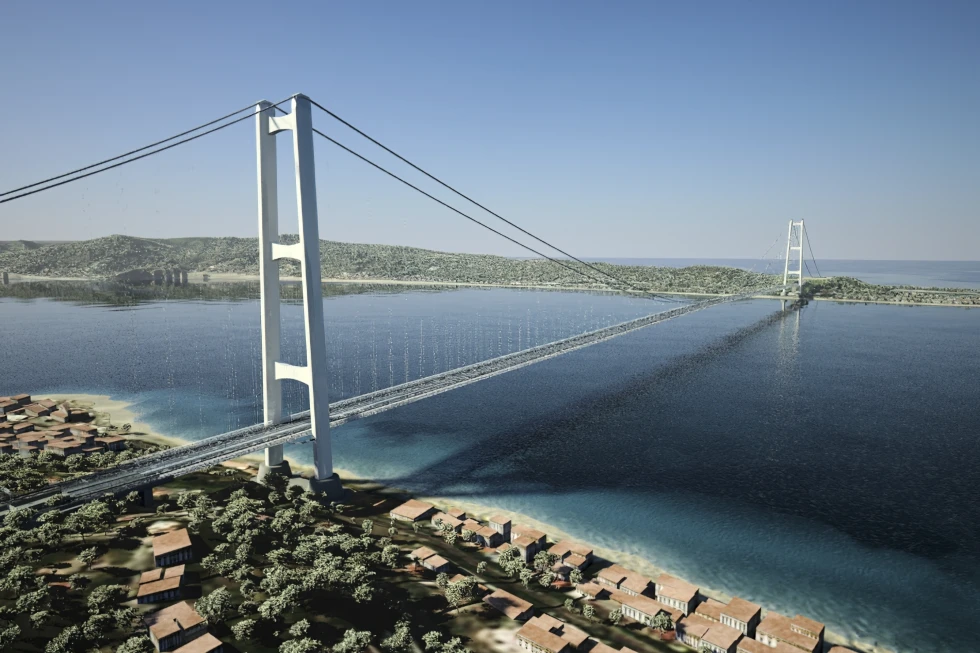
Digital rendering for Messina Strait Bridge. (Webuild – Eurolink Image Library via AP)
Since Roman times, the 3.1-kilometer-wide sea gap between the island of Sicily and mainland Italy, known as the Strait of Messina, has created a cultural and economic barrier that some academics say has prevented economic cohesion of the Italian people. The current Prime Minister, Giorgia Meloni, has announced plans to build a world-record-setting suspension bridge that would connect the island to mainland Europe. Meloni has endorsed the engineering endeavor since 2022, and has described it as a “strategic project for the development of the entire nation.” The project has taken many turns, addressing seismic activity, funding sources, permit approval, and public opinion.
Funding
During NATO’s latest Summit in The Hague in June of 2025, new spending plans were enacted. Member nations are urged to reach an investment in defense worth 5% of their annual GDP by 2035. This would require a “quantum leap” in defensive investment over the next 10 years, said NATO Secretary General Mark Rutte. Meloni has planned to include the Strait of Messina Bridge as part of Italy’s 5% goal, but controversy arose over whether the project is worthy of NATO funding or serves more civilian and local benefits.
On September 2, the American Ambassador to NATO, Matthew Whitaker, stated that the bridge has “no military strategic value.” He pushed back against classifying projects like the Strait of Messina Bridge as defense or NATO-eligible spending if they lack clear military necessity. Before this interview release, the Italian Prime Minister had repeatedly spoken about it being a dual project, but has since stepped back, claiming that it would be entirely state-funded on September 4.
Over the past eight months, support from both the Economic and Financial Plan and the Environmental Impact Assessment has enabled the approval of the bridges’ final blueprint. A preliminary report from the Ministry of Infrastructure and Transport has stated that the national budget has been prepared for the initiative since 2023.
However, CIPESS—the committee that signs off on Italy’s large public investment projects under Italy’s administrative law- only becomes usable money after two formalities: the first of which is obtaining the Court of Auditors’ preventive legality control and publication in the Official Gazette. On October 29, 2025, the Court of Auditors announced that it would not bring the CIPESS Resolution No. 41/2025 to the registration stage, which paused its legal effect while the Court gave itself 30 days to articulate its reasoning. The prime minister described the denial as an “intolerable intrusion” on the long-developing plan, which is marketed as a service for the public good, and would be beneficial to the less economically advanced regions of southern Italy.
On November 27, 2025, the Court of Auditors publicly detailed the motivations for their official rejection of the government’s authorization of the bridge project:
1) Violation of Directive 92/43/EC on the conservation of natural habitat, by lacking investigation and reasoning to validate the Imperative Reasons of Overriding Public Interest (IROPI) as detailed by the overheading EU.
2) Negotiated contract procedures without prior publication, a violation of Articles 32 and 72 of Directive 2014/24/EU, which only allows such behavior when a contract is considered highly urgent.
3) The final construction would result in a tolled highway, which lacked the required official opinion from Italy’s Transport Regulatory Authority (ART) on the toll action plan.
Concern has also focused on the high seismic activity in the Messina Strait region, as well as the opportunity for the mafia to facilitate fraud during its construction, particularly Cosa Nostra and ’Ndrangheta, who have infiltrated public works in the past. The project will depend on complex contracting chains, including subcontracted firms for specific phases. The construction’s logistic structure has raised concerns from Italy’s Anti-Corruption Authority about oversight and potential infiltration by organized crime groups.
Several identified institutional and expert actors have raised substantive objections to the CIPESS proposal for the Messina Strait Bridge, noting the following weaknesses:
Geological studies conducted by Eurolink supporting the project were partially based on documentation produced in 1983 and 1994. When the project was reactivated, these studies were not comprehensively updated to incorporate revised seismic models. Given that the Strait of Messina lies in a high seismic-risk zone, reliance on outdated data limits the accuracy of the project’s environmental impact assessment, as described by the European EIA Directive. The lack of full alignment with current EU standards was identified by the European Parliament as a central issue for long-term environmental monitoring and mitigation planning of the Messina Strait Bridge project.
From an economic perspective, the cost–benefit analysis used in the submission relied on transport-demand forecasts and multiplier effects derived from pre-2013 data, creating an imbalanced cost-to-benefit ratio, as found by infrastructure and transport journalist Francesco Ramella. The review, completed by Stefano Lenzi, Head of the Institutional Relations Office of WWF Italy, also highlighted insufficient transparency regarding funding sources and disbursement schedules.
Transparency International Italia identified patterns that have a lack of documentation on subcontractor allocation. Webuild S.p.A., the lead contractor responsible for designing and building the bridge, uses extensive subcontracting for such projects of scale. Considering the project’s multi-tier structure, this arrangement dramatically reduces accountability tracing according to the National Anti-Corruption Authority. However, proponents responded with Italy’s White List law, enacted in 2013, which screens applicants to exclude possible crime organizations and blocks subcontracted hiring for workers not fully vetted.
Political Tension and Public Opinion
A significant economic divide still exists between Northern and Southern regions of Italy. Together, southern Italy and Sicily have only roughly half the average GDP per capita compared to Northern provinces.
This disparity upsets some citizens near the construction zone. In particular, some believe the €13.5 billion price tag for the bridge could be better spent elsewhere, as a Messina resident explained, saying, “We lack reliable trains, hospitals, and jobs.” Gino Sturniolo, another resident and activist, said, “The money would be better spent on essential needs like water supply.” Across the strait in Reggio Calabria, unemployment is nearly 16%, 8.3 points higher than the national average in the same year and an increase of 1.3 points from the previous year. Residents who continue to experience decaying roads and underfunded schools have expressed their dissatisfaction.
However, some residents, such as Daniela Micali, a lawyer from the area, believe the bridge will “bring in new life,” and is “what Sicily needs to catch up.” Transport Minister Matteo Salvini estimated the project could generate 120,000 jobs annually, providing southern Italy with the uplift needed to cure the ongoing economic divide. A poll conducted by Lab 21 and cited by Alessandro Morelli, Undersecretary to the Presidency of the Council of Ministers, found that over 62% of the one thousand respondents found the bridge to be an economic opportunity, with the 62% understanding the potential risks others have pointed to of seismic activity and opportunity for organized crime.
Numerous protests against the bridge were carried out in early-mid November 2025, with over eighty organizations, including the Italian General Confederation of Labour (CGIL), some members of the Democratic Party, the Five Star Movement, and the Green Alliance.
In the wake of these events, Prime Minister Giorgia Meloni has continued to frame the bridge as a national priority. Touting it as proof of Italy’s capacity to deliver long-promised modernization. Yet, dissent has surfaced among bridge supporters; Matteo Salvini, whose ministry oversees the project, faced criticism from Anthony Barbagallo, Democratic Party leader, over what he described as unrealistic timelines and politicized urgency. The latest construction timeline, which pushes the start date to 2026 and completion to 2032, has been interpreted by opposing parties as evidence of administrative incohesion. The Democratic Party and Five Star Movement have both accused the government of using the bridge as “propaganda” rather than as infrastructure that truly maximizes benefits for the Southern Italian connection.
With Italy’s €13.5 billion commitment at stake, the extended timeline and public approval swinging well below 50%, the Messina project may continue to be highlighted in Italian politics.
