
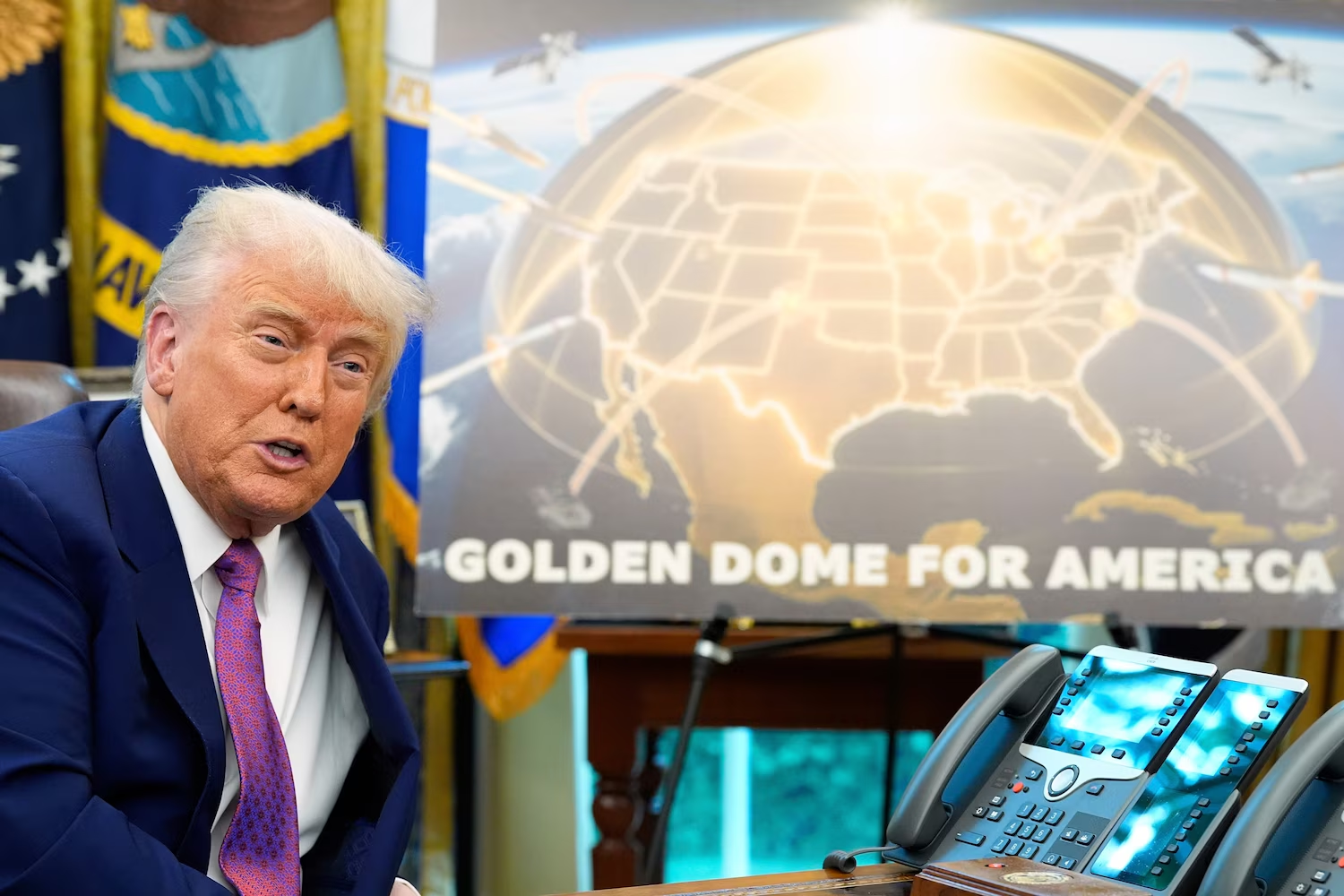
President Donald Trump in the Oval Office on May 20, 2025. (Alex Brandon/AP)
During a June 2024 campaign rally in Racine, Wisconsin, Donald Trump pledged to supporters that under a second term, the U.S. would “build a great Iron Dome” over the country, which he described as a “state-of-the-art missile defense shield” built “entirely” in America. He also noted that former President Ronald Reagan had attempted a similar project while in office, but that it fell short due to technological constraints. This message was echoed in the 2024 GOP platform published one month later.
On January 27, 2025, a week after his inauguration, Trump issued Executive Order (EO) 14186 titled “The Iron Dome for America,” directing the deployment and maintenance of such a missile defense shield capable of deterring foreign attacks on the homeland, defending citizens and critical infrastructure, and guaranteeing the U.S. has a second-strike capability. It also set a new stance on U.S. homeland missile defense policy to defend against “any foreign aerial attack” from “peer, near-peer, and rogue adversaries,” shifting away from the emphasis on defense against intercontinental ballistic missiles (ICBMs) and development of capabilities to “defend against strikes from rogue states” (i.e. North Korea and Iran) that existed under the past three presidential administrations. To achieve the goals sought by this initiative, Secretary of Defense Pete Hegseth described an effort to build upon past investments, incorporate next-generation technology, and integrate existing and future missile defense systems to provide a “layered defense” of the homeland.
The Department of Defense (DOD) has since renamed the program as “Golden Dome for America” to differentiate it from Israel’s missile defense system, “Iron Dome.” In the past, Trump has referenced Israel’s Iron Dome while discussing his plans for the Golden Dome in the U.S. This includes the Republican National Convention, when he asked, “Israel has an Iron Dome—Why should other countries have this and we don’t?” and his State of the Union Address, where he asked a similar question.
Some are skeptical of this comparison, including Jeffery Lewis, a professor at the Middlebury Institute of International Studies at Monterey who specializes in missile defense. Lewis described the comparison of the proposed Golden Dome to Israel’s Iron Dome as “the difference between a kayak and a battleship.” Aside from the geographical size difference between the U.S. and Israel, Iron Dome is not capable of intercepting the ICBMs possessed by Russia and China, which are “completely different” from what Lewis called the “slow-moving, short-range projectiles” Iron Dome is designed to intercept.
The Strategic Defense Initiative as a Comparison
The reference to Ronald Reagan’s endeavor to “build an effective defense against nuclear attacks” in the EO alludes to the Strategic Defense Initiative (SDI). Reagan announced this program during a televised address in March of 1983, which sought to “develop a space-based missile defense program that could protect the country from a large-scale nuclear attack.” The American people, plagued by the uncertainty of the Cold War and fears of a nuclear attack that existed since the end of World War II, were supportive of this approach. Theoretically, such a system could have ended the Cold War because something capable of destroying the Soviets’ ability to attack first would “undermine the USSR’s ability to pose a threat to the United States at all.”
Although the initiative was logically appealing, numerous obstacles prevented it from coming to fruition. Fundamentally, SDI lacked both a clear design and a role for the newly created Strategic Defense Initiative Organization (SDIO), with experts considering possibilities ranging from space and ground-based lasers to different missiles and tracking systems. Much of the science needed to create such technology did not exist, raising skepticism in the scientific community regarding its feasibility and contributing to the adoption of “Star Wars” as its nickname. There were also concerns that even if possible, SDI would threaten the “firmly instituted policy” of mutually assured destruction (MAD) that kept the two superpowers at bay, and that it could lead to a new arms race. Others feared it would violate the Anti-Ballistic Missile (ABM) Treaty signed by both countries in 1972, which was intended to “constrain the Parties from deploying territory-wide defenses against strategic ballistic missiles.” Regan’s administration asserted SDI adhered to the treaty because it sought the “development” of such capabilities rather than deployment.
After receiving “around $30 billion in funding during the 1980s,” Reagan’s SDI saw a decrease in funding after he left the White House and a loss of purpose with the collapse of the Soviet Union in 1991. While his mission remained unfinished, an article from the National Museum of Nuclear Science and History suggests SDI was “most effective” as a tool to pressure the Soviet Union to fund its own defense system as it struggled economically, and describes SDI as being a “key negotiating point” in arms control negotiations between the two countries. From the differing perspective of Mallory Stewart, who served under the Biden Administration as the Assistant Secretary Bureau of Arms Control, Deterrence, and Stability, “a key legacy” of SDI is that it “did not aim to achieve a unilateral strategic advantage,” but rather that it was pursued with the hope it would “enhance strategic stability and reduce the risk of nuclear war.”
Interestingly, the Golden Dome initiative is already facing similar criticisms to those of SDI. In a commentary from March 2025, Brookings defense specialist Michael E. O’Hanlon stated that while technology today is “much better than before,” the size and scale of the proposed architecture is “daunting” and “could kindle an arms race” with Russia and China. After noting the high price of attempting to put weapons in space and suggesting quicker alternatives, such as repositioning current interceptors, O’Hanlon concluded that the impact of Golden Dome may be limited to important dialogue about the future of American territorial defense.
With concerns regarding the Golden Dome’s potential impact on an arms race and strategic stability, the Center for Strategic and International Studies (CSIS) conducted an assessment on reactions to the initiative from the perspective of Chinese and Russian defense analysts. While skeptical of the scope and feasibility of the project, the analysts contended that the initiative is an aggressive shift from past policy and “emblematic of the United States’ continued destabilising pursuit of a strategic advantage, expressing concerns over it weakening the strength of nuclear deterrents. CSIS suggested that the responses from Russia and China will likely involve the intensification of existing programs and efforts “rather than a horizontal expansion into completely new capabilities.”
Current U.S. Systems
The three physical components of the current U.S. missile defense system include sensors/radars, interceptors, and command and control infrastructure. Senors and radars, which can be ground-based, sea-based, or space-based, are responsible for detecting, monitoring, and tracking incoming threats. The global network of command and control centers then routes the necessary information to the interceptors, which include the Ground-Based Midcourse Defense (GMD) system, Aegis Ballistic Missile Defense (BMD), Terminal High Altitude Area Defense (THAAD), and Patriot Advanced Capability-3 (PAC-3). Aegis BMD, THAAD, and PAC-3 are considered theater (regional) systems deployed in Europe, the Middle East, and Asia. In contrast, the GMD system is specifically designed to protect the U.S homeland from ICBMs.
GMD is composed of ground-based interceptors (GBIs), which use a process known as “hit-to-kill,” in which a multistage booster delivers an exoatmospheric kill vehicle (EKV) to space, where it separates from the booster and collides with the enemy missile while in the midcourse (middle) stage of its trajectory. Until this year, the system consisted of 40 silos armed with GBIs at Fort Greely in Alaska and four at Vandenberg Air Force Base in California. There are now 60 silos at Fort Greely following the construction of 20 additional silos completed by Boeing in March 2025, a project started under Trump’s first term and funded through Joe Biden’s presidency. Congress has also directed The Missile Defense Agency (MDA) to build a third interceptor site on the East Coast of the U.S. by 2031 via the 2025 National Defense Authorization Act (NDAA).
Some of the shortcomings of the current GMD system were highlighted in the 2022 Missile Defense Review (MDR) published by the DOD, which explained it “is neither intended for, nor capable of, defeating the large and sophisticated ICBM, air-, or sea-launched ballistic missile threats from Russia and the People’s Republic of China (PRC).” Given such findings, the “mixed flight test record” of GBIs, and the need to counter the growing threat posed by the improvement of ballistic missiles and their capabilities, Next Generation Interceptors (NGIs) are being developed and will be integrated into existing GMD infrastructure. A document discussing the NGI Program from the Government Accountability Office (GAO) explains that NGIs will have new booster designs and will have multiple kill vehicles per interceptor–rather than the one used by GBIs–to enable defense against “a greater volume of increasingly complex adversary missile threats.” In 2021, DOD selected Lockheed Martin and Northrop Grumman in an effort to increase competition in the development of the technology. By 2024, MDA announced it would stick with Lockheed to lead the effort, which is now nearing completion on an NGI production facility in Courtland, Alabama.
Aegis BMD also plays an important role in missile defense as a predominantly sea-based system equipped by around 50 U.S. Navy ships. Additionally, there are two land-based Aegis Ashore sites in Europe. The interceptor missiles used by Aegis BMD include the Standard Missile-3 (SM-3), which is designed to intercept ballistic missiles in the midcourse phase, and the SM-6, designed for terminal (final) phase intercept. Aegis BMD may also play a role in hypersonic missile defense in the future, as the MDA and the U.S. Navy are actively “developing a capability for the SM-6 to intercept hypersonic missiles.”
Hypersonic weapons are fast, maneuverable, and hard to detect, and have become an area of focus for U.S. defense as they are being developed by Russia and China. As a result, MDA is “developing a layered defense capability against regional hypersonic threats and has initiated a development program for Glide Phase Intercept (GPI).” Similarly, the U.S. Navy is looking to arm vessels with PAC-3 Missile Segment Enhancement (MSE) interceptors in response to anticipated advancements in Chinese missile technology, including hypersonics. According to an article by the Congressional Research Service (CRS), PAC-3 MSE has been used recently to intercept ballistic threats and aircraft in Ukraine and the Middle East, making it “an attractive addition to Navy magazines.”
THAAD can defend against short, medium, and limited intermediate-range ballistic missile threats “inside or outside the atmosphere during their final (terminal) phase of flight.” The Army has eight THAAD batteries, with five based domestically in Texas. THAAD works with the Army Patriot system, which can utilize the PAC-3 missile to provide an “integrated and overlapping defense” against missiles in the terminal phase.
What is the Golden Dome Offering?
Trump’s vision for the Golden Dome is still arguably best outlined in his EO, as DOD has greatly limited the amount of public information around the program from reaching the public. The order states the architecture should plan to provide defense from “ballistic, hypersonic, advanced cruise missiles, and other next-generation aerial attacks,” calling for the development of space-based hypersonic and ballistic tracking sensors and space-based interceptors “capable of boost-phase intercept.” Current systems are only designed to intercept targets in the midcourse and terminal stages, so such technology would allow for interception while the missile is in its slowest phase. While space-based interceptors (SBIs) themselves do not currently exist, the leader for the Office of Golden Dome for America, General Michael Guetlien, stated that he “firmly believe[s]” the technology to deliver Golden Dome “exists today,” which would include the technology for SBIs.
Beyond the challenges of developing new technologies, Reuters reports that contractors are also having to consider the high development costs expected to be borne by those competing for awards. One top contractor expressed concerns regarding prolonged competition and “the possibility that the next administration will abandon the program.” There are also logistical challenges posed by the size of Earth and the speed at which satellites orbit, meaning the Golden Dome would potentially require putting thousands of interceptors into orbit. This was demonstrated in a report from the American Physical Society, which estimated that a “constellation of about 16,000 interceptors would be needed to counter a rapid salvo of ten solid-propellant ICMBs like the Hwasong-18,” a North Korean missile. Nonetheless, the U.S. Space Force has already awarded a set of contracts for the Space-Based Interceptor (SBI) prototype.
The EO also called for the “development and acceleration of the deployment of the Hypersonic and Ballistic Tracking Space Sensor layer” (HBTSS) and the “custody layer of the Proliferated Warfighter Space Architecture” (PWSA). As explained by the Missile Defense Advocacy Alliance (MDAA), HBTSS was a product of research into space-based sensor systems as part of the 2019 MDR, and it intends to detect and track hypersonic missiles to enable defense systems to intercept threat missiles. The custody layer of PWSA, on the other hand, has been defined by the Space Development Agency (SDA) as a “hybrid constellation” consisting of government and commercial satellites to provide “near-real time ground target tracking and targeting information.” PWSA encompasses several additional layers related to positioning, navigation, deep space detection, and satellite operations support, and is designed to provide global coverage once fully fielded.
According to the Center for Arms Control and Non-Proliferation, other components that are under discussion include directed energy weapons like high-powered lasers and the integration of artificial intelligence (AI) for “faster sensor-to-shooter linkages.” Breaking Defense reports that the U.S. Army has been developing directed energy weapons in recent years and is “eyeing potential applications for a broader missile defense effort. Keith Krapels, head of the Army Space and Missile Defense Command’s Technical Center, described the technology as “pretty mature” and just needing to be pulled “across the finish line.” As it relates to possible AI integration, Emil Michael, Under Secretary of Defense for Research and Engineering, explained that AI could be used in Golden Dome similar to the way it can be used to “help the warfighter discern what’s happening in an environment” to enhance decision making and effectiveness.
More details on the Golden Dome initiative emerged in August 2025 from a U.S. government presentation at a defense contractor event in Huntsville, Alabama. Reuters reported that the presentation depicted a system that would “include four layers–one satellite-based and three on land–with 11 short-range batteries located across the continental U.S., Alaska and Hawaii,” and with a “new large missile field” for NGIs in the Midwest alongside THAAD and Aegis BMD systems. The presentation also highlighted the technological hurdle of “communication latency across the ‘kill chain’ of systems,” which is composed of a variety of systems developed by different defense contractors.
Funding and Steps Toward Implementation
On May 20, 2025, Trump claimed that the Golden Dome would cost $175 billion and should be “fully operational” by the end of his term in 2029. Some experts are skeptical of this timeline, considering the large scope of the project and the fact that SBIs still need to be developed. Trump also announced that Congress would provide a $25 billion “initial deposit” to begin work on the project, which was ultimately delivered through the passage of the One Big Beautiful Bill Act (OBBA), signed into law on July 4, 2025. This included funding for “next-generation missile defense technologies”––including military space-based sensors and improved ground-based missile defense radars—and “layered homeland defense,” which includes the acceleration of hypersonic defense systems.
Some estimates suggest the program may cost much more than $175 billion, according to a report by Todd Harrison of the American Enterprise Institute (AEI) cited in the CRS article regarding the Golden Dome. Harrison estimated that over 20 years, a “limited tactical defense” could cost up to $252 billion in Fiscal Year (FY) 2026 dollars, while a “robust all threat defense” that best fits Trump’s description of the program could cost up to $3.6 trillion. Similarly, Bloomberg estimated a system capable of protecting the U.S. from an “all-out aerial attack” would cost around $1.1 trillion, and noted that a May report from the Congressional Budget Office estimated that a constellation of SBIs alone would cost $161 billion to $542 billion. While the accuracy of these estimates is yet to be determined, CRS highlighted the fact that missile defenses have historically “exceeded initial budget estimates and schedules.”
The potential cost did not deter Congress from supporting the project in the 2026 NDAA, which passed and was signed into law in December 2025. According to the House Armed Services Committee’s (HASC) legislative summary, the NDAA will help build Golden Dome by requiring DOD to submit a plan aligned with the goals outlined in Trump’s EO, authorizing more funding for “air and missile defense development and testing,” and encouraging the growth of space capabilities. The bill also includes reforms to the defense acquisition process, including an accelerated requirements process to “rapidly seek innovative solutions from industry” and expediting the bureaucratic processes that make it difficult to “keep up with emerging threats or deliver innovative technology.” Golden Dome may benefit from such reforms as defense companies work to deliver the technology being sought by the program.
Relatedly, two “contracting vehicles” for the defense system have been established, beginning in March of 2025 with the MDA’s Multiple Authority Announcement (MAA), an acquisition tool targeting “disruptive technologies & rapid capability development from non-traditional sources.” The Scalable Homeland Innovative Enterprise Layered Defense (SHIELD) was announced in July as the second “contracting vehicle,” which, according to Breaking Defense, will span 10 years and allow DOD to “rapidly issue orders under one enterprise flexible arrangement.” MDA announced the “first phase of staggered awards” to 1,014 “qualified offerors” on December 2, a second batch of 1,086 awards on December 18, and an additional 340 on January 15, 2026.
Aside from the legislative success, Reuters reports that setbacks to the project are already expected following the 43-day government shutdown in 2025, which both delayed hiring and the approval and signing of contracts. It is also highlighted that a clear plan for allocating the first $25 billion has yet to be delivered, despite the fact that one was due to Congress in August, 2025. That plan was then expected in December 2025 from Deputy Secretary of Defense Steve Feinberg, but was never delivered. The House and Senate Defense Appropriations Subcommittees have since directed the DOD to provide a comprehensive spending plan for Golden Dome within 60 days after the defense appropriations bill for FY26 is enacted.
Nonetheless, some information regarding the initiative has been shared behind closed doors. On September 15, 2025, Gen. Guetlein briefed Congress on Golden Dome’s “goals and schedule,” and on September 17, briefed the Pentagon on the proposed architecture. As of November 20, 2025, a Pentagon spokesperson told Breaking Defense that “the baseline architecture has been established, and the implementation plan is currently undergoing a review.” Even if the plan gets approved in the near future, DOD intends to “rigorously” avoid sharing details on the program with the public, as it has cited “operational security” concerns in the past.
In the most recent developments on the initiative, Trump has claimed that Greenland would serve an important role in the success of the Golden Dome, citing it during his initial push for the U.S. to take control over the country, which is a territory of Denmark. As explained by John Leicester of the Associated Press (AP), Greenland “could be a useful place” to station interceptors, as the shortest flight paths for ICBMs launched from China or Russia” to the U.S. would “take many of them over the Arctic region,” in which Greenland is located. NBC News reports that Trump now appears to be moving toward a deal with Denmark that would allow the U.S. “to place more troops, bases and military hardware” on the island, something which a Danish official noted would have been “available to Trump from the start.”
