
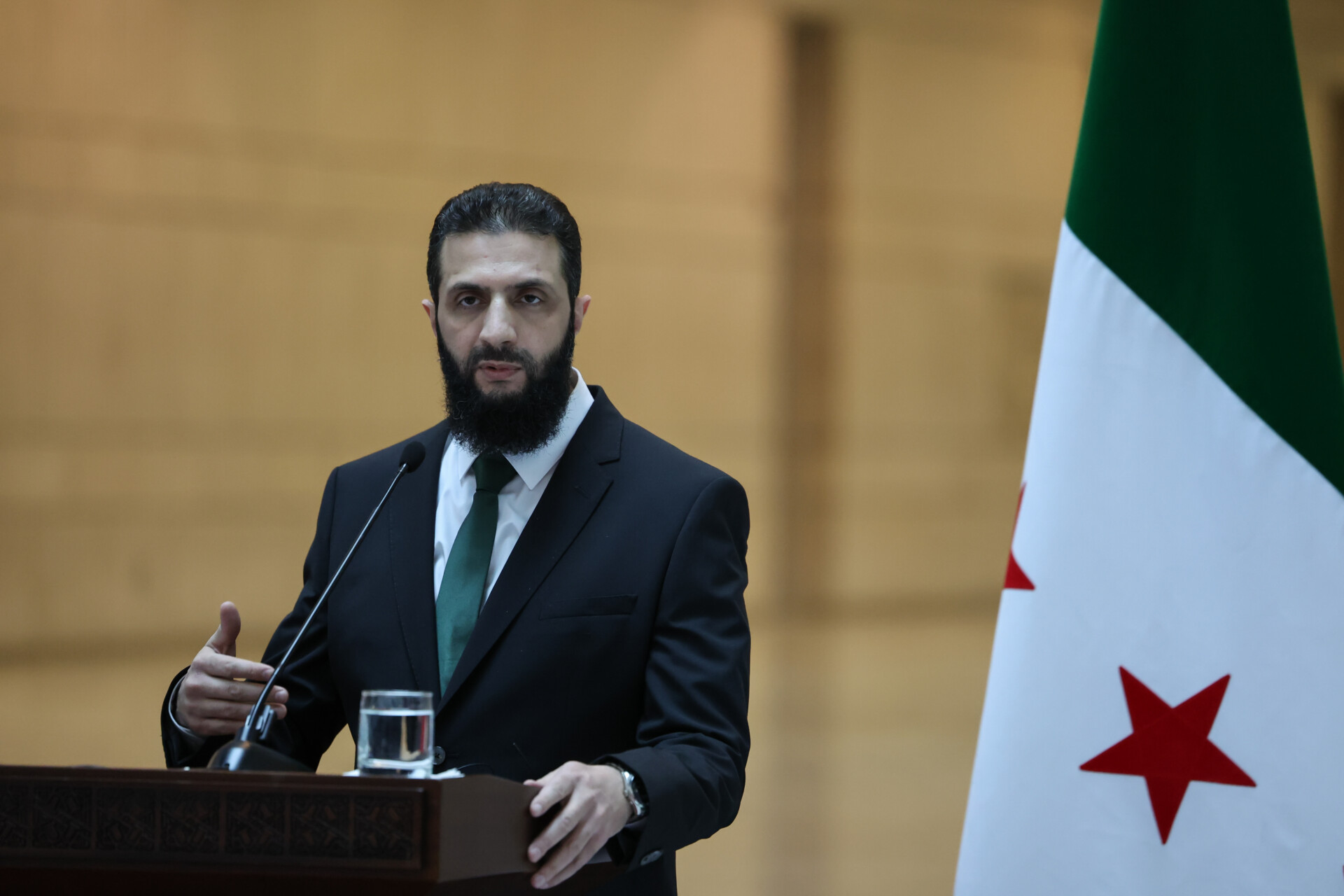
President Ahmad al-Sharaa of Syria, at a press conference in Damascus on Dec 22, 2024. (Arda Kucukkaya/Anadolu)
The Syrian Civil War
Since March of 2011, the country of Syria has been engulfed in a civil war which has led to an estimated 657,000 fatalities and forced 14 million Syrians to leave their homes. The civil war initially began with large protests caused by the arrest and torture of fifteen school children who wrote anti-government graffiti in the city of Daraa. The government they were protesting was led by Bashar al-Assad, the son of Hafez al-Assad, who seized power through a coup in 1971 under the Syrian Ba’ath Party. The party believed in the creation of a single Arab socialist state, opposed imperialism, and drew inspiration from what it considered the positive aspects of Islam. When Bashar al-Assad came into power in 2000, there was hope among many in Syria that he would be different from his father, who was characterized as a cold dictator. Bashar al-Assad, on the other hand, who many saw as being benevolent and caring for the people, released many political prisoners and opened political forums at the beginning of his rule. When the protests began, however, the al-Assad government decided to openly fire at protesters, killing some. This created an outcry from Western nations and Arab states and caused some countries to call for al-Assad to step down. Countries like Turkey, which initially supported al-Assad, began to withdraw their support of the regime. Alternatively, Russia and China both vetoed the UN resolution to condemn the Syrian regime. By the time July 2011 arrived, parts of the military had defected from the Syrian Armed Forces to form opposition rebel groups.
In the early years and throughout the civil war, chemical attacks were utilized in the conflict. One study estimates that more than 300 chemical attacks occurred. The study ascribes 98% of the chemical attacks to have originated from al-Assad forces, or allied forces such as the Russian-sponsored militia, Tiger Forces. By 2015, as the region began to grow increasingly unstable, groups like the Islamic State (IS) started to gain a stronger foothold in the northern and eastern parts of the country, carrying out the other 2% of chemical attacks during the war. The rise of this internationally designated terrorist group caused the United States to lead a coalition of 74 nations to help support Kurdish and Arab militia groups to combat IS in Syria. Within just a few years, the IS went from a strong faction which controlled significant swaths of the country to, by 2019, having negligible influence in Syria.
When it came to the conflict between the rebels and al-Assad forces, a major ceasefire was agreed upon in March of 2020, with the civil war turning into a stalemate. During this time, there was little change to the front lines, various foreign authorities were active in the region, and periodic escalations were not uncommon. This is how the conflict would remain until November 27th, 2024, when a coalition of rebels launched an offensive that initially began with trying to capture cities like Idlib and Aleppo, which they managed to capture within a few days of the start of the offensive. As al-Assad’s forces began to collapse, these rebel forces continued to move southward to the city of Homs, and finally, on December 8th, to the capital city of Damascus to topple the al-Assad government, ending the nearly 14 years of civil war in Syria.
The New Syrian Government
Following the overthrow of the old regime, Ahmad al-Sharaa became the de facto leader of Syria, although he was officially appointed as president in January of 2025. Al-Sharaa was formerly the head of Hayat Tahrir al-Sham (HTS). The group initially was associated with al-Qaeda, but later separated from the terrorist organization over ideological disagreements. The HTS has a more pragmatic approach, focusing exclusively on local issues in Syria and on nationalistic jihad, which contrasts with al-Qaeda, with its more violent and global aims. Since the new transitional government has been established, al-Sharaa has pursued a strategy of rapprochement with Western powers, and countries such as the United States and the United Kingdom have lifted much of their sanctions on Syria. China, on the other hand, has yet to recognize the new Syrian government officially. Beijing is concerned that Uyghur fighters who have been integrated into Syria’s defense forces may begin to turn their attention to Chinese affairs. Nevertheless, al-Sharaa has met with French President Emmanuel Macron, South Korean Foreign Minister Cho Tae-yul, and U.S. Secretary of State Marco Rubio. These visits were intended to establish bilateral relations with the new Syrian government.
On October 5th, 2025, the new government planned to hold its first election. Raja Abdulrahim, a correspondent for the New York Times, explained how the new government would select its members of parliament: not through direct voting, but through local councils and regional bodies. Only certain regions will have a say, with places still not controlled by the Syrian government – such as the north-east Kurdish region – unable to vote in the election. The parliament will reportedly consist of 210 members, with 70 members chosen directly by the president. The next day, the spokesperson of the election committee, Nevvar Najmeh, announced the election results. Najmeh noted how 4% of those elected had disabilities and were wounded during the civil war. He also explained how the election results were not ideal in their representation. Only two seats were won by Christians, and the number of women voted for office was disproportionate to their size in society.
Perspectives on the New Government
Due to the uncertainty surrounding the formation of new governments, many experts have tried to suggest specific policy actions or analyze the likelihood of a successful transition to a democratic system of governance in Syria. Jon B. Alterman, the Zbigniew Brzezinski Chair in Global Security and Geostrategy at the Center for Strategic and International Studies (CSIS), argued in testimony to the U.S. Congress that, “it is much better to support [Ahmad al-Sharaa] modestly, to test him continuously, and to ensure that our allies and partners in the region remain closely tied to our policy.” Alterman lauded the Trump administration for relaxing sanctions on Syria, allowing the new government to focus on its internal issues.
Some participants in the electoral process have expressed how much more democratic the elections feel compared to those held during the former al-Assad government. Lina Daaboul, one of the electoral officials, stated how she did research on all the candidates and inquired about their history and popularity, explaining that she was happy to be part of the electoral process.
Others are less optimistic. Hicham Bou Nassif, an associate professor of International Relations and the Middle East at Claremont McKenna College, asserts that, “…for now, Syria’s democratic prospects look vanishingly small.” He believes that, due to the lack of a cohesive national identity, a culture of strongman politics, and a deep relationship between the state and religion, the nation will struggle to create the conditions for democracy to appear. One major issue Nassif notices is majoritarianism, where a majority group is entrenched in the country, leading sectarian identities to shape decisions rather than flexible political choices. Nassif mentions how in Syria, minority groups like Christians, Druze, Alawis, and Ismailis would be subject to Sharia law, which would place them as second-class citizens, and with no reasonable way for these minority groups to resist or gain influence over the majority, they would be perpetually oppressed in an undemocratic manner.
Even after the toppling of the al-Assad government and the formation of the transitional government, there were still reports of clashes between security forces and Kurdish forces. They have since agreed to a ceasefire, although not before some casualties were made during the clashes. The tensions between the new administration and Kurdish fighters have not fully subsided, however, and a plan by President al-Sharaa to merge the Syrian security forces with the Kurdish-led Syrian Democratic Forces has yet to be implemented.
Looking ahead, some are hopeful about the political situation in Syria, while others are uncertain about the new administration and the prospect of a democratic Syria. Only time will tell what will come from this political transformation.
