
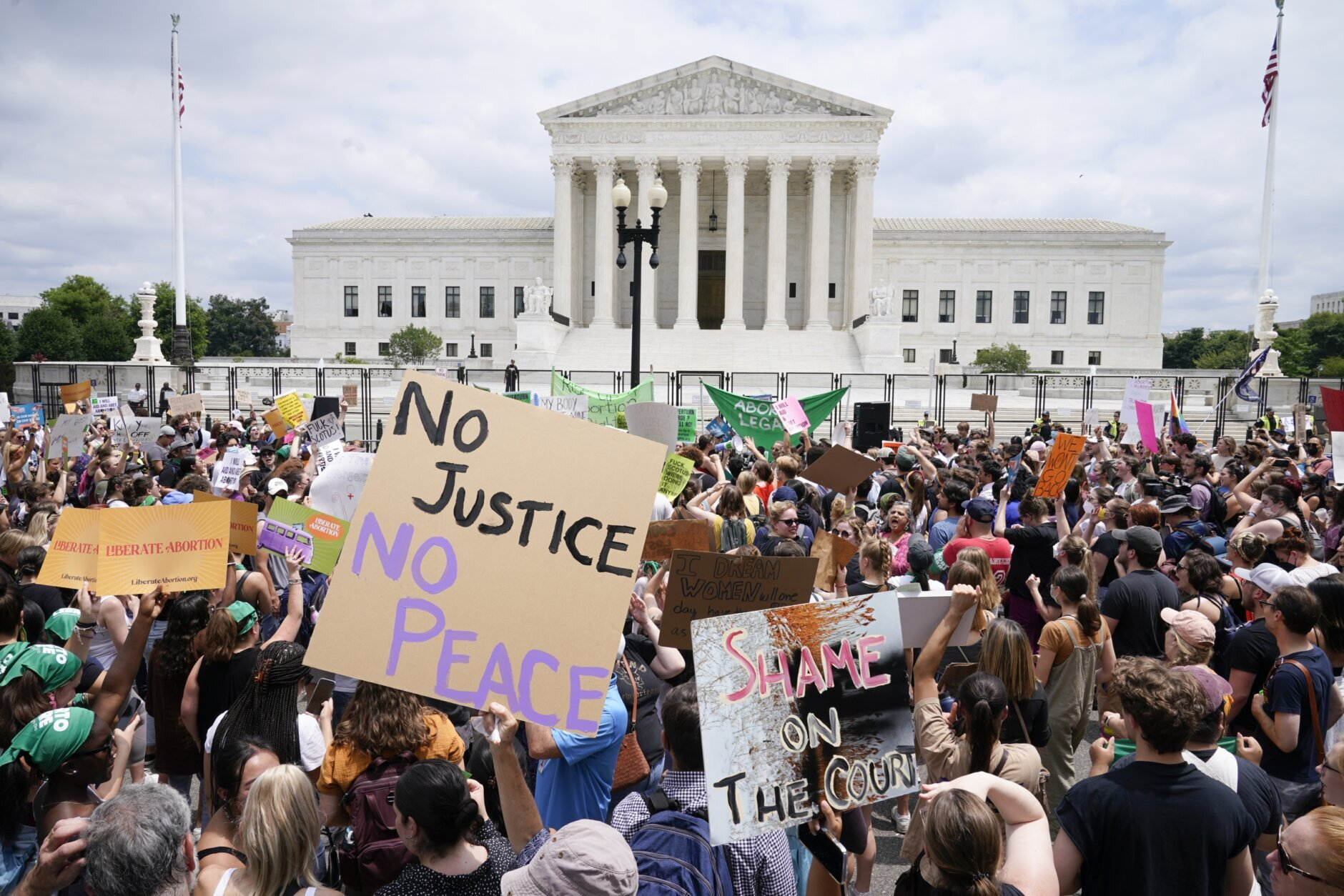
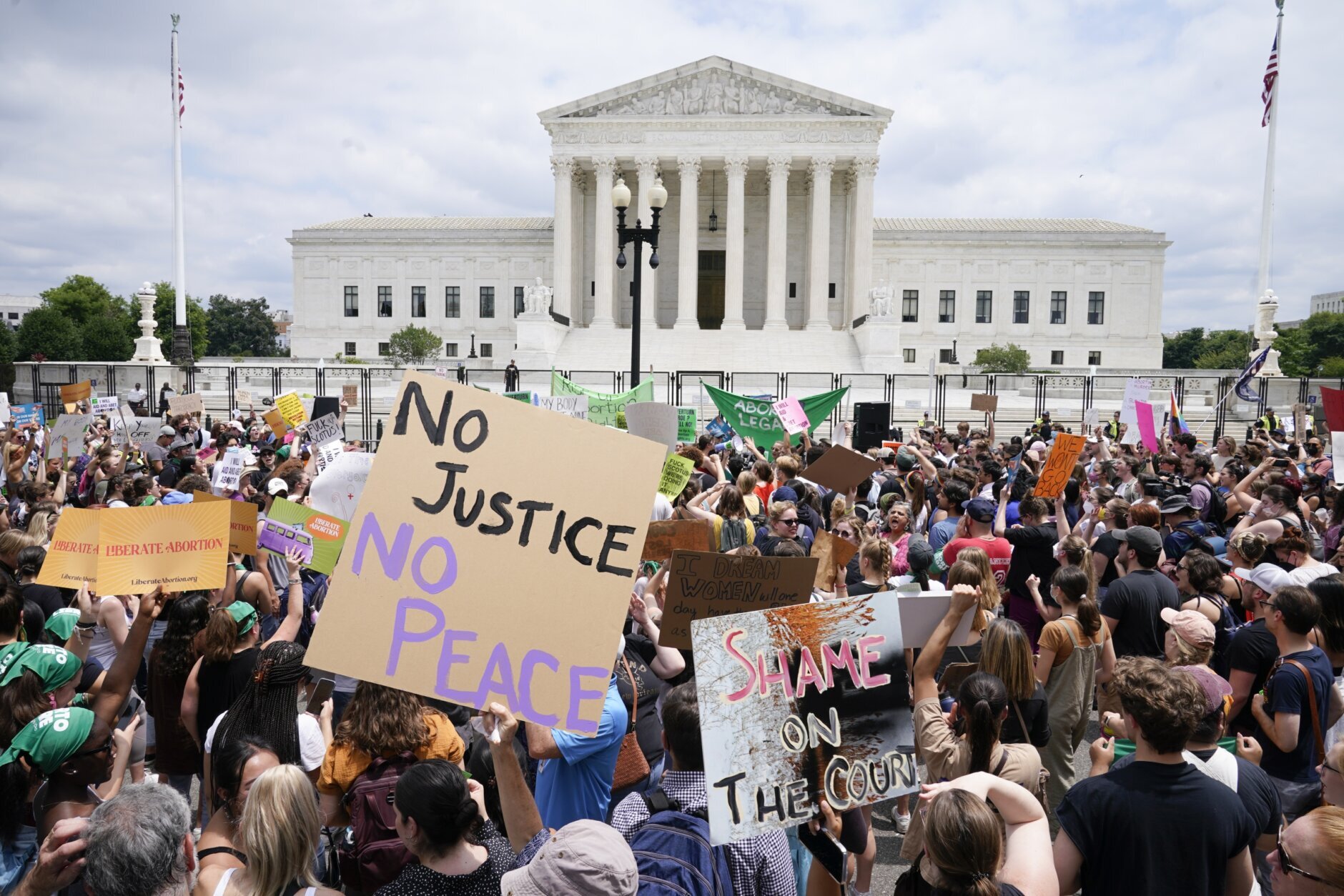
A group of protesters gathered outside the US Supreme Court. (Jacquelyn Martin/Associated Press)
Over the past five years, the American public’s opinion of the US Supreme Court has declined from 70% to less than 50% reporting a favorable opinion of the Court, according to Pew Research. A closer look reveals that the growing disapproval is partisan. Over 70% of Republicans hold a positive opinion compared to just 26% of their Democratic counterparts. Only 14% of Americans overall say the justices are doing a good job of remaining apolitical.
In a panel discussing how the American public views the Court’s recent attitude towards precedent, James Gibson, the Sidney W. Souers Professor of Government at Washington University, said the average American’s focus is to discern “whether decisions are based on principle or strategy.” Principled decisions are made with consistent political ideology. By contrast, strategic decision-making is seen as the same kind that politicians in Congress use.
How Partisan Presidents Help Make the Supreme Court
The United States Supreme Court consists of nine judges who hold the power and responsibility to decide the constitutionality of the laws in cases brought before them. The nine Justices are not elected officials like other political institutions. The president has the sole power to make judicial appointments under Article 2 of the U.S. Constitution. To be placed on the bench, nominees must appear before the Senate Judiciary Committee. Here, nominees answer questions about their qualifications. After, the full Senate must vote to confirm the nominee. Traditionally, if the nominee receives a two-thirds majority, they will be appointed. Once appointed, Supreme Court justices serve until voluntary retirement, death, or impeachment. The only requirement to remain in office is that the Justice maintains “good Behavior.”
The President’s power to nominate justices who remain in their positions of power long after the president’s term is over is viewed by many as part of a president’s legacy. The Justices’ presidents appoint can impact how laws are interpreted for generations, creating precedents which shape future interpretations of the law even after that president and justice is gone. Traditionally, presidents aim to fill open seats with justices of the same ideology, though that doesn’t always go as intended.
Republican President Ronald Regan nominated Justice Anthony Kennedy in 1987. While Justice Kennedy was expected to shift the Court’s composition in a conservative direction, he would go on to break with other Justices appointed by conservative presidents in major cases. Justice Kennedy wrote the majority opinions for cases protecting same-sex marriage, abortion rights, and striking down prayer in public schools. These opinions led to the demand for ideological consistency among conservatives when it came time for George W. Bush’s to appoint a nominee with the saying, “No More Tony Kennedys.”
How Partisan Elected Officials Help Make the Court
Because the Senate must confirm Justices, the Senate majority party can control how quickly, when, and if a president’s nominees are voted on. Most recently, the confirmation of Justice Amy Coney Barrett lasted just one month, making it the quickest nomination to confirmation ever for a Supreme Court Justice.
Justice Barrett’s confirmation also exemplified the Senate’s power to decide when a nominee is confirmed. The confirmation of Amy Coney Barrett took place one week before Election Day. It marked the closest to an election the Senate had ever confirmed or considered a Supreme Court nominee. The Senate confirmed her along party lines. This was the first time a Supreme Court nominee was confirmed without a single vote from the minority party since Edwin Stanton in 1869. Though Stanton died just four days after his confirmation and was never sworn in.
Previously confirming a judicial appointee required a 2/3rds vote in the Senate to confirm. However in 2017, a change in Senate rules made way to offer the majority party options around bipartisanship. After nearly 3 months of filibustering from Democratic Senators over the confirmation of Trump nominee Brett Kavanaugh, Senate Majority Leader Mitch McConnell moved to change the Senate rules and lower the voting threshold required to confirm a Justice Kavanaugh. 52 Republican senators supported the motion, which lowered the required percentage of votes needed for confirmation from two-thirds to a simple majority, allowing Kavanaugh’s confirmation.
The Senate Republicans invoked what’s known as the “Nuclear Option,” which changes the voting threshold needed for certain Senate actions. In this case it was used to lower the voting threshold for judicial nominees. Given how extreme this option is, it’s very rarely used. The only precedent for this action prior to Kavanaugh’s nomination was in 2013, when Democratic Senate Majority Leader Harry Reid invoked this rule to confirm the nominations of 3 lower court judges appointed by then-President Barack Obama. However the Nuclear option passed in 2013, prevented filibusters on executive appointments and a majority of judicial nominations, but did not extend to Supreme Court nominees. After the option was invoked in 2013, Republican Senator John Thune warned, “What goes around comes around,” and in 2017, Republican Senator John Cornyn would say, “The way I look at this is it’s come full circle. Then-Democratic Senator Joseph Manchin said of the choice, “Everybody took the easy way out…Harry Reid took it in 2013, Mitch McConnell just took it in 2017.” Now that the door has been opened for this rule change, the way Supreme Court nominees are confirmed has been permanently changed.
The Court’s Shifting Ideologies and Approach to Precedent
The court is often described as being made up of the conservative and liberal blocs. Currently, these blocs refer to the six Justices appointed by Republican presidents and the three Justices appointed by Democratic presidents. When it comes to hot-button issues such as abortion rights, LGBTQ+ rights, or immigration law, we often see opinions written along party lines. According to the New York State Bar Association, the “ideological direction of the court…has been indisputably and markedly politically conservative.” As seen in the contentious 6-3 overturning of Roe v. Wade in the case of Dobbs v. Jackson’s Women’s Health Organization, the influence of partisan politicians and presidents who control Supreme Court nominations and confirmations is reflected in the way issues are examined and ultimately decided by the Court.
Changes in the Court’s composition are also reflected in the way the court considers certain judicial philosophies. For example, the way precedents are treated over time shifts with the Court’s changing composition. Historically, the court typically uses a certain level of judicial restraint, or stare decisis (Latin for “let the decision stand”), and uses the decisions of other cases as guiding “rules” for making decisions about future cases (such as in Casey v. Planned Parenthood, which affirmed the precedent set in Roe v. Wade). However, these precedents are not binding, and the justices do not have to follow them. For example, the decision in Dobbs v. Jackson Women’s Health Organization abandoned the longstanding precedents of Casey and Roe.
Dobbs was not the first time the Court has thrown out precedents along partisan lines. Overturning precedents is also not unique to Courts with a dominantly conservative composition. In 1937, the Hughes Court decided 5-4 in West Coast Hotel Company v. Parrish that setting a minimum wage for women was constitutional, overturning the decision of Adkins v. Children’s Hospital of DC. The five in the majority consisted of “The Three Musketeers,” referring to the Liberal Bloc at the time, plus 2 swing votes. One of these swing votes included Justice Owen Roberts, who had previously been a part of “The Four Horsemen,” the conservative bloc, but shifted his political beliefs to side with his liberal colleagues in response to the threat of then-president Franklin D. Roosevelt, a democrat, packing the court. Justice George Sutherland, appointed by Warren G. Harding, a republican, criticized Justice Roberts for his switch in affiliation. In his dissent, Justice Sutherland wrote, “The suggestion that the only check upon the exercise of judicial power…is the judge’s own faculty of self-restraint is both ill-considered and mischievous.”
Partisanship from The Perspective of The U.S. Supreme Court Justices
Given the partisan influences on the appointment of Justices, some argue that Justices are incapable of keeping their own politics out of their decisions. Former Justice Benjamin Cardozo, a member of the majority in West Coast Hotel Company v. Parrish, author of “The Nature of the Judicial Process,” said in his book: “There is in each of us a stream of tendency…which gives coherence and direction to thought and action. Judges cannot escape that current any more than other mortals.”
While Justice Cardozo focuses on the political tendencies of individual justices, former Justice Anthony Kennedy sees his own past decisions through the lens of a dynamic political landscape. In a recent interview with PBS about his new book “Life, Law & Liberty: A Memoir,” he pushes back on the metaphor of his votes being “swing votes”, saying instead that it’s the cases that swing. He also speaks to the current conservative shift of the Supreme Court. When asked if he was worried about his legacy of a more liberal series of case rulings (specifically Obergefell v. Hodges) becoming undone by the more conservative streak of the current court, Justice Kennedy responded, “Well, of course, the law must stand the test of time…so the fact that there is a reexamination and additional conversation, to me, is a strength of our system.”

Excellent breakdown and explanation of how the Supreme Court functions and has shifted throughout history. The Court is the least known and understood branch of government. Ms. Priolo did a great job of explaining the Court’s functions and shifts over time.