
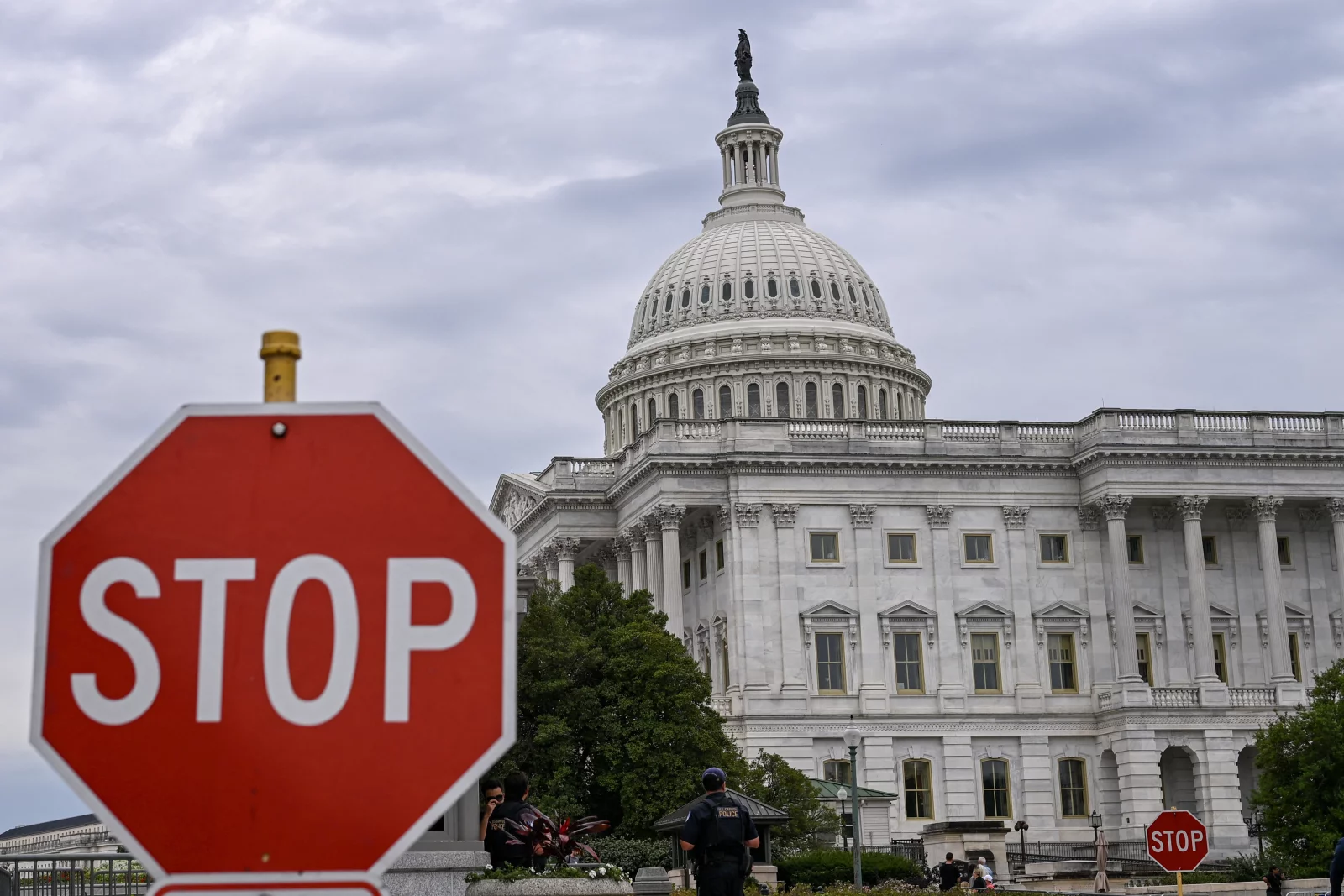
The United States Capitol (Alex Wroblewski/AFP via Getty Images)
The United States government shut down on October 1, after the U.S. Senate failed to pass a budget funding for the next fiscal year. The shutdown will continue until a spending bill is negotiated, voted on, and passed by both chambers of Congress. This shutdown is the first in almost seven years, as the last shutdown occurred in December of 2018 during President Donald Trump’s first term.
Before the shutdown took effect, Trump sat down with top congressional leaders from both parties – House Speaker Mike Johnson (R, LA-4), Senate Majority Leader John Thune (R, SD), House Minority Leader Hakeem Jefferies (D, NY-8), and Senate Minority Leader Chuck Schumer (D, NY), with no bill agreed on.
While Republicans have a 53-seat majority in the U.S. Senate, they needed 60 votes to pass the budget bill approved by the U.S. House in September. The bill failed 55-45, with Democratic Senators Catherine Cortez Masto (NV) and John Fetterman (PA), as well as independent Senator Angus King (ME), crossing party lines to support the Republican-led budget bill. Republican Senator Rand Paul (KY) joined Democrats to vote against the bill, saying he “won’t vote for $2 trillion more in debt.”
Democrats have emphasized “Republicans refuse to negotiate” in the making of a stopgap bill. The Democrats have stated they want to expand tax credits for the Affordable Care Act, which are set to expire at the end of the year.
What is Changing?
Many aspects of the government have closed, but some essential agencies have remained open. Members of Congress will continue to receive pay during the shutdown. Lawmakers on both sides of the aisle, like Congressmen Greg Murphy (R, NC-3) and Senator Andy Kim (D, NJ), have chosen to withhold their pay, while Senator Ruben Gallego (D, AZ) says “it’s not feasible” to withhold his salary from his family.
Active duty service men and women are supposed to be working without pay; however, President Trump ordered the remaining money leftover from last year’s budget to be used as salary for service members. Some Republicans in Congress, like Senator Lisa Murkowski (R, AK), expressed concern about the move, saying, “I don’t think [the appropriations] process is being respected.”
Social Security and Medicare checks are still being sent. Conversely, services deemed essential, like Immigration and Customs Enforcement (ICE), air traffic control, and border control, also remain at work without pay. However, Department of Homeland Security Secretary Kirsti Noem has announced that many are now being compensated for the work. Non-essential workers and federal government contractors are on temporary, unpaid leave.
Federally funded food assistance programs are also at risk. The Women, Infants, and Children program is one at risk (WIC), which “provides free healthy foods, breastfeeding support, nutrition education, and referrals to other services.” The shutdown, which began on October 1, coincided with the beginning of a new fiscal year, meaning programs like WIC, which rely on annual infusions from the federal government, are nearly out of money. Currently, the program is being kept afloat by a $150 million contingency fund, but experts say it could run dry quickly. The National Park Service has also had to reduce staffing at its parks.
The Supplemental Nutrition Assistance Program (SNAP) which provides food stamps to low income households is set to end disbursement November 1st, 2025.
The United States Postal Service (USPS) is not dependent on congressional funding and will continue operating as normal throughout the shutdown. Air travel has seen increased delays due to short staffing among air traffic controllers. Airports like Hollywood Burbank (BUR), Newark (EWR), Dallas (DFW), and Nashville (BNA) have experienced flight delays, with shortages in controllers at times forcing pilots to coordinate plans on their own.
According to the National Conference of State Legislators, loans and grants should not be affected, as most have already been distributed for the year, since distribution usually happens over the summer months. The Education Department has said it will continue funding direct Federal Student Loans as well as Pell Grants, because they are funded through mandatory funding, which is not controlled by a congressional funding bill.
While most schools are funded by state and local dollars, some schools located on Native American reservations or federal land receive federal funding from a program called Impact Aid. Impact Aid is a federally funded program for schools on federally owned land. Because these schools are on federal land, they are exempt from municipal and statewide taxes, which usually fund public schools. Impact Aid is used for a wide variety of funding in schools, from teachers’ salaries to advanced placement classes. Currently, “Impact Aid payments to districts containing federal property will not be available during the shutdown.”
When is the Shutdown Expected to End?
There is no timeline for when the shutdown could end. Democrats are calling for negotiations and a meeting with President Trump as necessary for a successful bill to be passed, but Congress is currently stalled by continuing blame games being played by both parties.
Congressional Republicans believe they have a “clean” bill, meaning no policy riders are included in the bill. Meanwhile, congressional Democrats want an extension to health insurance tax credits that are set to expire, as well as a reversal of Medicaid cuts implemented in Trump’s “Big Beautiful Bill” passed earlier this year.
The longest shutdown in U.S. history occurred during the first Trump term, lasting 34 days from December 21, 2018, to January 25, 2019.
President Trump’s Promised Retaliation
The Trump White House has vowed to reduce the size of the federal government during his second term. Over the past nine months, the president has laid off thousands of federal employees, an effort which he credits to the new Department of Government Efficiency (DOGE).
As promised before the shutdown, Trump began mass layoffs of 4,000 people, before being halted by a court order after the American Federation of State, County, and Municipal Employees and American Federation of Government Employees filed a lawsuit. There has been an indefinite halt, which will stop all mass firings following the hearing on October 28th.
“They don’t have to do it; they want to. They’re callously choosing to hurt people – the workers who protect our country, inspect our food, respond when disasters strike,” Schumer said of the Trump administration and its Republican allies. “This is deliberate chaos.”
The government shutdown is expected to cost “$15 billion a week,” according to the Director of the National Economic Council, Kevin Hassett. He went on saying, “If the shutdown continues for a long time, then there are going to be a lot of things that don’t happen, and it will show up in the GDP number.”

Full of accurate and interesting info! Written like a professional !