
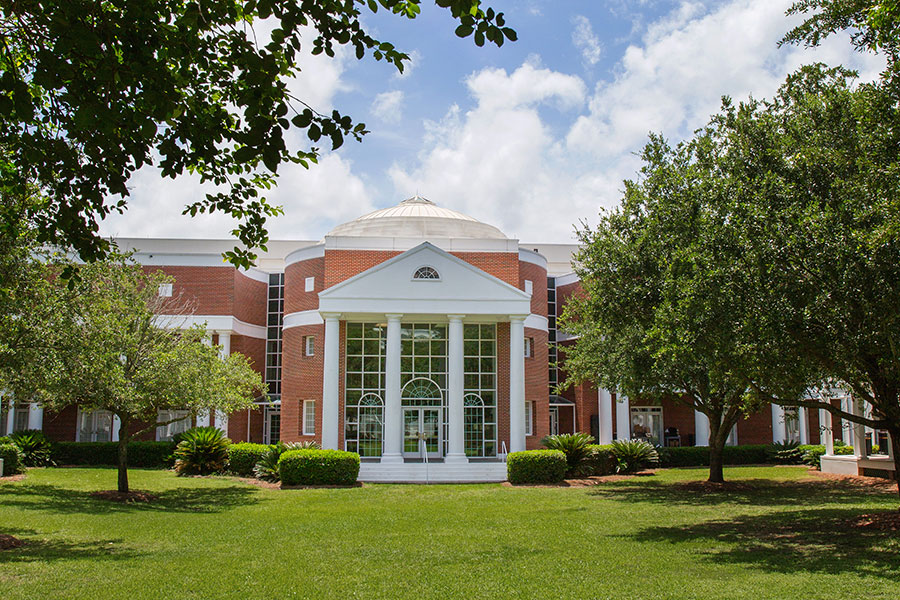
FSU College of Law Building (Bill Cox)
On October 2nd, the FSU College of Law held a dynamic panel discussion on two of the United States Supreme Court’s upcoming cases involving free speech: First Choice Women’s Resource Center, Inc. v. Platkin and Chiles v. Salazar. Featured speakers included Jane Bambauer, Erin Hawley, Michelle Kalan, and Cameron Norris. Both cases deal with the concept of “chilling speech,” a legal term referring to the deterrence of lawful speech due to the fear of legal consequences. Honing in on Chiles is important for understanding the implications of chill speech and how the courts can be expected to address it.
Chiles v. Salazar
For background, Chiles is a Christian, licensed counselor who works with clients experiencing sexuality or gender dysphoria by advising them against transitioning and having same-sex attraction. According to Oyez, she advises clients who “seek religiously informed care that aligns with traditional biblical understandings of sexuality and gender.” However, after the enactment of a 2019 Colorado law banning conversion therapy for minors, Chiles has refrained from engaging in these discussions for fear they could violate the law as forms of conversion therapy. She claims the law has significantly hampered her professional abilities and is a threat to her free speech. Cameron Norris, an accomplished partner and legal scholar, argues there is an unconstitutional chill on Chiles’ free speech. Norris said at the event in support of Chiles that the government cannot regulate speech in a viewpoint-based way, which he and Chiles claim Colorado does by saying counselors can only advise in one direction–towards gender transition. He also warned the court’s decision could potentially allow states to burden speakers they don’t agree with, which goes against the neutrality of the First Amendment.
To assess a law’s adherence to First Amendment neutrality, Norris proposed an exercise judges often employ: imagining the opposite were true. For instance, could a conservative state ban counseling which helps individuals embrace gender transition?
Another point Norris made in support of Chiles is that it’s not very hard to chill speech, and once that’s been done, it’s a concrete, present injury. Unlike other amendments, where the pre-enforcement doctrine applies, it’s nearly impossible to challenge the First Amendment without breaking the law. The pre-enforcement doctrine generally allows parties to challenge a law without being subject to penalties when there is a credible threat the law will be enforced against them. Erin Hawley, a former law professor who has litigated extensively before the Supreme Court, mentioned during the panel that the country’s rule of law is set up so people can resolve legal questions before they escalate to potentially unlawful conduct; in other words the case should be resolved at the state level on grounds that you can make a pre-enforcement challenge to the First Amendment However, Norris argues it’s not really eligible for pre-enforcement when speech is chilled, because if a law is convincing someone not to speak, their rights are currently violated.
The Colorado solicitor general argues the state’s law is permissible and can be enforced without offending the First Amendment. Michelle Kallen, a legal partner and scholar, contributed to the conversation on Thursday by giving the perspective of these state officials. Colorado believes the case is about regulating professional contact between counselor and patient. Their brief emphasizes that they’re not targeting speech because of viewpoints, but rather regulating a therapeutic practice which the state has the power to deem harmful under its roles of regulating health and safety. They point to long-established precedents, like malpractice and informed consent laws, allowing a state to regulate how professionals speak. Kallan also noted that “[Colorado’s] setting the boundaries for what constitutes safe and ethical medical practice,” which helps balance individual liberty with state police powers.
Bias Response Teams
Cameron Norris then brought the conversation to talk about the relevance of the cases to public universities. Last term, Norris filed a cert petition to the Supreme Court in a First Amendment case involving chilling speech. In his petition, he cited a case involving Indiana University’s bias response teams. Norris raised the question of when and whether students have the right to challenge these bias response teams. According to Norris, they’re “grossly unconstitutional” because they ask students to anonymously report each other for incidents of biased speech. Discipline, including involving law enforcement, is possible following a complaint. Oxford University describes bias response teams as less of a punishment and more of a DEI initiative, where their purpose is to respond to incidents of discrimination ranging from “microaggressions to overt acts of prejudice”. Some argue they can certainly be effective in preventing hate speech and advocating for minorities. Others argue they burden speech because students will refrain from saying something they fear will get reported and lead to adverse consequences. Norris expects the Court to delve into these questions with Chiles v. Salazar, hoping the Court finds that these bias response teams constitute an unconstitutional chill on Chiles’ free speech.
HB 49
Here in Florida, Republican state Representative Peggy Gossett-Siedman recently sponsored and filed HB 49 in the House. However, HB 49 was withdrawn on October 3rd just 6 days after it was introduced. HB 49 sought to regulate political speech in K-12 public schools and university campuses. The question again arose of whether HB 49 protected students from bias or violated free speech rights. The Florida Senate claimed it was meant to emphasize neutrality in education settings. Gosset-Siedman said it would “achieve political parity in spaces that have long been misused for partisan advantage.” The bill would have made posting campaign signs, distributing campaign literature, and collecting political donations a second-degree misdemeanor. The bill also would have prohibited faculty from using school emails, resources, or office time for political advocacy. However, when asked whether HB 49 would limit the activities of student-led organizations such as the Democrat-leaning Florida Future Leaders or Republican-leaning Turning Point USA, Gossett-Seidman said no. It’s unclear whether student-led political parties on FSU’s campus, like College Democrats or Republicans at FSU, would have ceased to exist under the bill. The Florida Legislative Session begins January 13. Although withdrawn, other legislation like HB 49 may be introduced in the coming session.
