
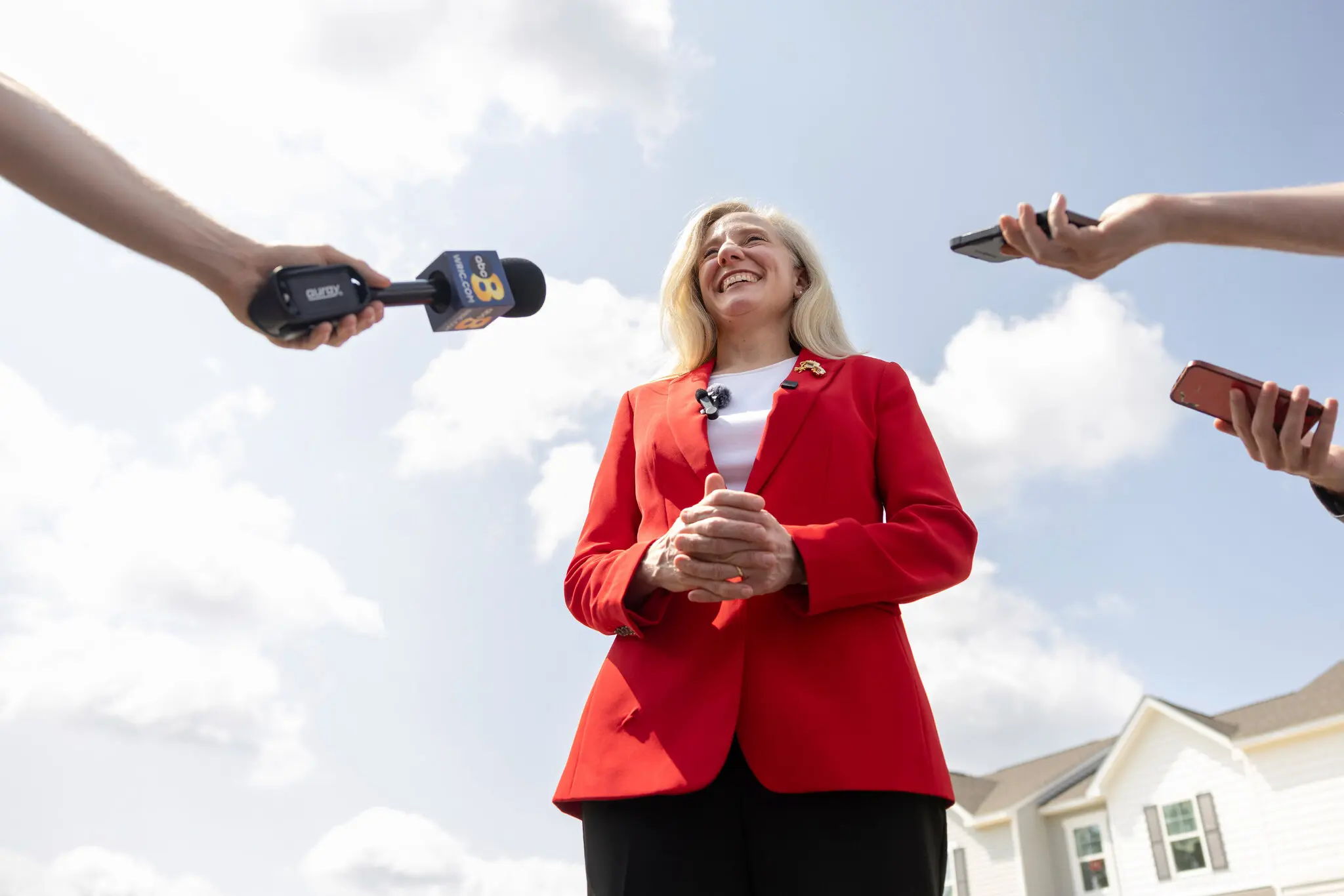
Former U.S. Representative Abigail Spanberger, the 2025 Democratic nominee for Virginia governor (Mike Kropf/Richmond Times-Dispatch)
Virginia’s upcoming election on Tuesday will determine who leads one of the nation’s most politically dynamic states.
Since 2008, Democrats have won Virginia in every presidential election. However, Republicans have occasionally won statewide races, such as the 2021 gubernatorial race, when Republican Glenn Youngkin defeated Democrat Terry McAuliffe by 1.9 points.
Virginia is one of only two states which elects a governor in the year immediately following a presidential election, and every race is open because governors are barred from serving consecutive terms. The unique timing makes Virginia’s contests a magnet for national attention and outside spending. As Bo Erickson of Reuters notes, “Virginia’s governor election this year is a popularity test for Republican President Donald Trump and his policies,” framing the contest as a referendum on the GOP and its leadership. Millions of dollars from both national parties are flooding into the Commonwealth on the path to election day, underscoring why analysts like Jeff Schapiro, scholar with the University of Virginia’s Center for Politics, describe Virginia’s race as a “bellwether” heading into the 2026 midterms.
The Contest
On November 4, Virginians will head to the polls to choose their next governor. On the ballot are Republican Lieutenant Governor Winsome Earle-Sears and Democratic former U.S. Representative Abigail Spanberger. No matter the outcome, Virginia will make history: the Commonwealth is guaranteed to elect its first female governor.
But Virginia’s gubernatorial election is not only about shattering a glass ceiling. Dr. Eric Claville, political analyst and Norfolk State University professor, said, “I believe the commonwealth of Virginia is going to be the ultimate litmus test for both parties.”
Winsome Earle-Sears’ Pitch to Voters
In 2021, Earle-Sears made history as the first woman of color elected to a statewide office in Virginia when she won her race for Lieutenant Governor by 1.6 points. As a Jamaican-born veteran of the United States Marine Corps, Earle-Sears has cultivated a political identity rooted in conservative principles.
On the campaign trail, Earle-Sears has aligned herself closely with Trump, stating, “President Donald Trump is fighting tirelessly to protect Americans from out-of-touch policies,” and telling supporters she is “supporting what the president is doing.” Earle-Sears has emphasized her support for policies like school choice, tax relief, and stricter immigration laws. She has also spoken out against what she calls “radical policies” in the criminal justice system, including bail reform and leniency from progressive prosecutors.
Earle-Sears has drawn support from several prominent Virginia Republicans and has raised $35 million for her campaign. However, Trump has not formally endorsed her, a gap that Mark J. Rozell, dean of George Mason University’s Schar School of Policy and Government, argues could signal uncertainty about her path to victory. Rozell stated, “Winsome Sears has a tough balancing act to perform because the GOP base will expect her to give her full support to the president, whereas swing voters will want her to show some independence from the president when it is in Virginia’s interests to do so.”
This leaves Earle-Sears in an unusual position of running in a high-profile statewide race without a formal endorsement from the president, a factor which has drawn attention from national party operatives and political observers alike. By contrast, Trump has endorsed the Republican gubernatorial nominee in New Jersey, Jack Ciatterelli.
Abigail Spanberger’s Path to Richmond
Spanberger, a former CIA officer and former three-term congresswoman from Virginia’s 7th district, has built her career as a centrist Democrat willing to buck her party’s leadership. She was a member of the Blue Dog Coalition, a group of fiscally moderate Democrats, and served as its co-chair for communications, emphasizing bipartisan cooperation. Spanberger was ranked fifth on the Lugar Center – McCourt School of Public Policy Bipartisan Index in the 117th Congress.
When she was first elected in 2018, Spanberger flipped a Republican-held district and has since carved out a reputation for pragmatism on national issues. Spanberger has campaigned on expanding access to affordable healthcare, protecting abortion rights, and investing in housing. She opposed the HEROES Act of 2020, arguing that it went far beyond what was necessary to provide pandemic relief. Spanberger has also framed abortion rights as central to her candidacy, stating, “Virginians can feel confident that when I am Governor, I will sign the Right to Contraception Act into law — and I will always defend their reproductive freedoms.”
Simultaneously, she is courting families in Hampton Roads, home to the world’s largest naval bases and one of the most heavily concentrated populations of active duty service members and veterans in the country. Spanberger, who often reflects on her national service background, has campaigned on issues affecting veterans. In a statement on Military Appreciation Month, Spanberger stated, “As Governor, I will always speak up for the Virginians who’ve stood up for us, and I will work to protect the healthcare, benefits, and job opportunities they’ve earned through their service.”
Additionally, Spanberger’s fundraising numbers are nearly double those of her opponent, totaling $65 million, bolstered by national Democratic groups, such as the Democratic Governors Association and the Democratic Party of Virginia. Spanberger also touts endorsements across the Democratic spectrum, ranging from former Governor Ralph Northam and Senator Tim Kaine to organizations like the Human Rights Campaign and the Virginia Police Benevolent Association.
Jay Jones & Debate
A new flashpoint in the race emerged when private text messages from Jay Jones, the Democratic nominee for Virginia Attorney General, resurfaced. In 2022, Jones made violent remarks about then-Republican House Speaker Todd Gilbert, describing a hypothetical situation in which Gilbert “gets two bullets to the head” and wishing that Gilbert’s children “die in their mother’s arms.” Jones has apologized, calling his language “embarrassing” and a lapse in judgment. Most Democrats, including Spanberger, have condemned Jones’ language, but have stopped short of calling for him to exit the race.
The controversy took center stage on October 9th at Norfolk State University, where the only scheduled debate between the gubernatorial candidates was held. During the debate, Earle-Sears repeatedly pressed Spanberger to denounce Democratic attorney general nominee Jay Jones and call for his withdrawal, framing the issue as a question of moral leadership. Spanberger condemned Jones’s comments as “abhorrent and unacceptable,” but declined to explicitly rescind her endorsement, arguing that voters should decide his fate at the ballot box. Beyond the Jones controversy, the candidates clashed over abortion rights, tax policy, and immigration enforcement.
Earle-Sears, however, faced scrutiny of her own during the debate on opposing same-sex marriage and LGBTQ+ protections. Earlier this year, she signed HB 174, a law which requires officials to issue marriage licenses, regardless of sex, gender, or race. However, she signed that she was “morally opposed” to the bill, remarks which have alienated younger and more moderate voters. She defended her position by invoking religious freedom, but when pressed on the issue at the debate, she pushed back, insisting, “that’s not discrimination.” The exchange between the candidates highlighted the broader cultural divides shaping Virginia’s political landscape.
As Virginians head to the polls on Tuesday, the outcome will determine the state’s leadership for the next four years and could offer a glimpse of the electorate’s mood heading into the 2026 midterm elections. As of November 2, the polling average on RealClearPolitics shows Spanberger with a 7.6 point lead over Earle-Sears. A recent poll from Roanoke College ending on October 27 shows Spanberger holding a 51%-41% lead, even as Miyares leads Jones 46%-38% in the attorney general race.

This article was a great read !