
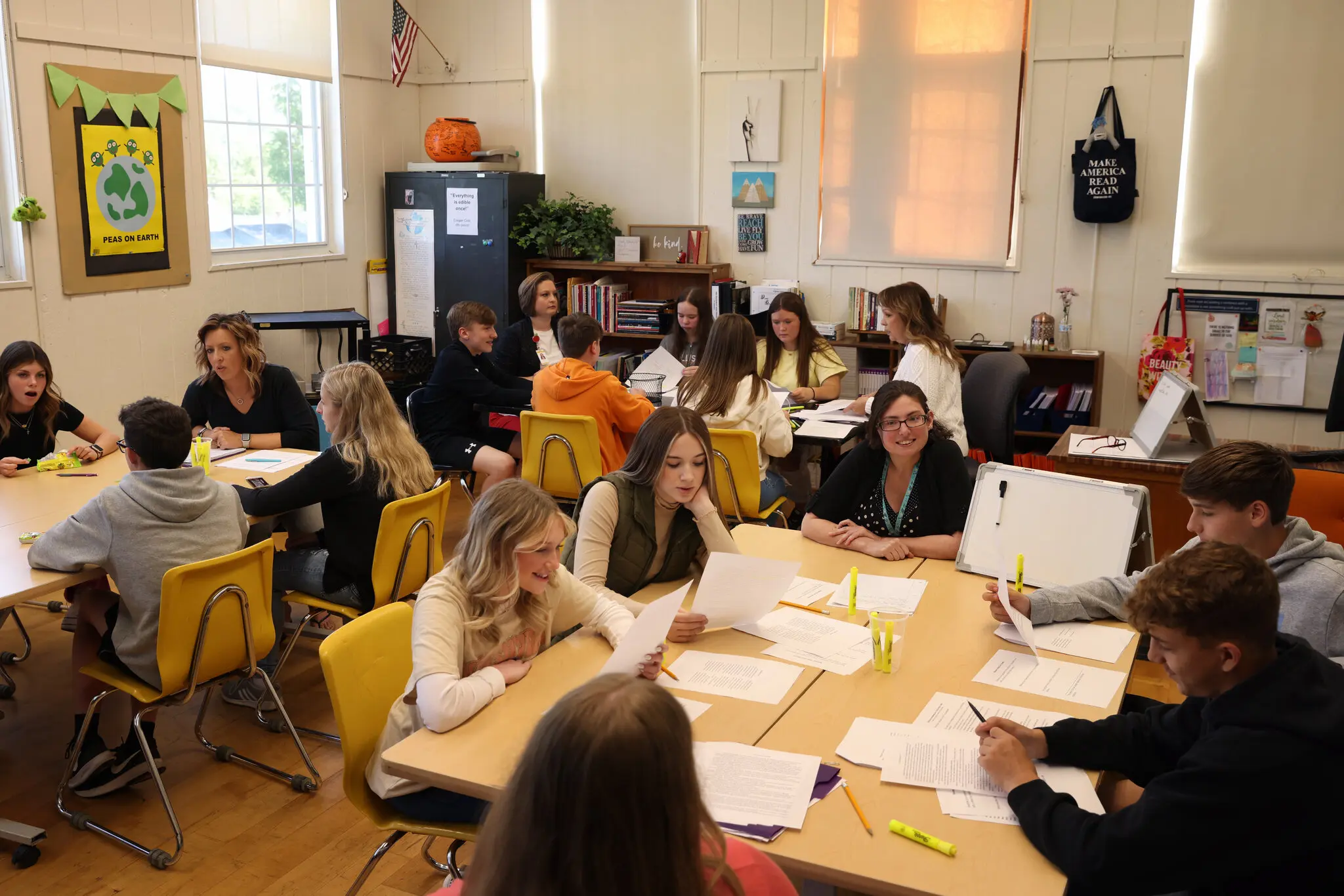
A classroom in Elizabethton, Tennessee (Travis Dove/The New York Times).
American students are struggling academically five years after the COVID-19 pandemic, which interrupted the educational systems across the country. Current evaluations indicate that reading and math performance are lower than pre-pandemic levels, and efforts are underway to address the decline in learning standards.
The National Assessment of Educational Progress (NAEP), also known as “The Nation’s Report Card,” published its findings in January of 2025, indicating a continued decline in reading for both 4th and 8th-grade students. The scores for both grades decreased by 2 points from their 2022 scores, continuing declines measured between 2019 and 2022. Less than one-third of students are proficient in reading at both grade levels, and about 40% of 4th-graders and one-third of 8th graders are below the threshold.
Although results in 4th grade mathematics improved nationwide by 2 points, 8th-grade mathematics scores remain below pre-pandemic levels of performance. Of particular note is the fact that it is mainly better-performing students who are credited for improved results in mathematics, leaving low-performing students who are struggling in mathematics performance as a particular concern, according to Martin West, a professor at the Harvard Graduate School of Education who identified a widening gap in achievement level between better- and low-achieving students as one of the worrisome aspects of the current paradigm in education following 2020.
Tutoring Programs Face Uncertain Future
High-dose tutoring is among the most encouraging interventions to have demonstrated positive outcomes in the current pandemic era, according to a recent study. High-dose tutoring is conducted in small groups of children, with a single teacher remaining with them for at least 30 minutes, three times a week.
The federal government used pandemic funds to expand school programs. The National Center for Education Statistics contacted a nationally representative sample of schools to gather information on the level of tutoring. By December 2022, 51% of the schools reported that tutoring was in place, a level that remained relatively constant until the end of October 2024, but dropped to 43% by June 2025.
Because the Elementary and Secondary School Emergency Relief Funds were scheduled to expire by the end of September 2024, these districts faced an uphill task in deciding how best to proceed in light of the aforementioned programs. The state of Louisiana has proposed a budget allocating $30 million in tutoring support for math and reading, due to the need for mandatory tutoring for non-proficient students in reading and math at the elementary level. Tennessee is the only state with high-impact tutoring programs factored into its K-12 formula, according to the National Student Support Accelerator.
The District of Columbia has budgeted $4.8 million for high-impact tutoring in its 2024-25 budget. But its long-term sustainability is also in doubt, given that some states have provided competitive grants, while others have developed lists of approved providers, allowing districts to identify approved programs.
Science of Reading Gains Momentum
Another response by schools to lower reading levels has been the integration of ‘science of reading’ practices, focusing on phonics and other aspects of reading, including vocabulary and comprehension. This shift has occurred from ‘balanced literacy’ approaches, aiming to train children to rely on context clues and picture recognition when reading. In 2024, fifteen states aligned their early literacy policies with the science of reading: Alabama, Arizona, Delaware, Florida, Georgia, Indiana, Iowa, Kansas, Minnesota, Missouri, New Jersey, Oklahoma, Pennsylvania, South Carolina, and Virginia. Additionally, “three-cueing” is banned in most of these states.
Three cueing is the process by which students use context clues rather than letter sounds when decoding words. In October 2025, California took a step away from three cueing when Governor Gavin Newsom signed legislation that offers training for school principals and reading specialists in reading science, in addition to updating approved reading materials to be based on phonics concepts. This legislation followed heated discussions in which some educators and organizations opposed making phonics education mandatory, especially for ELL (English-language learner) students in some schools.
New York and Massachusetts have also recorded similar large-scale commitments to improving literacy. Massachusetts Governor Maura Healey proposed a five-year early literacy plan with a $30 million commitment to align reading instruction from kindergarten through 3rd grade with evidence-based practices. A proposed 2025 budget by New York Governor Kathy Hochul requires that districts’ curricula be grounded in scientifically based practices. Several states, including Mississippi, Louisiana, Tennessee, Indiana, Ohio, and California, have reported increased reading scores from their efforts to improve their state’s phonics curricula and related literacy components. For example, in the Los Angeles Unified School District, the newly implemented phonics curriculum led to a 5.5 percentage point increase in California’s ELA (English Language Arts) student achievement level.
Chronic Absenteeism Remains a Major Challenge
The consensus among educators indicates a larger educational issue that has arisen as a result of the 2020-2021 COVID-19 pandemic: chronic absenteeism (missing more than 10% of scheduled school days) is a factor preventing recovery and schools’ return to stable operation. A recent RAND national report found that approximately 22% (or 10.8 million) of K-12 students were classified as chronically absent during the 2024-2025 school year, up from 15% prior to the COVID-19 outbreak.
Chronic absenteeism is particularly prevalent in urban school districts, where rates are reportedly many times higher than in other districts. The data reflect rates as high as 5 or 6 times the rates experienced in rural and suburban school districts. Studies conducted by the American Enterprise Institute indicate that the rate of chronic absenteeism improved less in 2024 than in previous years, suggesting it will likely remain above normal.
States are reacting with a range of responses. At least 22 states introduced 56 bipartisan pieces of legislation about chronic absence during the 2025 session. Many are early intervention-oriented rather than punitive.
Georgia’s SB 123, signed by Governor Brian Kemp in 2025, ensures that students cannot be expelled solely for absences and requires local school boards to establish an attendance review team for chronically absent students. Indiana’s SB 482, which was also enacted in 2025 by Governor Mike Braun, defines chronic absenteeism and prohibits schools from using disciplinary actions solely for truancy. It also provides a plan for the state’s resource allocation for intervention. Maryland formed a state task force to study chronic absenteeism, while Virginia strengthened attendance tracking requirements to better report and maintain accurate attendance standards.
Some of the initiatives involve new approaches: The state of Hawaii proposed a pilot program offering ice cream rewards for attending class, while Utah’s HB 206 provides $400 each year, matched in a 529 savings plan, to incentivize student attendance.
Experts emphasize the importance of partnerships in reducing absenteeism. “School connectedness is as close as we have to a universal prevention measure,” said Robert Balfanz, a researcher at Johns Hopkins University, speaking with Education Week regarding the importance of having every child connect with an adult at the school.
Mixed Results and Ongoing Challenges
While progress has been made since the beginning of this pandemic in students’ ability and willingness to learn, the path to success remains uncertain, with the next steps unclear. According to the Brookings Institute’s report on multiple assessments used to evaluate recovery, across the United States, there are more instances of recovery in Mathematics but fewer in ELA. Approximately 75% of states across the country have been trending upward in Mathematics scores while remaining below pre-COVID levels; ELA, on the other hand, has seen very uneven recoveries across States, with just 8% of States reporting full recovery of proficiency before COVID-19.
Researchers have identified several issues contributing to the confusion surrounding students’ actual recovery in academics. One issue identified was that several states changed the cut scores for proving proficiency before administering state assessments, generally reducing cut scores for Mathematics by 16 points between 2013 and 2025 in New York State and 11 points for reading, among others. Similar adjustments have been identified for Oklahoma, leaving some to question whether reported increases are indicative of sustainable academic gains.
Moving forward, experts believe that considerable complexity will be required to ensure ongoing recovery for students post-COVID. Evidence-based practices will require continued investment and improvement; however, experts also advise that no one solution exists for addressing the myriad of challenges confronting American public education moving forward.
