
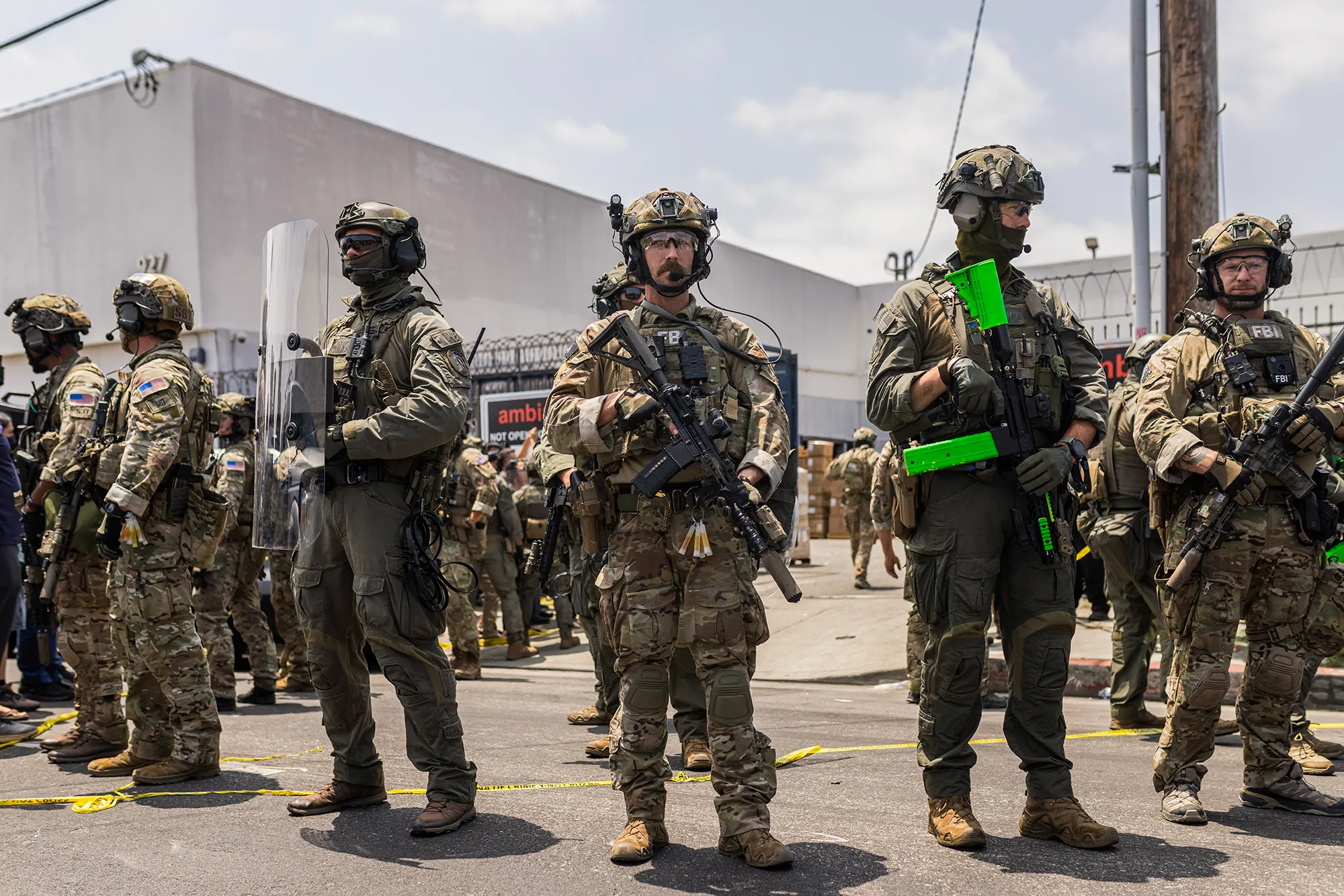
Federal Bureau of Investigation agents face off against protesters during an ICE raid in Los Angeles (J.W. Hedricks/CalMatters)
On June 8, 2025, President Donald Trump deployed hundreds of California National Guard soldiers in Los Angeles, California. It marked the beginning of numerous National Guard deployments to other cities, which Trump believes have pressing crime issues, including Washington, D.C., Chicago, and Memphis. There have been differing responses to the deployments from the various local leaders of these impacted cities.
Los Angeles
According to a presidential memorandum released by the White House, deploying the California National Guard to Los Angeles (L.A.) was necessary to ensure the safety of immigration enforcement agents. In the memorandum, President Trump outlined incidents of violence and disorder that occurred during immigration protests in L.A., which he believed threatened the security of federal property and “inhibited the execution of the [immigration] laws.” In a press statement, Trump justified the deployment, stating, “If we didn’t get involved, Los Angeles right now would be on fire and we have it in great shape.”
White House Press Secretary Karoline Leavitt further explained Trump’s deployment of the national guard, stating, “In recent days, violent mobs have attacked ICE Officers and Federal Law Enforcement Agents carrying out basic deportation operations in Los Angeles, California… The Trump Administration has a zero-tolerance policy for criminal behavior and violence, especially when that violence is aimed at law enforcement officers trying to do their jobs.” No additional information was given by the White House to support these claims.
Both California Governor Gavin Newsom and Los Angeles Mayor Karen Bass have strongly opposed the deployment of the National Guard. The two have, through various press statements and social media posts, expressed doubts about the necessity of the deployment. Bass called the deployment “ intentional chaos” and said, “[T]here was no need to federalize troops. And having this here is really just a provocation and something that was not needed in our city.”
Governor Newsom had a similar response, writing on X that “this is a serious breach of state sovereignty—inflaming tensions while pulling resources from where they’re actually needed.” Governor Newsom has since sued the Trump Administration over the deployment of the National Guard.
Roughly 3 months after Newsom brought the suit against Trump, U.S. District Judge Charles Breyer ruled the Trump Administration violated the Posse Comitatus Act, prohibiting the White House from using the National Guard or military to execute domestic law in California. The Posse Comitatus Act outlaws the use of the military to enforce the law, except in circumstances allowed by Congress or the Constitution. Mayor Karen Bass responded to the ruling, stating, “The White House tried to invade the second-largest city in the country. That was illegal. Los Angeles will not buckle and we will not break. We will not be divided and we will not be defeated.”
In response to this, in mid-July, the Trump Administration began withdrawing troops; 100 guard members remain in California. Additionally, the administration appealed this ruling, and as of October 31st, a decision is pending.
Washington D.C.
Trump has also deployed the National Guard to D.C. as part of his efforts to reduce crime in the nation’s capital. D.C. Mayor Muriel Bowser has expressed her concern over the takeover, calling President Trump’s decision an “authoritarian push.” However, despite her disapproval, she is cooperating with Trump as D.C. authorities are helping to clear homeless encampments and cooperating with immigration officers.
Mayor Bowser is in a unique situation, however, since Washington, D.C. is not a state. The Home Rule Act of 1973 grants the District a Council and Mayor; however, the authority of these two entities is limited, and the Home Rule Act gives Congress and the President ultimate authority over the city. Under the Act, the District’s government has the power to both pass and enforce laws and pass a budget; however, bills are required to be reviewed by Congress, and the ACLU says both Congress and the President can legally “micromanage local laws and local tax dollars.”
Section 740 of the Home Rule Act states that if the President declares an emergency requiring the use of the Metropolitan police for federal purposes, the mayor must provide the President with the use of the police force for up to 30 days. As a result, Mayor Bowser’s legal options are limited. According to the Associated Press, an anonymous source familiar with Mayor Bowser noted her “response is a reflection of the reality of the situation.” As of November 24, the National Guard is still deployed in D.C., despite the 30-day emergency order having expired and a Judge ruling on November 20th that the deployment is illegal.
On September 8, Mayor Bowser defended her crime policies before the House Committee, while acknowledging that the National Guard’s presence has helped lower D.C. crime rates. After being questioned by members of Congress over D.C.’s alleged crime issues, Bowser deemed the hearing “disgraceful in its characterization of the district,” arguing that while D.C. did experience a crime spike in 2023, the city has driven down crime over the course of the past two years.
Chicago
Citing coordinated assaults aimed at obstructing Federal law enforcement, Trump argues that the deployment of the National Guard to Chicago is also justified. Chicago also has high crime rates—according to the BBC, in 2024, the FBI and the Chicago Police Department recorded 461 and 591 homicides, respectively. This was the 8th-highest per capita homicide rate in U.S. cities.
In a press release, White House Press Secretary Karoline Leavitt expanded on these crime statistics, saying, “out of Chicago’s 147,899 reported crimes this year… there have only been arrests in 16% of them. These numbers are unacceptable.”
The Democratic Governor of Illinois, JB Pritzker, has expressed his opposition to Trump’s decision, calling the deployment “absolutely outrageous and un-American to demand a Governor send military troops within our own borders and against our will.” He believes the deployment is unnecessary, contrary to Homeland Security Director Kristi Noem’s description of Chicago as a “war zone.”
Chicago Mayor Brandon Johnson also opposes the deployment of troops. In a statement made after President Trump’s initial threats of deployment, Mayor Johnson said he has “grave concerns about the impact of any unlawful deployment of National Guard troops” and that he believes the President’s actions are “uncoordinated, uncalled for, and unsound.”
Mayor Johnson and many Chicagoans recognize crime as a problem in Chicago; however, they do not believe sending in the National Guard is the solution. Mayor Johnson and the Governor have instead requested more funding for crime prevention programs; however, they did not specify any particular program.
Memphis
On September 15, President Trump issued an order to deploy the National Guard to Memphis again, citing an effort to combat crime, in a similar fashion to Washington, D.C. According to FBI statistics, in 2024, Memphis had roughly 2,500 violent crimes per 100,000 people, including about 41 homicides per 100,000 people, which is much higher than in similarly sized cities, though crime rates have been declining.
In contrast to Democratic state leaders in California and Illinois, Republican Tennessee Governor Bill Lee approves of the deployment of the National Guard, stating, “Everyone who lives in that region understands how desperately we need to remove the crime element from the streets of Memphis, and everyone in those law enforcement agencies from the top of the federal government all the way down are working together to make sure that happens.” The state’s two Republican U.S. senators have also approved of the deployment.
State Democrats, including Memphis Mayor Brandon Paul Young, disapprove of the deployment, however. In a CNN interview, Mayor Young stated he was “certainly not happy” about the troops’ deployment, emphasizing he did not request the deployment. Specifically, Mayor Young stated concerns about the impacts on his community, saying, “we want to make sure that as these individuals come into our city and in our community, that they are … able to engage in a way that is not threatening, and that they are supportive to our law enforcement efforts.” Both Mayor Young and other Memphis leaders acknowledge crime is an issue; however, they do not believe a solution requires the National Guard.

Well written article!