
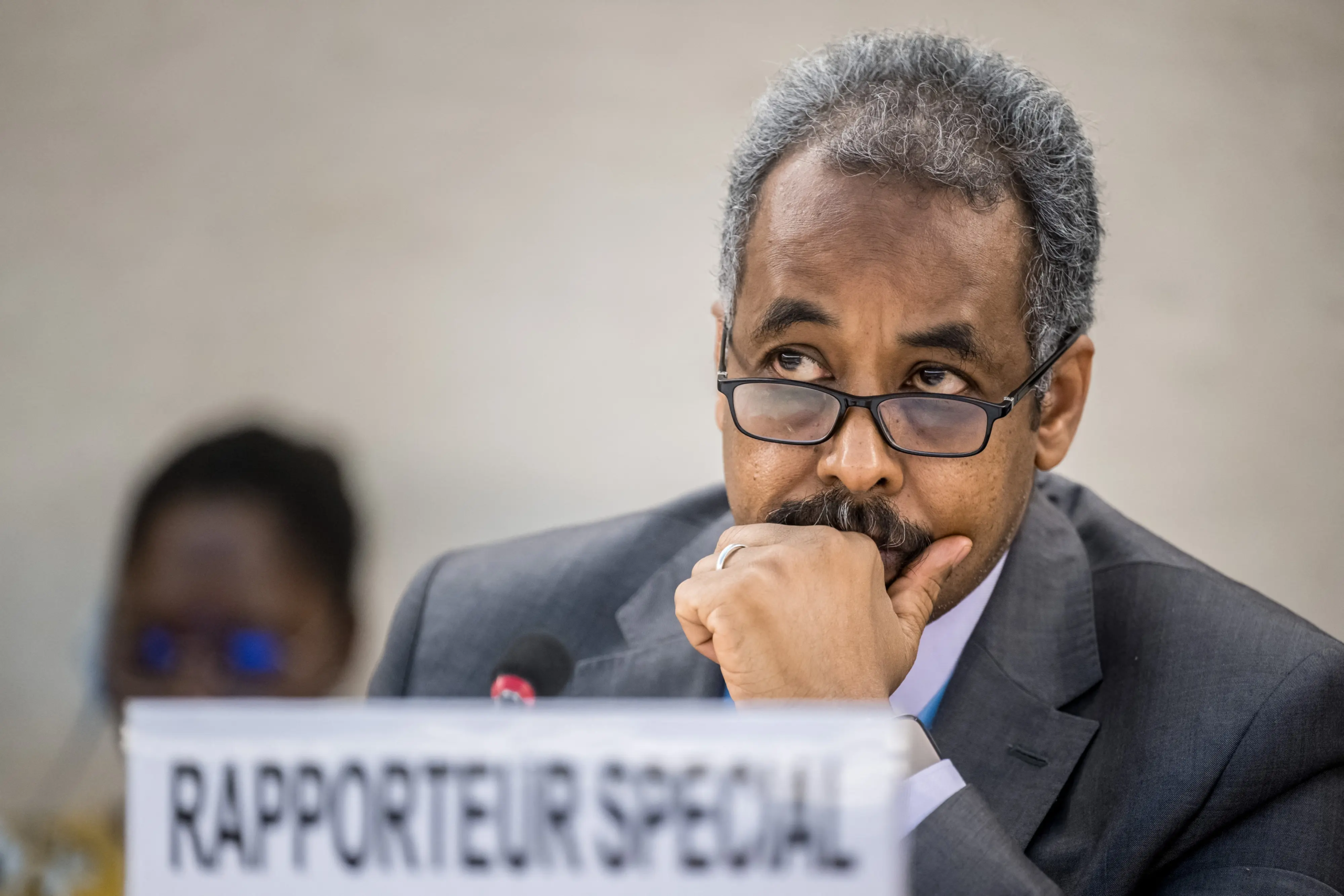
The UN-appointed Special Rapporteur for Human Rights in Eritrea, Dr. Mohamed Abdelsalam Babiker (Fabrice Coffrini/Getty Images)
On July 4, 2025, the United Nations Human Rights Council voted to reject Eritrea’s attempt to end international scrutiny of its human rights situation. The motion was defeated by a vote of 25 against and 4 in favor. Since 2012, Eritrea has been under investigation by a UN-appointed special rapporteur for its alleged human rights violations. The position is currently held by Dr. Mohamed Abdelsalam Babiker.
A Brief History of Eritrea
After a 30-year war, Eritrea won independence from Ethiopia in 1991. Two years later, in 1993, Eritreans officially voted for independence, and the ruling militia group became known as the People’s Front for Democracy and Justice (PFDJ). The PFDJ remains the sole legal political party in Eritrea, and its unelected president, Isaias Afewerki, has led the country since 1993. While there were early signs of movement towards a constitutional democracy, Afewerki’s government has increasingly consolidated power. A feature by Amanda Poole and Jennifer Riggan for the nonpartisan Migration Policy Institute suggests the consolidation of power is due to “a political culture oriented towards militarization.” Poole is a Professor of anthropology at Indiana University of Pennsylvania, and Riggan is a Professor of global studies at Arcadia University. Both women have authored works on Eritrean refugees.
In 1994, Eritrea instituted mandatory military training for men and women aged 18 to 40. At the turn of the century, Eritrea was involved in a border war with Ethiopia (1998-2000), which “further entrenched a culture of sacrifice and militarization.” Although the war ended, tensions between the two countries remained. Facing widespread criticism, Afwerki shut down private media organizations in 2001 and indefinitely extended both civil and military service in 2002. Since 2003, after the government closed the only university in the country and expanded militarization policies, refugees and asylum seekers leaving the country have continually increased. In 2024, the United Nations High Commissioner for Refugees (UNHCR) recorded a total of 663,058 refugees leaving Eritrea.
The Current Situation in Eritrea
In 2018 and 2022, Eritrea established peace with both Ethiopia and the Tigray region. However, “observers have warned about the possibility of another outbreak of war, and both Ethiopia and Eritrea have mobilized troops.” The prospect of renewed conflict has contributed to continued militarization. In 2022 and 2023, Eritrea called up reservists in their 50s and 60s, as well as school-age children. Avoiding mandatory service is difficult, as those who refuse to serve risk torture, arbitrary detention, or other punishment.
Many Eritreans have attempted to leave the country, but doing so remains dangerous. Another factor is the fact that it is illegal to leave the country without an exit visa, which Poole and Riggan note is “nearly impossible to obtain.” Further, another barrier to leaving the country is the 2% Recovery and Rehabilitation tax. In the UN Special Rapporteur’s report, it explains the tax is placed on those in Eritrea’s global diaspora on documents they may need to be issued, such as “passports, birth and marriage certificates, academic records, and other critical documents.” These documents may not be obtained until the tax is completely paid.
Poole and Riggan highlight the consensus from observers that there is currently little to no rule of law or any political freedom in Eritrea. Most people are arrested or held without trial or official accusations. The freedom of information is limited, and Eritrea “consistently has one of the highest number of jailed reporters in Africa.” There are instances of enforced disappearances where critics of the government, journalists, draft evaders, religious leaders, and others disappear. Only four state-sanctioned religions are legally recognized. Followers of unrecognized religions are subject to arrest and enforced disappearances, as well as intimidation of children in school.
Eritrea and the United Nations
During the 59th session of the UN Human Rights Council, Eritrea sought to end scrutiny of its human rights situation. Throughout negotiations, Eritrea claimed it is facing “capacity constraints” as a developing country and denied systemic human rights violations. They argued that since Babiker “never set foot in the country,” the mandate should end as it has no impact. UN Geneva Director Hilary Power called Eritrea’s claims a “circular argument suggesting their refusal to cooperate should be grounds to end international scrutiny.” She claimed the lack of cooperation is why continued scrutiny is “essential.” Eritrea responded to the UN decision by promising to “never engage” with Babiker. The report presented by Babiker covers the period from April 17, 2024, to April 15, 2025. It was based on this report, and Eritrea’s response to it, which led the United Nations to decide not to end international scrutiny of Eritrea. In the introduction, Babiker calls the human rights situation in Eritrea “critical” and says it has now “permeated all aspects of life.” Babiker could not gain access to Eritrea, instead employing visits to third countries (countries Eritreans have sought asylum in), interviews with victims and their families, discussions with diplomats, human rights defenders, and UN representatives to learn of Eritrea’s situation.
He acknowledged Eritrea has shown some cooperation with human rights mechanisms, such as the ratification of the Convention on the Rights of Persons with Disabilities (December 2024). However, out of 293 recommendations by 98 states in the Universal Periodic Review, Eritrea only supported 126. This decreased their rate of acceptance from over 50% to 43%. Babiker suggests a “national action plan” is required to create change in Eritrea.
Subsequently, Babiker goes into the details of the human rights situation in Eritrea. He points out that Eritrea has not taken any steps to reform its indefinite national military and civil service program. He explains that the program “deprives individuals of their fundamental freedoms – including freedom of movement, and the rights to pursue education, employment, and family life.” For example, citizens are called to serve far from their families and are not given leave to see their families for years. The administration of the state is dependent on national service. This has far-reaching impacts – for example, in the education sector, nearly three-quarters (74.8%) of the children who sat for their school leaving exam in 2024 did not pass.
The government has had broad powers due to the view there is no separation of powers or a proper legal system. People may be arbitrarily detained or disappear without a formal charge or trial. For example, “hundreds of Muslim teachers and religious community leaders have been forcibly disappeared since 1991, when the Eritrean authorities targeted and closed Muslim religious schools and institutions.” The civic space is nonexistent, as the public cannot express their grievances, and any private gatherings are subject to monitoring by the state. Eritrea controls the narrative globally by using social media and other online platforms to track human rights defenders, activists, and journalists while attacking or discrediting them.
Babiker goes on to assess the international response to Eritrea and how it has factored into the human rights situation there. Eritrea has not been referred to the International Criminal Court, nor has it successfully implemented human rights decisions made by the African Commission on Human and Peoples’ Rights. A few entities, notably the European Union and the United States, have sanctioned Eritrean entities, and Canada held a Canadian mining company accountable for human rights abuses in Eritrea. However, Eritrean human rights activists and civil societies are “disappointed and frustrated at the absence of meaningful follow-up by the international community,” despite the continual reports from Babiker, which encourage the international community to address Eritrea’s human rights situation.
Implications of the UN Decision
At the end of the report, Babiker gave Eritrea seven recommendations and gave the international community seven recommendations to improve the human rights situation in Eritrea. The recommendations influenced countries in the UN Human Rights Council to block Eritrea’s request for reduced scrutiny. According to Power, the message from the council is “only once Eritrea ends its abusive practice of indefinite conscription, releases all of those being held unlawfully, and Eritreans are free to speak, meet, and pray freely, should the council even consider changing track.” She mentions the decision is a ‘relief’ to Eritrean human rights groups who have been campaigning for this outcome. Babiker ends the report by recommending that international organizations should “keep Eritrea under close scrutiny” and, in the meantime, “protect Eritrean refugees, asylum-seekers, and migrants.” He acknowledges Eritrea’s progress while giving more suggestions as to how the country can improve the lives of its citizens.
