
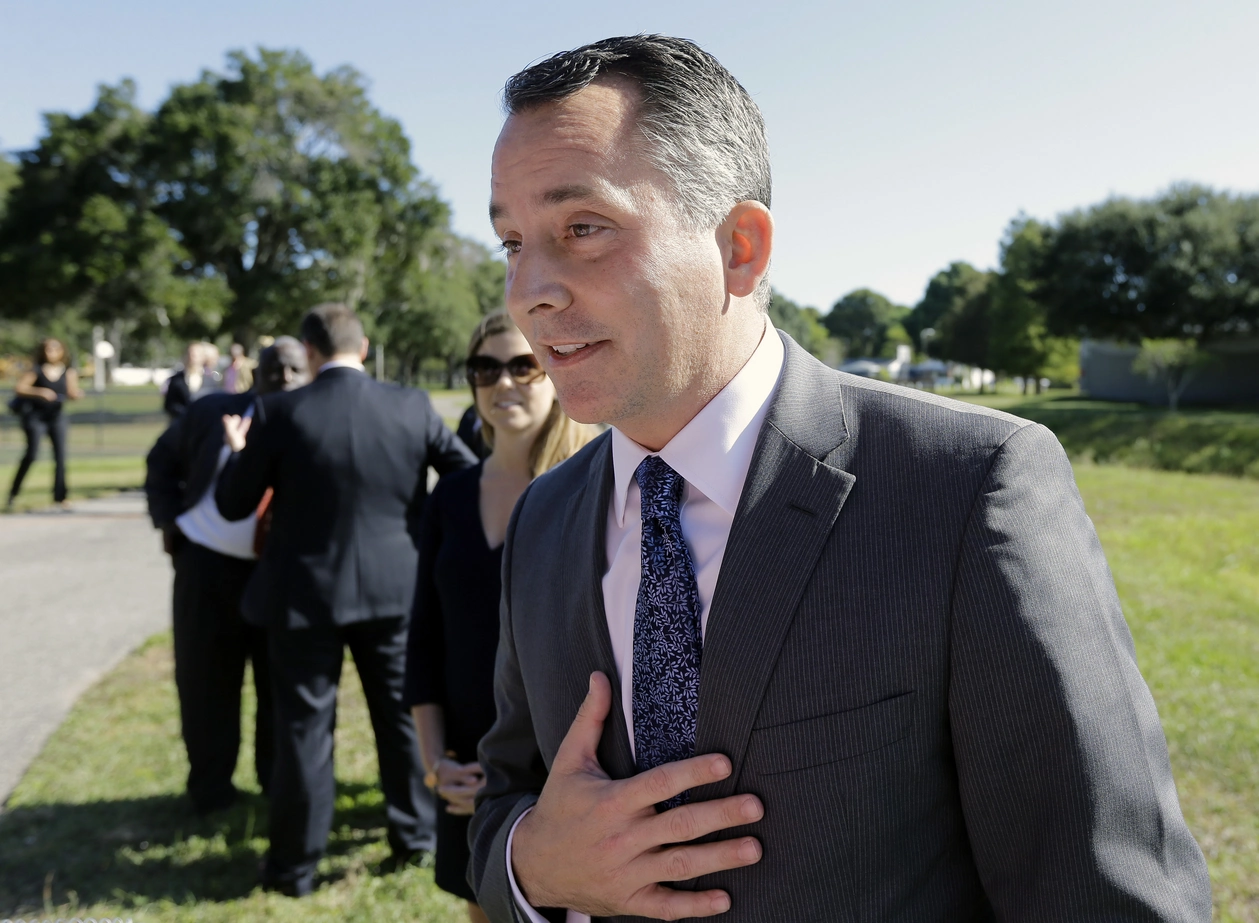
Former U.S. Representative David Jolly, a 2026 Democratic gubernatorial hopeful in Florida. (Chris O’Meara/AP)
The 2026 Florida gubernatorial election is less than a year away – and voters will get to decide a successor to term-limited Republican Governor Ron DeSantis in a state that has not elected a Democratic governor since 1994.
Former Republican U.S. Representative David Jolly, a front-runner for the Democratic nomination, is angling to become the Florida Democratic Party’s next standard-bearer.
David Jolly’s Complicated Identity
Jolly previously represented Florida’s 13th congressional district in Pinellas County from 2014 to 2017 as a Republican. Toward the end of his tenure, he became increasingly critical of then-presidential candidate Donald Trump – even calling on him from the House floor to drop out of the 2016 presidential race after Trump called for a “total and complete shutdown” of Muslims entering the nation.
During his time as a Republican congressman, Jolly described himself as being “pro-life” and of the belief that a “faith-based perspective” should be applied to the constitutional question of abortion – positions that he asserts have evolved following his time in office. Jolly has acknowledged that Florida residents could question his transformation, stating now that he would be a “pro-choice governor.”
After leaving office, the former congressman registered with no party affiliation – citing his ostracization from the Republican Party. Jolly ultimately registered as a Democrat in April 2025.
Jolly then declared his candidacy for governor about a month later, prompting criticism from his new party. Orange County Mayor Jerry Demings then entered the gubernatorial race on November 6, with wife and former U.S. Representative Val Demings claiming that he “doesn’t change his party or his political views like he changes his suits” in a dig toward Jolly’s recent Democratic affiliation.
In response, Jolly has pointed to what he identifies as consistent failure of past Democratic nominees like 2022 gubernatorial nominee Charlie Crist while describing his campaign as an alternative to “failed strategies of the past.” Both Crist and Jolly were once Republican congressmen from Florida’s 13th district, but Jolly has positioned his turnaround as being borne out of “conviction” and political growth over the past decade while asserting that Crist lost the election because he tried to convince voters that the “[Republican Party] left him,” not the other way around.
Democratic Primary
Florida’s primary elections will occur on August 18, 2026, where candidates from both the Republican and Democratic coalitions will face their peers in pursuit of their respective party’s nominations. In the Democratic primary for governor, Jolly narrowly leads Demings by a 23%-19% margin with 58% undecided – within the margin of error – according to January polling data from Mason-Dixon.
Jolly has sought to gain universal appeal by championing affordability as a candidate, vowing to squash the “painfully high cost of living” and “skyrocketing insurance rates,” crises that have handicapped Florida residents in recent years.
Additionally, Jolly’s campaign has condemned a Democratic “circular firing squad,” arguing that internal party attacks are a significant reason why Florida Democrats have lost elections for nearly three decades.
Midterm Momentum
Floridians will head to the polls to vote in the general election on November 3, 2026. The Democratic nominee faces an uphill battle – DeSantis soared to reelection over Crist by 19 points in 2022, while President Donald Trump carried Florida by 13.1 points during the 2024 presidential election.
Nonetheless, recent elections in New Jersey, Virginia, and New York yielded sweeping victories for the Democrats – and party leaders are confident that this momentum will propel them to victory in 2026, with Democratic National Convention Chair Ken Martin asserting in a November 2025 memo that “in ‘26, we’ll do it again.”
Despite Democratic optimism, October polling data from the University of North Florida found both Jolly and Demings trailing U.S. Representative Byron Donalds, the likely Republican nominee, by 45%-34% margins in the general election.
A Crossover Campaign
Jolly’s campaign has emphasized voters’ participation and recognition rather than their votes. For instance, Jolly has sought to give “voices to voters who are screaming” about the affordability crisis that he claims has plagued Florida.
Through his self-described “Front-Porch Swing,” Jolly has traveled to conservative strongholds throughout Florida to bridge a partisan divide he claims “Democrats have ignored for 30 years.”
Tara Newsom, director of the St. Petersburg College Center for Civic Learning and Community Engagement, says that “asking voters to help join in making change is building a movement.”
Further, Jolly’s campaign is seeking to frame issues as being universally “Floridian” rather than Republican or Democratic – pointing to affordability, authenticity, and unity as critical issues. In September, Jolly revealed that he believes Floridians are “screaming for change” in support of his ambitions to reset the state government by committing to 11 specific actions, including the removal of DeSantis appointees and the institution of a state-backed hurricane coverage fund, for instance.
Jolly has been candid in his criticism of Governor Ron DeSantis and his administration, arguing that DeSantis has catered to partisan politics while Floridians have succumbed to skyrocketing costs. In one instance, Jolly rebuked the condition of Florida public education – calling for the removal of politicians from classrooms as well as doctors’ offices.
According to A.G. Gancarski of Florida Politics, “there’s little indication from new polls that the GOP is in any danger of losing the Governor’s Mansion next year.” A Democratic victory would upset the increasingly Republican tilt Florida has assumed over the past few years.
