
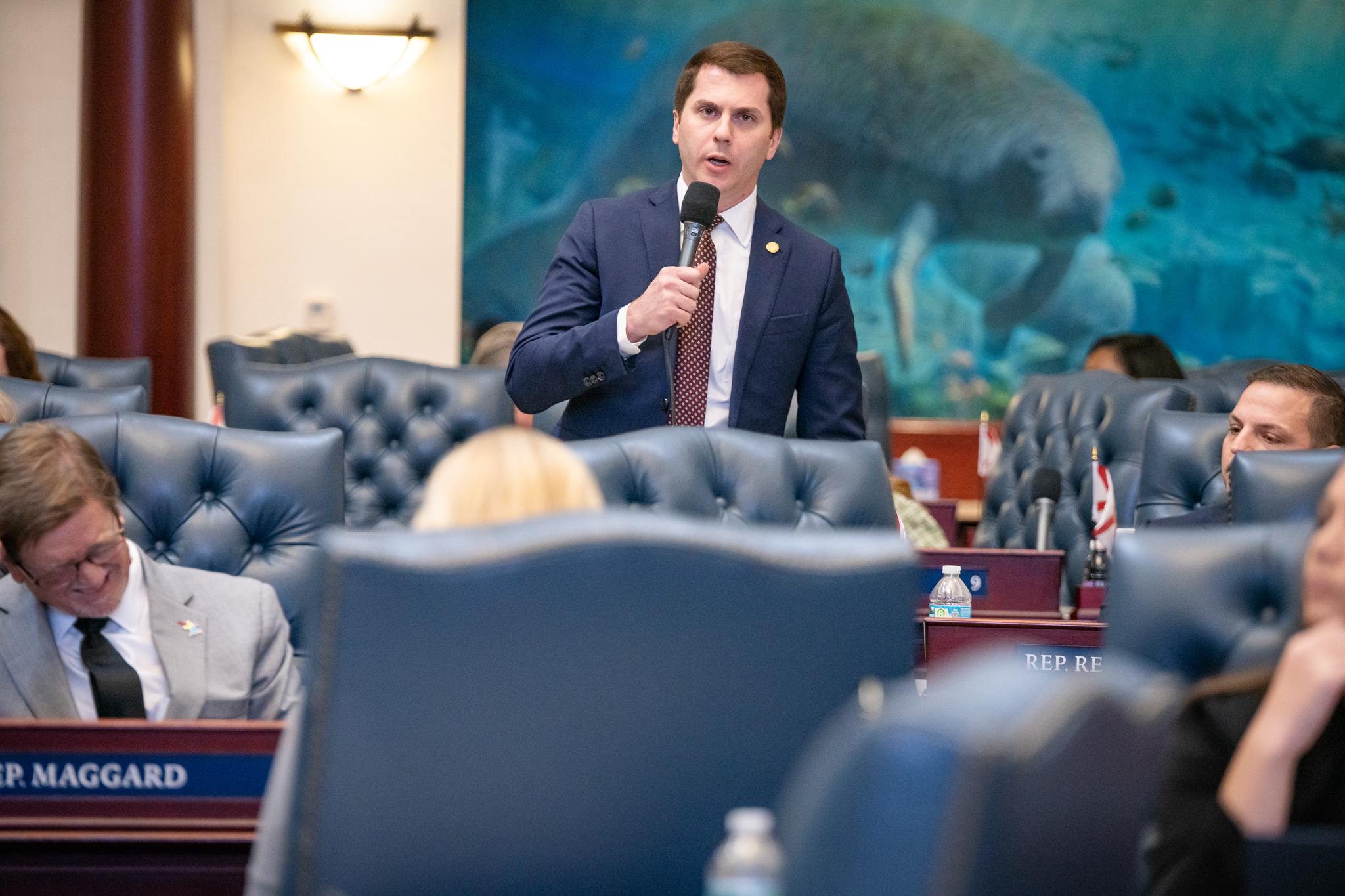
Republican State Representative Sam Greco of Florida’s 19th House district, who introduced HB 289. (Sarah Grey/Florida House of Representatives)
On the second day of the Florida Legislative Session, lawmakers passed House Bill 289, known by the name “Civil Liability for the Death of an Unborn Child,” in a 76-34 vote, along party lines.
This is the second time “Civil Liability for the Death of an Unborn Child” has passed the House. In 2025, the bill passed the House 79-32, but died in the Senate Rules Committee.
The 2026 iteration of the bill was filed and introduced by Republican Representative Sam Greco, who represents Flagler County and parts of St. Johns County, and co-sponsored by Republican Representatives Bankson, Barnaby, Kincart Jonsson, Nix, Persons-Mulicka, Plakon, William Robinson, and Valdés.
HB 289 would allow the parent of an unborn child to sue for mental pain and suffering caused by the wrongful death of their unborn child due to a wrongful act or negligence. The bill would expand Florida’s Wrongful Death statute, which currently allows spouses, children, and parents of a minor child to sue responsible parties in the death of their loved one, to include the parents of deceased unborn children. The bill prohibits lawsuits against the mother of an unborn child, which would prevent lawsuits against women for having a miscarriage or receiving an abortion, and prohibits suits against health care providers for “lawful medical care, including, but not limited to, care related to assisted reproductive technologies.” The bill goes on to cite FL Statute 742.13, which explicitly refers to provisions relating to In Vitro Fertilization (IVF), as an example of “assisted healthcare technology,” meaning that a lawsuit involving wrongful death of a fetus due to an IVF procedure is not allowed under HB 289.
Greco has expressed that the bill would close the gap in legal recourse for families who lose their unborn child due to the actions of others, and has given the example of HB 289, allowing a “mother who might lose her unborn pregnancy because of an abuser’s abuse to sue that abuser.” On the subject of domestic violence and HB 289, opponents of the bill, such as Planned Parenthood of Florida, have expressed concerns that the bill could have negative consequences on victims of domestic violence who seek out an abortion. In a press statement, Planned Parenthood of Florida detailed how a similar law in Arizona led to an abusive partner filing a wrongful death lawsuit against his wife. Although the Florida law has protections against suing the mother of a child in a lawsuit, Planned Parenthood of Florida believes that the law could still be weaponized by abusers to pursue lawsuits they know will be unsuccessful to harass their victims.
Furthermore, despite never explicitly mentioning abortion, the bill has extensive support from anti-abortion groups such as the Florida Conference of Catholic Bishops, which has released a press statement calling the bill “pro-life” and saying it “recognizes life begins in the womb.” The anti-abortion group Florida Family Voice has also expressed support for the bill, claiming it “humaniz[es] the unborn.”
The bill’s support among pro-life groups and representatives has been met with concern by pro-choice organizations such as the American Civil Liberties Union of Florida, which has stated in its legislative tracker that the bill “attempts to confer legal personhood on fertilized eggs and embryos, treating them as equivalent to living people.”
The bill has also been opposed by Democrats, in particular Representative Anna Eskamani of Orange County, who attempted to introduce anamendment to the bill that would remove the language of “unborn child” in the bill, and replace it with “wrongful death action for the demise of a fertilized egg, embryo, or fetus…without the consent of the mother.” The amendment would have removed the fetal personhood language opposed by pro-choice groups, while also providing legal protection for abortion by emphasizing the mother’s consent. The amendment failed.
The bill has now been sent to the Senate and is currently in the Senate Rules Committee. An identical bill, SB 164, is also in the Senate Rules committee.

