
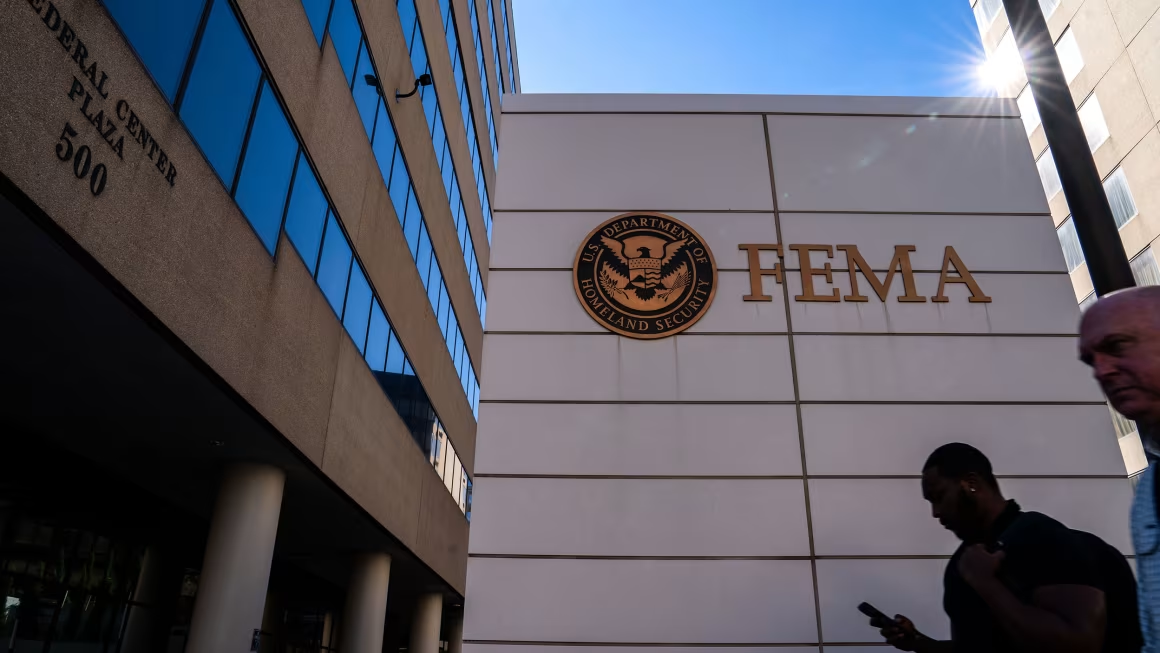
FEMA headquarters in Washington D.C. (Kent Nishimura)
Following his inauguration in January 2025, President Donald Trump expressed a desire to dismantle the Federal Emergency Management Agency (FEMA). In particular, he questioned the effectiveness of FEMA in responding to disasters. Due to this skepticism, the Trump Administration established the Federal Emergency Management Review Council (“Council”) on January 24, 2025. The Council is tasked with regularly assessing FEMA’s capability to respond to disasters occurring in the United States. Using these assessments, they provide the President with recommendations for changes needed so the agency can best serve “national interest.”
In a speech given in the Oval Office on June 10, 2025, Trump announced his plan to eliminate FEMA and “bring it down to the state level” at the end of the 2025 hurricane season while also suggesting a fundamental overhaul of the agency. He asserted that state governors should work together to address the problems posed by disasters and develop effective systems to assist people.
History of FEMA
The Federal Emergency Management Agency employs over 20,000 people across the United States. It is headquartered in Washington, D.C., and has ten regional offices across the country.
Before FEMA’s creation, the federal government faced bipartisan criticism over alleged bureaucratic failures in responding to major disasters like Hurricane Agnes in 1972 and the Johnstown, Pennsylvania flood in 1977. President Jimmy Carter, with support from governors and interest groups, intended to replace a disjointed, outdated disaster-response system with a centralized, all-hazards agency, which could handle both peacetime disasters and wartime emergencies. President Carter created FEMA on April 1, 1979, by signing Executive Order 12127. Later, in July of 1979, Carter signed another order giving the agency the dual mission of emergency management and civil defense. FEMA is at the forefront of the federal government’s response to all disasters, including floods, hurricanes, earthquakes, forest fires, tsunamis, biological hazards, and terrorism. Its central mission is to help people “before, during, and after” disasters by “assisting individuals, families, and businesses whose property has been damaged” and “whose losses are not covered by insurance.”
Following 9/11 and the reorganization of the federal government, the Homeland Security Act of 2002 created an umbrella department to oversee national security interests. In 2003, the Department of Homeland Security was created to include FEMA, along with 21 other organizations involved in national security and intelligence sharing. Currently, FEMA’s structure and framework stem from the Stafford Act (1988), which set clear procedures for emergency management, response, and recovery standards in the United States.
Overview of the 2024 Hurricane Season
The 2024 Atlantic hurricane season concluded on November 30, 2024, and showcased above-average activity. There were 18 named storms, eleven of which were hurricanes. Five hurricanes made landfall in the continental United States, with two making landfall as major hurricanes (Category 3 or higher).
Hurricane Helene made landfall in the Florida Gulf Coast in September as a Category 4 hurricane with sustained winds of 140 miles per hour when it arrived in the Big Bend region. Western North Carolina, southwestern Virginia, and eastern Tennessee were most impacted by record-breaking flooding and infrastructural damage. It was the deadliest hurricane to hit the U.S. mainland since Hurricane Katrina (2005). In October 2024, Hurricane Milton made landfall near Siesta Key, Florida, and spawned dozens of tornadoes across southern Florida. Milton’s 10 feet of storm surge caused damage all along the Gulf coast. The total cost of damage caused by Helene and Milton is estimated to have totaled $113 billion, with at least 191 direct human fatalities.
In describing FEMA’s 2024 performance, Republican Senator Thom Tillis of North Carolina complained that “FEMA’s failure to act and communicate swiftly put vulnerable families at risk with freezing temperatures outside,” and that the agency “made little progress in providing direct housing solutions for those most affected by Helene.” Republican Senator Susan Collins of Maine agreed with Tillis, telling reporters how “very disappointing” reports on FEMA’s 2024 operation were. However, Collins added that she believed there should be a “FEMA-like” agency at the federal level and that reforms are warranted based on the feedback she received.
Halting the BRIC Program
One of the FEMA programs the Trump Administration moved to end amidst reforms was the Building Resilient Infrastructure and Communities (BRIC) program. According to FEMA’s website, BRIC “supports state, local, and territorial governments and Tribal Nations as they work to reduce their hazard risk.” The goal of the program is to prepare territories, grow partnerships, support infrastructure projects, and create flexibility and consistency.
Congress created BRIC through the Disaster Recovery Reform Act of 2018 to ensure a stable source of funding for mitigation projects. Since 2021, FEMA has selected 2,000 projects to receive $4.5 billion in BRIC funding for projects like constructing levees, floodwalls, and helping generate electricity in rural communities. On April 4, 2025, FEMA announced that it is ending the BRIC program and cancelling all applications from Fiscal Years 2020-2023. They also canceled the 2024 notice of funding opportunity (NOFO). Any grant funds not distributed will be returned to the U.S. Treasury. FEMA stated that ending the program would “help ensure that grant funding aligns with the President’s Executive Orders and Secretary Noem’s direction and best support states and local communities in disaster planning, response and recovery.”
The Administration’s cancellation of the BRIC program is currently being litigated in court. The administration was sued by the State of Washington shortly after it announced the cancellation of the BRIC program. On August 11, 2025, a U.S. District Judge in Boston issued a temporary injunction stopping the Trump administration from reallocating the $4.5 billion set aside for the BRIC program. The ruling, however, does not force the administration to disperse the $4.5 billion to states. The administration will remain preliminarily enjoined until the court renders a final judgment on the merits of the case.
Is FEMA’s Future Certain?
After visiting the aftermath of the flooding in Texas’s Hill Country this July, Trump Administration officials claimed that shutting down FEMA outright is not on the agenda. According to a White House official, no action is being taken to phase out FEMA, and future changes will “probably” be a “rebranding” that will increase state leaders’ roles in responding to disasters. Assistant Secretary of Homeland Security Tricia McLaughlin said in a statement that FEMA will “shift to a deployable disaster force that empowers state actors to provide relief for their citizens” while the FEMA Review Council is “developing a comprehensive plan for necessary change.”
Florida experienced the most hurricanes in the U.S. between 1851 and 2022. 120 hurricanes impacted the state, accounting for 40% of all hurricanes to hit the mainland US in the given period. Last year, Florida received more than $1 billion in federal relief from FEMA for Hurricanes Milton, Helene, and Debby. Going forward, top officials in the state on both sides will continue to debate the future of disaster relief.
